Same Day Flowers Delivery - Australia Wide!

How To Navigate Sympathy Flower Etiquette When You Are Truly Unsure
Sympathy orders are different from every other flower order we handle. Andrew and I have run this business since 2006, nineteen years now, tens of thousands of deliveries, and I still find sympathy the hardest to talk about. A birthday is joyful. An anniversary is warm. A sympathy order is someone at the worst point of their week reaching out because they do not know what else to do.
Most people placing that order have never sent funeral flowers before. They are searching on their phone, probably within hours of hearing the news, and everything feels urgent and confusing, which flowers, what colour, do they go to the funeral home or the family's house, what on earth do you write on the card. I remember our first sympathy delivery in Kingscliff, 2006 or maybe early 2007, and Andrew and I just looked at each other afterwards. Yeah it was hard.
We asked Anna to lead this guide. She trained as a florist in Auburn, North Carolina and spent fifteen years on the bench before joining us, thousands of sympathy arrangements over that time, the colour choices, the timing, the coordination with funeral directors, the conversations with families who were barely holding it together on the phone. That stuck with all of us.
Funeral Flowers and Sympathy Flowers Are Not the Same Thing
This is where most people get confused, and it changes everything about what you order, where it goes, and what you write on the card.
Funeral flowers go to the service venue. The chapel, church, funeral home, or crematorium. They are part of the visual tribute alongside the casket. They are designed for display, often one-sided, and the card includes the full name of the person who has died so the venue staff can direct the arrangement to the correct service. Timing is rigid. They need to arrive before guests do.
Sympathy flowers go to the family's home. They are a personal gesture, not part of the formal service. Any arrangement style works. They can arrive the day of the funeral, the day after, or weeks later. The card is addressed to the family with a personal message from you.
People mix these up constantly. We used to get calls asking for "funeral flowers" when what they actually wanted was something for the family's house. It matters because the arrangement style is different, the card message is different, and the delivery address is different. I would always ask: "Is this going to the service, or to the family at home?" Two different answers, two different orders. Get that question right and everything else follows.
If you are not sure, send sympathy flowers to the home. They are more flexible on timing, the family can enjoy them privately, and there is no risk of the arrangement arriving at the wrong venue or missing a service window.
What to Send: Arrangement Types and When Each One Is Right
Walk into this blind and every arrangement looks the same on a screen. They are not. Each type exists for a specific purpose, and picking the right one depends on your relationship to the family and where the flowers are going.
Wreaths
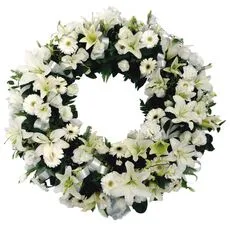
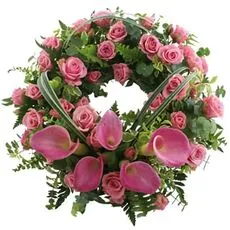
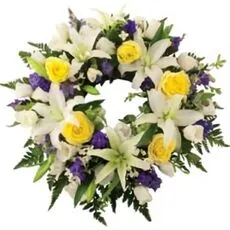
The circular shape represents continuity. No beginning, no end. Wreaths are displayed on stands near the casket during the service, or placed at the graveside afterwards. Anyone can send a wreath. They are appropriate from friends, extended family, colleagues, and community groups. Our three wreaths all sit at $152.25.
Wreath construction is harder than people think. You are working in a circle, which means every stem has to be angled outward from the centre of the ring at roughly forty-five degrees. Push stems straight down into the foam like a vase arrangement and the flowers point inward. The wreath looks collapsed. Lily stems are the hardest to place because the multiple blooms create uneven weight distribution. Getting a lily to sit at the right angle in foam without toppling takes experience.
A good florist stages the lilies deliberately. A mix of open and bud-stage blooms. The open ones give immediate impact at the service. The buds mean the wreath still looks fresh if the family takes it to the graveside the next day. A wreath where everything is fully open has already peaked.
Chrysanthemums are the backbone. They fill volume, they hold structure in warm chapel conditions when softer stems wilt, and they last. A wreath that needs to survive a two-hour service in a room with no aircon is relying on the chrysanths to still look right at the end. Roses would be wilting. Chrysanths will not. Carnations are the other workhorse. They last longer than almost anything in foam, they come in pure white without the creamy undertones that some white roses carry, and they are economical enough that the florist can be generous with them. That generosity is what makes a wreath look full rather than sparse.
Foam in a wreath ring holds less water than a block in a box arrangement. The water reservoir is spread thin around the circle. In warm conditions it depletes faster. A florist who knows sympathy work soaks the foam until fully saturated and selects stems that tolerate foam well. Gerberas in foam are tricky. The hollow stem can buckle, and in a vertical display on a stand the stem has to support that heavy flower head at an angle. A good florist wires them or uses foam-friendly stem supports. Otherwise they droop within hours.
The three wreaths in our range each carry a different emotional weight. The all-white wreath works across every faith and every cultural tradition in this guide. White reads as respectful regardless of context. The pink wreath carries warmth and femininity. Nine out of ten pink wreaths Anna built over the years were for a mother, grandmother, or close female friend. The white and purple wreath threads the needle between traditional and personal, and it carries something the other two do not: fragrance. Stock and lily together fill a chapel, the stock giving a warm spicy base note and the lily the sweet clean top. People in the front rows will smell it before they see it.
Sheaves and tied bouquets
A sheaf is a hand-tied spray, flat on the back, designed to be laid beside the casket or carried to the graveside. No foam, no frame, no ring. Just stems, binding, and tissue on the underside. Less formal than a wreath. Faster to prepare, which makes them practical for urgent same-day orders. And they have a second life that wreaths do not.
A sheaf does two jobs. It looks proper at the funeral, lying beside the casket. Then the family takes it home, cuts the binding, trims the stems, and puts it in a tall vase. It becomes a home arrangement. A wreath stays at the service or the graveside. A sheaf travels with the family. That dual purpose is why I used to recommend sheaves more than any other sympathy arrangement to people who were unsure.
The construction has to account for the flat back. Every flower is angled so it faces upward when the sheaf is horizontal. Build it like a normal bouquet and lay it down, half the flowers face the ceiling and half face the wall. The big structural leaves on the underside are the chassis. They line the back, protect it from whatever surface it rests on, and act as a moisture barrier. A sheaf sits on polished wood, carpet, or stone. Water marks on a casket lid are not acceptable. The leaves prevent that.
Pollen is even more in a sheaf than a wreath. A wreath sits on a stand and nobody touches it. A sheaf gets carried. The family picks it up after the service, takes it to the car, takes it home. Every time someone handles it, those lily anthers brush against a sleeve or a jacket. If the anthers have not been removed, somebody is going home with orange pollen on their funeral clothes. No exceptions on this one. The anthers come off before the sheaf leaves the shop.
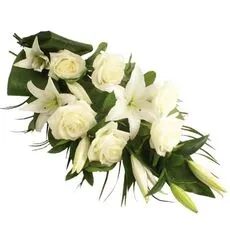
The three sheaves in our range serve different purposes. The pink lily and rose sheaf ($152.25) is the statement piece. Stargazer lilies for immediate impact at the service, roses held at a slightly tighter stage so they continue opening over the next few days when the sheaf is in a vase at home. That slow reveal is part of the value. The arrangement grows with the family through the first week.
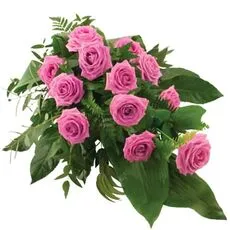
The pink rose sheaf ($147.40) is the quieter choice. Twelve matched roses. No lilies competing for attention, no spikes, no filler. That simplicity communicates something different. A dozen matched roses reads as intention. In Anna's experience, this is the arrangement ordered by one person for one family. Not "the team at Smith and Partners" but Sarah. Margaret. One name on the card, one personal gesture. The roses soften uniformly over the week, and when the petals finally release they scatter gently around the vase. Some families keep them. Press them. Put them in a memory box.
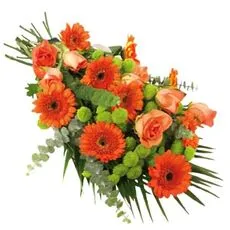
The orange flower sheaf ($152.25) breaks from the other two entirely. Warm gerberas, peach roses, green chrysanthemums. This is the celebration-of-life sheaf. Anna would send this for a service at a surf club, an RSL, a family's back garden. And she would send it for a man. Orange carries no feminine association and no romantic weight. It says warmth and friendship. The home afterlife is different too. Orange gerberas and green chrysanths in a vase look like someone bought flowers at the market on Saturday morning. They bring colour into the house without performing grief. For some families in week two, that is exactly what they need.
Choosing between the six: Anna's quick guide
Three wreaths. Three sheaves. All between $147.40 and $152.25. Each serving a distinct purpose.
White Funeral Wreath
Wreath. Universal, traditional, safe across all faiths. Formal funeral, any cultural context. $152.25
Wreath With Pink Tones
Wreath. Personal, feminine, contemporary. Service for a mother, grandmother, close female friend. $152.25
White & Purple Tones
Wreath. Complex, warm, fragrant. Semi-traditional service with personality. Friendship tribute. $152.25
Pink Lily & Rose Sheath
Sheaf. Dramatic, fragrant, dual-purpose. Service tribute that comes home as a generous vase arrangement. $152.25
Pink Rose Sheath
Sheaf. Intimate, quiet, personal. Individual gesture from one person to one family. $147.40
Orange Flower Sheath
Sheaf. Bright, warm, life-affirming. Celebration of life, gender-neutral, male or female. $152.25
Sympathy bunches and arrangements for the home
These go to the family, not the service. A vase arrangement is the most practical choice because it arrives ready to display. Nobody in the middle of grief should be looking for scissors and a clean vase. Anna's rule on this is straightforward and hard to argue with.
For the family home, send something in a vase. They are dealing with enough. An elaborate hand-tied bouquet that needs unwrapping, trimming, and a vase creates one more task for someone who cannot handle one more task. A boxed arrangement or a ready-to-display vase piece is more considerate than anything that requires assembly.
Casket sprays and standing sprays
Casket sprays sit on top of the closed coffin. Standing sprays are large vertical arrangements positioned on easels flanking the casket. Both are significant, formal pieces. If you are not immediate family, these are not your arrangements to order. The family coordinates them, usually through the funeral director.
Standing sprays run between $300 and $700. Casket sprays between $150 and $500 and up. The partner florist needs at least one to two days to source and build them.
Potted plants
A peace lily outlives every cut flower arrangement. Families keep them for years. They require almost no maintenance, and every time the family waters it, they think of the person who sent it. For someone who wants their gesture to last beyond a week, a potted plant is the quiet, practical answer.
Colour Choices: What Anna Learned from Fifteen Years of Sympathy Work
Colour is where people freeze. They stand at the screen thinking: is yellow okay? Are bright colours disrespectful? Do I have to send white?
The answer depends entirely on the tone of the service. A traditional funeral and a celebration of life are asking for completely different things.
Colour affects mood, and grief is already overwhelming. The visual environment should calm rather than stimulate. That is why whites, soft creams, and muted greens have been the default for traditional sympathy flowers for as long as anyone can remember. They do not compete with the weight of the moment. A bright yellow sunflower bouquet at a formal funeral can feel like someone did not understand what happened. Not offensive, just tonally wrong.
For a celebration of life, the rules change completely. We get orders now for bright gerberas, sunflowers, arrangements in the deceased person's favourite footy colours. If the family has said "celebration of life" on the notice, that is your cue. Bold colours, personal touches, whatever felt like the person you are remembering. I once made an arrangement in Hawthorn brown and gold because the family said he would have wanted that more than any white lily. They were right.
When you are genuinely unsure about the tone, whites and soft pastels are the safest choice. The families who came back to say thank you always mentioned the colours first. Not the price. Not the size. Whether the arrangement felt right in the room.
Traditional Funeral
Whites, creams, soft greens, pale pinks, and touches of lilac. Calm, respectful, grounding. Lilies, chrysanthemums, white roses, and white carnations are the standard stems.
Pink
Warmth, femininity, tenderness. Pink reads as personal rather than formal. It carries affection without the romantic weight of red. The overwhelming pattern Anna saw over the years: pink sympathy flowers were almost always for a woman someone loved deeply.
Yellow
The most misunderstood colour in funeral flowers. People avoid it because it feels cheerful. But yellow actually reads as friendship, remembrance, and warmth. It carries no romantic weight. A yellow rose at a funeral says "I was your friend."
Orange and Warm Tones
For celebrations of life where the family wants energy and personality. Gender-neutral. No feminine association, no romantic weight. Orange says warmth and vitality. There is a courage to sending bright flowers, and when the family has signalled celebration, that courage is its own form of respect.
Red Roses: A Caution
Red roses carry a romantic association. Unless the deceased was your partner, pink, yellow, or white roses are more appropriate. Red roses at a friend's funeral can send an unintended message.
Celebration of Life
Different rules entirely. Bright colours, the deceased person's favourite flowers, footy colours, personal touches. Read the funeral notice carefully. The language tells you which register the family wants. "Celebration" means bold is welcome.
Cultural and Faith Considerations for Australian Funerals
Australia's population includes over 300 recorded ancestries. A funeral etiquette guide that only covers Western Christian traditions misses the reality of Australian funerals in 2026. The single most important piece of advice Anna gives on multicultural sympathy orders is this: if you are unsure, ask the family. A two-minute phone call prevents genuine distress.
Anglican and Protestant Christian
Any flowers are appropriate. White and pastel tones are traditional but not required. Wreaths, standing sprays, sheaves, and bouquets are all acceptable. Flowers can go to the church, funeral home, or family residence. The casket spray is typically arranged by immediate family. No significant restrictions on colour or type.
Roman Catholic
Any flowers are suitable. Catholic funerals often have more flowers than other services because the church setting allows for larger displays. Altar arrangements, pew markers, standing sprays near the coffin. Standing crosses and heart-shaped tributes carry religious significance for Catholic families. Casket sprays are common for immediate family.
Eastern Orthodox (Greek, Russian, Coptic, Armenian)
White flowers are strongly preferred. They represent purity, peace, and innocence. Flowers are welcomed and typically sent to the funeral home. Orthodox services can run considerably longer than other traditions, which means the flowers need stamina.
Anna: "Orthodox services tend to run longer. The flowers need to hold their structure for hours. I would choose lilies, chrysanthemums, and carnations over anything delicate. Soft roses in a warm church for two and a half hours will look tired by the end."
Jewish
Orthodox Jewish families generally do not display flowers at funerals. Some Reform or secular Jewish families are more open, but this varies significantly. A fruit basket, food delivery, or charitable donation in the person's name is typically more appropriate. If flowers are sent, they go to the shiva house (the family home during the mourning period), not to the service itself.
Anna: "For Jewish families, check first. Many prefer no flowers at all, and sending them to the synagogue could cause real discomfort. A donation in the person's name or food for the shiva is usually more welcome. I learned this early and it saved a lot of awkward situations."
Muslim
Many Muslim families prefer charitable donations over flowers, and simplicity is central to Islamic funeral tradition. If flowers are appropriate for the particular family, roses and fragrant varieties are acceptable, but check with a family member or the Imam before sending anything. Excessive ornamentation should be avoided.
Buddhist
White flowers are the traditional mourning colour. Red flowers are associated with celebration and should be avoided. White chrysanthemums, white lilies, and white roses are the safest choices. Practices vary between Chinese Buddhist, Thai Buddhist, Vietnamese Buddhist, and Japanese Buddhist traditions.
Anna: "This catches people out when they are ordering for a Chinese or Vietnamese family for the first time. The default 'nice colourful bunch' is exactly wrong. White flowers only. No red, nothing bright. I had a customer once order a mixed bright arrangement for a Buddhist funeral without checking. The family was gracious about it, but it was uncomfortable for everyone."
Hindu
Mourners traditionally arrive empty-handed. The family arranges floral garlands and funeral sprays for the casket themselves. Sending flowers as an outside guest is not part of the tradition and could feel like overstepping. A fruit basket may be appropriate for the ceremony held around ten days after the funeral, or a simple card expressing condolences.
Chinese Tradition (Non-Buddhist Specific)
White and yellow are mourning colours. Red must be avoided entirely because it signals happiness and celebration in Chinese culture, and sending red flowers to a Chinese funeral would cause genuine distress. White chrysanthemums are the safest choice. Yellow is also acceptable if you know the family. Wreaths and standing sprays are common at the service.
Aboriginal and Torres Strait Islander: Sorry Business
Sorry Business is the period of mourning and communal grief observed across Aboriginal communities. Customs vary significantly between communities and language groups. The whole community participates and funerals may last days or weeks. The deceased person's name and image are often not spoken or displayed. Native flowers and plants can carry cultural significance, but the protocol around what to send and when varies between communities.
Anna: "For Sorry Business, the most important thing is to ask. Every community has different customs. The funeral director working with the family will know whether flowers are welcome and what form they should take. Do not assume. Ask."
Sikh
Flowers are generally acceptable and white is preferred. The service (Antam Sanskaar) is followed by cremation, and flowers can be sent to the gurdwara or to the family home afterwards. Check with the family if you are unsure about timing.
Secular and Non-Religious
No restrictions. Increasingly, families choose celebration-of-life services where bright colours and the deceased person's favourite flowers replace traditional whites. This is where you see the sunflowers, the gerberas, the arrangements in someone's football club colours. The "in lieu of flowers" request is most common in secular funerals.
Timing, Delivery, and the Funeral Director Coordination That Nobody Talks About
For flowers going to the service
Delivery to the venue needs to happen on the day of the service, or the afternoon before if the venue allows it. The card must include the full name of the deceased so venue staff can direct the arrangement to the correct service. You also need the address of the funeral home or church and the time of the service.
For elaborate arrangements like casket sprays and standing sprays, the partner florist needs one to two days notice minimum for sourcing and styling. Simpler arrangements, sheaves and wreaths, can be done same-day if ordered before 2pm on weekdays or 10am on Saturdays.
The funeral director call
When we receive a funeral flower order destined for a service, the partner florist contacts the funeral director directly. This is not optional and it is not a courtesy. It is a professional coordination step that determines when the venue is accessible for deliveries, where arrangements should be placed, whether the room runs warm (which changes how the flowers are conditioned), and whether the family has specific preferences.
Good florists call the funeral director. Every single time. Two minutes on the phone and you know the delivery window, the room temperature, the setup time, whether other arrangements are already confirmed. Without that call you are guessing, and this is the one delivery of the week where guessing is not acceptable. I used to call even for small arrangements because the timing matters more for sympathy than any other order. Flowers that arrive too early lose their best hours in a back room. Flowers that arrive during the service create a disruption. A florist who does not coordinate with the director is hoping it works out, and hope is not a delivery strategy.
This does not always go smoothly. Some funeral homes are difficult to reach. Some directors do not return calls on busy days when they are running three services. The florist works around it, tries again, adjusts the timing based on experience with that venue. We are honest about this because the coordination step is critical too much to pretend it is effortless every time.
For sympathy flowers going to the home
The timing pressure drops entirely. Sympathy flowers to the home can arrive the day of the death, the day of the funeral, or weeks later. Send them to a family member at the home address.
In the first few days, families are overwhelmed with flowers. The house is full. After a week or two, the flowers fade, the casseroles stop arriving, and the quiet hits.
A sympathy delivery that arrives at that point often means more than one that arrived on day one. Anna noticed this during her years handling inbound calls from Pottsville, around 2011 or 2012. The thank-you calls that came back most emotional were almost always for flowers that arrived in week two, after everyone else had moved on. Late sympathy flowers are not late.
What to Write on the Card
This is where people freeze up completely. You are staring at a text field on a screen and nothing sounds right.
The card matters way more than most people realise. I have had families tell me they read the cards over and over in the weeks after the funeral. Keep it simple and keep it sincere. You do not need to be poetic. You need to be present. A specific memory is worth more than any sympathy quote you found online. "I will always remember him laughing at that barbecue in January" says more than "thinking of you in this difficult time."
For funeral flowers going to the service
Keep the message brief. The card sits with the arrangement, not in a letter. Include the deceased person's full name so the venue can direct it.
"In loving memory of [Name]. With deepest sympathy, [Your name]."
"Thinking of you and your family. With love, [Your name]."
For sympathy flowers going to the home
More space for something personal. Share a specific memory if you have one. Offer something concrete rather than a vague sentiment.
"I will always remember [Name]'s laugh. Thinking of your whole family. Call me whenever you need anything."
For colleagues: "From all of us at [workplace]. [Name] made every Monday better."
For delayed sympathy (a week or two later)
"I have been thinking about you. Wanted you to know I am still here."
"It has been a few weeks now. I hope these bring a small moment of brightness."
The delayed card often lands hardest because it arrives when the initial support has faded and the family is starting to feel the absence properly.
Honest Mistakes People Make with Funeral Flowers
Anna kept a mental list of these over the years. Not to judge anyone, because every person placing a sympathy order is doing their best under pressure. But knowing what can go wrong helps you avoid it.
Red Roses for a Non-Romantic Funeral
Red roses carry a romantic association. Unless the deceased was your partner, white, pink, or yellow roses are more appropriate. This one trips up more people than you would expect.
Bright Colours Without Checking
Bright flowers are right for a celebration of life. They can feel jarring at a traditional funeral. Check the tone of the service before ordering. The funeral notice usually signals this.
Ordering a Casket Spray Uninvited
The casket spray is the family's decision, coordinated through the funeral director. Sending one as a friend or colleague, however well-intentioned, creates awkwardness. A wreath or sheaf is always appropriate.
Wrong Name on the Card
Funeral flowers need the deceased's name so the venue directs them to the correct service. Sympathy flowers to the home need the recipient's name. Mixing these up causes real logistical problems.
Scented Flowers to a Hospital
If the person died in hospital and you are sending flowers there, avoid lilies and heavy-scent blooms. Some hospitals have restrictions on scented flowers in wards and shared spaces.
Hand-Tied Bouquet to a Grieving Home
An elaborate bouquet that needs unwrapping, trimming, and a vase creates work during grief. A vase arrangement or potted plant is more considerate. Small thing, big difference.
The mistake I saw most often was people overthinking it. Twenty minutes agonising over flower types and colours when the family just wanted to know someone cared. Send something appropriate in muted tones, write something real on the card, and make sure it gets there on time. That is ninety percent of getting it right.
When the Notice Says "In Lieu of Flowers"
This is increasingly common in Australian funerals, particularly secular celebrations of life. The family prefers donations to a nominated charity or cause instead of floral tributes. Cancer research foundations, animal shelters, hospice services, community organisations.
It does not necessarily mean no flowers at all. The family may still have their own arrangements at the service. It usually means floral tributes from guests and attendees are replaced by donations. Sending a small arrangement in addition to a donation is generally acceptable unless the family has specifically said no flowers of any kind.
I understand why families request donations. Sometimes the person had a cause they cared about deeply. Sometimes the family just cannot handle more things arriving at the house during the worst week of their lives. Both are valid reasons.
But here is what I have observed over fifteen years of sympathy work. Flowers do something that a bank transfer does not. They are physical. They take up space. They fill a room with colour and fragrance during a week when everything feels grey and empty. A donation is generous and meaningful, but it does not sit on the kitchen bench reminding you that someone cared enough to choose something beautiful for you. Both have a place. They are not the same gesture.
If you want to do both, make the donation and send a small arrangement to the home a week later. The donation respects the family's request. The flowers arrive after the formalities are done, when the house is quiet, and they remind the family that someone is thinking of them.
What Happens to Funeral Flowers After the Service
Families rarely think about this beforehand. It comes up every time.
Wreaths and casket arrangements are often taken to the cemetery and placed at the graveside. Groundskeepers remove them once they fade. Smaller arrangements and vase pieces go home with the family. Sheaves are the easiest to transport because they do not need a stand or frame.
Some families invite guests to take a single flower from a larger arrangement as a memento. This is becoming more common and it is a genuinely touching practice. Excess arrangements can sometimes be donated to hospitals or aged care homes. Some funeral directors facilitate this, though it varies.
Individual blooms are pressed and laminated as bookmarks, framed, or kept in memory boxes. And certain flowers, if the family requests it, stay with the coffin through cremation or burial.
The most practical sympathy arrangements are the ones that have a second life. Sheaves can go in a vase at home. Potted plants live for years. A peace lily on a windowsill two years after a funeral still does its job. Thinking about what happens after the service is part of choosing the right arrangement in the first place. When I was working on the bench, I used to mention this to customers who were unsure. Most had not considered it. Once they did, the decision became easier.
Seasonal Considerations for Australian Funerals
A funeral in Townsville in January and a funeral in Hobart in July are two completely different environments for cut flowers. The florist adjusts, but the person ordering should understand why some stems are recommended over others at certain times of year.
Summer funerals in Australia are the hardest on flowers. Chapel temperatures can reach thirty degrees without air conditioning. The delivery van interior hits forty-five in the middle of the day. Flowers in foam arrangements dehydrate fast in that kind of heat, and soft-petalled stems like tulips and sweet peas will not make it through a two-hour service in a warm room. I would recommend chrysanthemums, orchids, and natives for summer services. They hold their structure. Roses are borderline. They can work if the chapel has decent climate control, but I would not gamble on it for a January funeral in Queensland.
This matters for choosing between the wreaths. The white funeral wreath with its chrysanthemum and carnation backbone holds in warm conditions for six to eight hours. The pink wreath is rose-dominant and more vulnerable to summer heat. For a February service in a country church with the doors open, the white wreath is the safer choice. The white and purple wreath sits in between, with stock that actually improves with mild warmth because the fragrance opens up. For a cool winter chapel, all three perform without concern and the stock-and-lily fragrance of the purple wreath fills the room beautifully.
Winter funerals in the southern states have the opposite advantage. Cold conditions extend flower life. Roses, carnations, and chrysanthemums all perform well in cooler temperatures. The risk in winter is for outdoor graveside services in places like Hobart, Canberra, or the highlands, where tropical blooms transported from a warm van into sub-five-degree air can blacken from frost shock within hours. The florist accounts for this with thermal wrapping, but it is worth knowing.
In tropical Queensland and the Northern Territory, humidity creates a grey mould risk (Botrytis) on roses and other soft-petalled flowers. Loose wrapping that allows airflow prevents moisture from trapping against the petals during delivery. The florists up there know to avoid tight cellophane for sympathy arrangements.
Regional and remote deliveries, particularly in western New South Wales, inland Queensland, and Western Australia, mean stems may be a day or two older on arrival because of distance from the nearest wholesale market. Partner florists in those areas source from Rocklea in Brisbane, Flemington in Sydney, Epping in Melbourne, or Canning Vale in Perth, and they account for the transit time in how they condition the flowers.
A Note on Lilies: The Default Funeral Flower and What Most People Do Not Know
Lilies are the most commonly chosen funeral flower in Australia. White oriental lilies in particular. They are beautiful, fragrant, and carry centuries of association with purity and peace. They are also the flower that generates the most complaints about pollen staining.
The orange anthers on an open lily carry pollen that stains clothes, coffin fabric, tablecloths, and anything it touches. The stain is persistent. It does not come out easily. Most experienced sympathy florists remove the anthers before the lily opens fully. You snip them out with small scissors when the bud is just starting to open, before the pollen matures and becomes powdery. If you receive lilies at home and the anthers are still on, remove them yourself. Do not brush the pollen off with your hand or a cloth. Use sticky tape to lift it, or let it dry and vacuum it. Rubbing spreads the stain.
Lilies are also highly ethylene-sensitive, which is important when they end up on a kitchen bench next to the fruit bowl. Ripening fruit releases ethylene gas. Ethylene accelerates flower ageing. Keep sympathy lilies away from fruit, and they will last noticeably longer.
What Families Have Said About Sympathy Deliveries
Sympathy reviews are different from other feedback. People writing them are often still in the middle of grief. The fact that they took the time to come back and write something says more than the words themselves.

All reviews sourced from Lily's Florist verified Feefo reviews. 22,600+ reviews across the network. Feefo Trusted Service Award 2024, 2025, and 2026.
How to Order Sympathy Flowers Through Lily's Florist
Same-day delivery is available when you order before 2pm on weekdays or 10am on Saturdays. The order goes to a local partner florist in the delivery area, not a warehouse. They source stems from the nearest wholesale market that morning, build the arrangement, and deliver it the same day. That proximity is vital for sympathy flowers because freshness and timing are both critical.
When you place a funeral flower order for a service, include the deceased person's full name, the name and address of the funeral home or venue, and the service time. Our team or the partner florist will contact the funeral director to coordinate the delivery window. You do not need to do this yourself.
Delivery is $16.95 across Australia. Sympathy arrangements start from around $70 for a Florist's Choice Sympathy Bunch, with wreaths, sheaves, and larger arrangements available at higher price points. If budget is a consideration, a smaller arrangement sent with a genuine card message is always better than no gesture at all. Browse our full sympathy and funeral flower range.
If anything needs to change after you order, email [email protected] or call us. Sympathy orders are treated as priority. If there is ever a problem with a delivery, contact us within 24 hours with photos and we will resolve it. We have been doing this since 2006 and sympathy deliveries are the ones we take most personally when something goes wrong.
Need to send sympathy or funeral flowers today? Our partner florists deliver same-day across Australia. Order before 2pm weekdays.
Sympathy & Funeral Flowers Florist's Choice SympathyRelated Guides
We have written more on specific aspects of sympathy and funeral flowers if you need deeper guidance: understanding the difference between sympathy and funeral flowers, what to write on funeral flower cards, and how to send flowers to a funeral.
About the Authors

Blog Categories
Recent posts
- Wreath, Sheaf, Casket Spray or Posy: Which One You Actually Need
- Can You Take Photos of Flowers at a Funeral?
- Sympathy Flowers: What to Send When You Don't Know What to Say
- Sympathy vs Funeral Flowers: What to Send, and Where
- What Kind Of Flowers Do You Send To A Funeral
- How to Send Flowers to a Funeral