
You have typed the message and deleted it twice. You know roughly what you did, and you know that "sorry" on its own is going to sound thin the moment it lands. The part that stings is simpler than that. The words are free. Anyone can type them in four seconds, and because they cost nothing to send, they are worth almost nothing to receive. The person you hurt knows that without thinking about it. And if you have been sitting on this for days, waiting for the right words to arrive, you have probably noticed they do not, and the waiting only makes it heavier. So the real work of an apology happens somewhere else entirely: in making it cost you something they can actually see.
A bouquet does exactly that, and it is not a metaphor. There is a body of research going back to 1975 that explains why a gift makes a "sorry" believable, a set of brain scans that show what happens inside the recipient's head when the sender means it, and a chemistry to flower scent that starts working before either of you has said a word. We have been sending apology flowers around Australia since 2009, and for years we knew this stuff worked without knowing why. The why turns out to be more interesting than we expected.
Our florist Anna trained in North Carolina, spent fifteen years on the bench, and took somewhere between ten and fifteen thousand phone calls for us from a home office at Pottsville between 2010 and 2013. She worked out the single most important rule about apology flowers from those calls, long before either of us had read a psychology paper. It matches the maths almost exactly. She turns up throughout this piece to translate each layer of the science into the one decision that actually matters: what to put in the vase.
One thing before we start. If you are reading this, you are probably the one who caused the hurt, sitting at a screen, feeling exposed. Nothing here is going to tell you flowers fix it. What a bouquet does is carry a message your words cannot carry on their own, to a door you cannot stand at yourself. You cannot make someone forgive you, only make the wanting to be forgiven impossible to miss. That is a smaller promise than fixing it, and a truer one.
In this guide
Why "sorry" is cheap, and apology flowers are not
The short answer
Flowers work as an apology because a spoken or texted "sorry" is free, and anything free is easy to fake and easy to doubt. A bouquet costs money, thought and a little vulnerability, and that cost is the part a shortcut cannot copy, the part that makes the apology believable.
Start with the problem an apology has to solve. When you say sorry, the person you hurt has to decide whether you mean it. They cannot read your mind. All they have to go on is the signal you send, and a signal made of words alone has a fatal flaw. It is free. A liar can produce it as easily as an honest person. Biologists have a blunt name for this: cheap talk.
The fix was worked out in 1975 by an Israeli biologist named Amotz Zahavi, watching birds rather than couples. He called it the handicap principle, and Alan Grafen gave it a formal mathematical footing in 1990. The logic is simple and it does not care whether you find it romantic. A signal is only believable if faking it would cost the faker something they would not want to pay. The peacock's tail is honest precisely because it is expensive to grow and drag around. Cheap to fake means cheap to ignore.
Apply that to saying sorry and the flowers stop being decorative. In 2009, two researchers, Ohtsubo and Watanabe, tested this directly and found that costly apologies are read as more sincere than free ones. A follow-up across seven different countries found the same thing holds regardless of culture or religion. The gift is not doing its work by being pretty, or even by being useful. It works because you chose to bear a cost, money, time, and the small social risk of putting yourself out there, and that cost is the part a shortcut cannot copy.
One genuinely useful wrinkle from the research: the cost that lands depends on where you both stand. In stable, long-term relationships, a symbolic gesture like flowers reads as more than enough, because the relationship itself is the collateral. In more transactional situations, people lean toward tangible compensation instead. For an apology to someone who matters, the symbol is the point. You are not repaying a debt. You are proving the relationship is worth a cost to you.
Zahavi's handicap principle (1975), formalised by Grafen (1990), holds that a signal is only honest if it is costly to fake. Ohtsubo and Watanabe (2009) applied it to apologies and found costly ones are judged more sincere, a result later replicated across seven countries. A separate strand of work shows the effect shifts with social context: relational signals win in stable communities, material compensation in transient ones.
The apology spectrum: from cheap talk to costly signal
The harder a gesture is to fake, the more believable the "sorry" behind it.
This is the mechanism, not a ranking of what to buy. A costed signal is believable because a person who did not mean it would not bother paying for it.
People used to ring wanting the biggest thing on the site. They thought size proved how sorry they were. I talked most of them down a size, because I had watched what the big gesture actually does. Go too large and it stops reading as remorse. It starts reading as someone trying to buy their way out of a conversation they still owe the other person. The bunch that works says you stopped and thought, not that you opened your wallet. Considered beats loud every time, and it usually costs less, which nobody expects a florist to admit. The ones who got it right were not trying to buy forgiveness so much as prove they would risk being turned down and send it anyway.
What Anna described on the phones has a name in the research she had never read. There is a sweet spot. The signal has to be costly enough to be believed, but push past that point and it curdles into overcompensation, which reads as guilt performing for an audience rather than remorse. The gesture that works sits in the middle.
The apology sweet spot
Anna's rule and the maths agree: aim for the middle.
Left: an afterthought, and they will read it that way. Right: overcompensation, which looks like guilt buying forgiveness. The middle proves thought without shouting.
There is a second kind of cost hiding in a good bouquet, and it is knowledge rather than money. Anna's rule on the bench was that a tight, closed bud photographs fresher but often lacks the sugar to open, so it sits shut for three days and then drops. Choosing stems that will actually bloom takes an eye you cannot fake. Part of the costly signal you send is the florist's expertise, bought on your behalf.
Anna worked out the sweet spot from ten thousand phone calls, years before the mathematicians modelled the same answer.Anna, Qualified Florist, 15+ Years
What a costly apology does inside their head
Here is where it gets specific. In 2018, a team led by Ohtsubo at Kobe University put people in an fMRI scanner and had them imagine receiving apologies from a friend, some costly, some not. The costly apologies produced markedly stronger activity in three regions: the medial prefrontal cortex, the temporoparietal junction on both sides, and the precuneus. Those three together have a name. They are the brain's mentalising network, the circuitry you use to model what another person is thinking and why they did what they did.
Read that again, because it is the whole point. A costly apology does not just make someone feel a bit better. It switches on the machinery they use to work out your intentions. A follow-up study extended the same finding to group apologies, from a team or a company, and a separate line of work back in 2014 found that receiving an apology recruits mentalising and reward circuits together, not some vague feel-good glow.
Now put the free apology next to it. A bare "sorry" gives the brain nothing to explain. There is no cost to account for, so there is no reason to run the expensive mental process of asking why you bothered. The one that cost you something forces that question. And the question, "why would they go to this trouble," is the exact cognitive step between "I am still angry" and "I think they actually mean it."
The mentalising network: where "do they mean it" gets decided
A costly apology lights up the three regions the brain uses to read another person's intent.
A free "sorry" leaves this network quiet. There is no cost to explain, so the brain never asks why you bothered. The costed gesture makes it ask, and asking is the step toward believing.
Ohtsubo and colleagues, "Costly apologies communicate conciliatory intention," used fMRI to compare costly and non-costly apologies. Costly apologies drove stronger activation in the medial prefrontal cortex, bilateral temporoparietal junction, and precuneus, the mentalising or Theory-of-Mind network. Independent work on receiving apologies and active forgiveness (2014) found apology processing recruits mentalising and reward circuitry, not a generic positive response.
The chemistry of a bouquet, before a word is spoken
The signal reaches the brain. The scent reaches the body, and it takes a shortcut nothing else is allowed to use. Every other sense you have, sight, sound, touch, gets routed first through a structure called the thalamus, which acts as a relay before passing the signal up for conscious processing. Smell does not. Odour molecules hit receptors in the nose and go straight into the limbic system, into the amygdala, which handles emotional weight, and the hippocampus, which handles memory. No relay. No queue.
The shortcut is why a smell can drop you into a feeling, or a memory of a person, before you have consciously worked out what you are smelling. Smell is the most direct line into the emotional brain that exists. A scented bouquet on the kitchen bench is quietly working on mood, on a channel that bypasses the part of the brain still deciding whether to stay cross with you.
Smell skips the queue
Every other sense is relayed through the thalamus first. Scent goes straight to emotion and memory.
The specifics are real, and worth stating carefully rather than overselling. In 2024, researchers had around fifty women wear a rose scent, whose signature compound is phenylethyl alcohol, continuously for a month, and MRI scans showed a genuine increase in grey matter volume, the first time continuous scent exposure has been shown to change brain structure rather than just activity. It is one study, and a small one, so hold it lightly. But it points the same way as decades of older work: fragrance measurably shifts how the brain processes what it sees, including a face, before conscious judgement fully kicks in. Lavender's calming effect, driven by a compound called linalool, is well replicated in inhalation studies, and is thought to work partly through the same GABA pathways that anti-anxiety drugs target.
Olfaction's direct route to the amygdala and hippocampus, bypassing the thalamus, is textbook neuroanatomy. Kokubun and colleagues (Brain Research Bulletin, 2024) showed month-long rose-scent exposure increased grey matter volume, a real but early, single finding. The precise claim that rose scent alters face perception in a fixed millisecond window is not established; the honest version is that fragrance changes face processing before conscious judgement. Linalool's anxiolytic effect is well supported; its exact receptor mechanism is still debated.
People assume the scent is the whole story. Colour does quiet work too. Blue is the one I watched change a room. Behind the counter, a customer holding something soft and blue settles a little before they have even decided to. I would not promise you a bunch of blue hydrangea heads that survives a hot doorstep, because they will not. But a blue and white palette does the same calming job without the risk, and it pairs with a light scent instead of a heavy one. For an apology, you want the room softer, not louder. Here is something the phones taught me: when callers rang back happy, they described the colour first, every time. It was so blue. The pinks were gorgeous. Nobody ever rang to tell me how big the bunch was.
The 150-year-old flower code, done properly
Long before anyone scanned a brain, the Victorians built an entire grammar out of flowers. A posy, called a tussie-mussie, could carry a message the sender could not say out loud, and the message was not only in the flowers. It was in how they were handed over. The mechanics are real and genuinely charming, and they are worth knowing before you trust the version you read on most florist blogs, which quietly oversells how reliable the whole system ever was.
How to read a Victorian posy
The message was in the flowers, and in the hands that gave them. Save this.
Which hand
Which way up
How received
The flowers themselves carried meaning too, and a few are worth keeping for an apology. Here are the ones with a real story behind them.
Blue hydrangea
Japan, hanakotobaIn the Japanese language of flowers, blue hydrangea means "thank you for understanding my feelings," an apology and a thank-you in one. A well-worn legend has an emperor sending hydrangeas to a woman he had neglected for affairs of state, remorse with no words attached. Explore the blue flowers range for the palette.
Pink carnations and roses
the classic apology paletteThe pink carnation was read as "I will never forget you," which is why it turns up in apology posies again and again. Pink roses carried gratitude, the appreciation you owe someone for their patience. Both sit naturally in the love and romance range.
White flowers
sincerity, a clean slateWhite reads as purity and sincerity, and, more usefully for an apology, a fresh start, the palette that says "let's begin again" without a word on the card. See the white flowers range.
The hardy ones
resilience, built inBaby's breath takes its botanical name from the Greek for "gypsum-loving," a plant that thrives in poor, rocky soil. Australian natives are built to come back after fire. Both carry a quiet resilience worth borrowing when the thing you are apologising for feels like it burnt something down. See the natives range.
Now the honest correction, because it is information the cheerful versions leave out. The Victorian code was real, but it was never standardised. By the late 1800s there were close to a hundred competing flower dictionaries, and they frequently disagreed, assigning the same flower opposite meanings. The "secret cryptographic code" framing oversells it badly. The code only worked if both people happened to own the same book.
| The claim | The story | What is actually true | Verdict |
|---|---|---|---|
| Amaryllis is named for an ancient Greek love myth | A maiden pierced her own heart to win a cold shepherd, and the flower sprang from the blood. | The plant sold as "amaryllis" is almost always Hippeastrum, native to the Americas and reclassified in 1987. True Amaryllis is a single South African species. Neither grew anywhere near the Aegean. | Busted |
| The language of flowers was a precise code | Every flower had one fixed, agreed meaning that lovers swapped in secret. | Real tradition, but never standardised. Nearly a hundred rival dictionaries often gave the same bloom opposite meanings. It worked only if both people owned the same book. | Oversold |
| Baby's breath stands for resilience | A delicate filler flower that somehow means toughness. | Its name, Gypsophila, literally means "gypsum-loving." It favours poor, rocky, gypsum-rich soil, so the resilience reading maps cleanly onto how the plant actually grows. | Holds up |
One last thing the old flower code gets right, and it matters most on an apology: the message counted as much as the bloom. The flowers prove you paid a cost. The card, in your own hand, says what that cost was for, and it is the thing they will still have in a drawer long after the stems are gone. One true line beats a paragraph every time. And if you are the one who received these, and you came here to work out what someone meant by them, that quiet, thoughtful palette on your kitchen bench is the message itself: they were sorry enough to stop and think.
What actually survives an Australian apology
Here is where most apology-flower advice quietly falls apart, because most of it was written for a northern hemisphere climate and never checked against ours. The blue hydrangea with the lovely Japanese legend? The most heat-fragile stem there is. White tulips, symbol of a fresh start? Out of season across most of an Australian year. A guide that promises them in a January bouquet is selling you a symbol that will not physically survive the doorstep it is delivered to. The symbolism is real. The horticulture has to agree with it.
On a 28 to 32 degree doorstep
How the popular apology stems really cope with an Australian summer delivery.
Vase-life figures are for a warm doorstep, not an air-conditioned room. A hydrangea in a cool, shaded home is a different flower. On a hot verandah in February, it is a gamble.
There is a reason to care about this beyond whether the flowers survive the trip. Ten days of natives on a mantelpiece is ten days the apology keeps speaking for you, every time they walk past it. A hydrangea that folds by Thursday stops speaking early. Longevity here is really a measure of how long the apology stays in the room.
A hydrangea drinks through its whole head, not just the stem, so in dry heat it loses water faster than it can pull it up. It can look perfect at nine in the morning and sit flat by lunch on a thirty degree verandah. Beautiful flower, wrong doorstep for an Australian summer. If someone has already sent one and it wilts, there is a rescue: cut the stem fresh and lie the entire flower head down in cool water for half an hour. It drinks through the petals and often comes back. That trick does not work on much else.
One more honest note, and it ties back to where we started. Most roses in a standard Australian mixed bunch are imported, usually from Colombia or Ecuador. It is not a quality problem, but it does mean the "costly signal" you are paying for is partly a costly logistics chain, cool rooms and flights and refrigerated road, working to get a stem to a door on the far side of the country. The cost is real. It just is not only sitting in the vase.
A Japanese apology legend built on hydrangeas is lovely. It is also the wrong practical choice for a bouquet that has to survive an Australian summer.Anna, Qualified Florist, 15+ Years
The one thing every apology guide skips
Read a dozen "best apology flowers" articles and not one of them mentions safety. The gap is real, because the moment people start thinking about scent and mood, some reach for essential oils and a diffuser to push the effect along. For a household with a cat, that instinct can go badly wrong, and it is worth understanding why before anyone lights up a diffuser next to the vase.
We do not diffuse anything into our arrangements, and we are not going to start. What you order is fresh flowers, not a scent cartridge. I mention it because the pet-poisoning calls about essential oils have been climbing, up around eighteen per cent in a recent year, and cats are close to sixty per cent of them. Cats are missing the liver enzyme the rest of us use to break those oils down, so what is harmless to you can build up in them. If there is a cat in the house, a plain, unscented bunch takes the whole question off the table. It costs us nothing to say so, so we say it.
Cats' deficiency in glucuronyl transferase, the enzyme that metabolises many phenolic and monoterpene compounds, is well documented by the ASPCA and the Merck Veterinary Manual. A 2022 double-blind study in Indoor Air found ultrasonic-diffuser emissions shortened reaction time at the cost of worse response inhibition and memory. Run in a closed room, those emissions can also react with indoor ozone to form secondary pollutants, including formaldehyde. None of this is a reason to fear a vase of flowers. It is a reason not to bolt a diffuser onto one.
Anna's four picks, and why
Enough theory. If you have read this far, you want the one decision the whole piece has been circling: what actually goes to the door. These are the four Anna reaches for across the apology range, each carrying a different piece of what we just covered rather than the same rationale four times over.
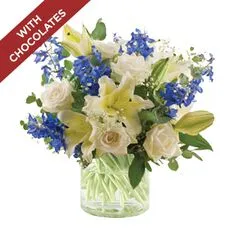
Blue Mist Bunch With Chocolates
$105.95 · the one to start withThis is the first one I point people to. There is a Japanese tradition of blue for exactly this, an apology that is also a thank-you, and blue does quiet work on a room. I will not sell you hydrangea heads that die on a hot doorstep, but this palette gets you the same settling effect without the risk. Considered, not desperate.
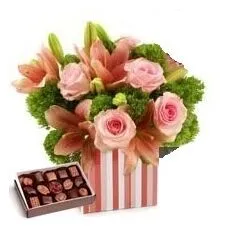
Blush Pinks Arrangement With Chocolates
$158.95 · the higher-stakes pickWhen someone tells me they have really stuffed up, not a forgotten coffee date, something that actually cost the relationship, I steer them here, and not to the biggest thing we sell. There is a reason for that, and it is the whole point of this article. Substantial enough to show you meant it, without tipping into buying your way out.
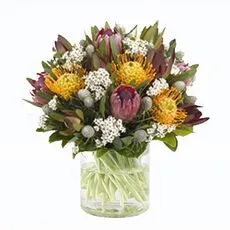
Australian Natives Bunch
$126.20 · the resilience pickPeople ask me for flannel flower because they read about it somewhere, and I have to be honest: it is a wildflower, not a standing line, so I cannot promise it on a Tuesday in July. This I can promise. Banksia and the rest are built to come back after fire, which is a fitting thing to send when the thing you broke felt like it burnt something down.
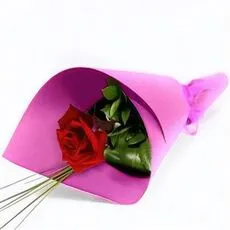
A Single Wrapped Red Rose
$42.95 · the honest smaller pickNot every mistake needs the big arrangement, and I will say that even though it costs us the upsell. Forgot to call back, snapped at someone over nothing? A single rose says the same thing a big bunch does. It says you stopped and thought about them. Oversized for an undersized mistake just reads as guilt performing. It sits in the range under sixty dollars, which is often exactly right. Keep it out of direct sun, by the way. Red pigment is the first thing to fade.
A wrapped bunch is a job you are handing someone: find the scissors, find a vase, cut the stems, fill the water. Fair enough on a good day. On the day you are apologising, when they are still cross with you, it is the wrong moment to hand them a chore. A vase arrangement lands ready to sit on the bench. If that is your situation, the Blue Mist that comes with a vase is built for exactly this.
How big was it, honestly?
Match the gesture to the mistake. Anna's call for each.
Keep it small and sincere
A small miss does not need a grand gesture. Oversized for an undersized mistake just looks like guilt performing. One good stem says you stopped and thought.
A Single Wrapped Red RoseConsidered, and calming
For real hurt, you want something that settles the room without shouting. A soft blue and white palette does that, and it carries an apology-and-thank-you meaning of its own.
Blue Mist BunchSubstantial, not oversized
When it actually cost the relationship, go substantial enough to show you meant it, and stop short of the biggest thing on the site. Big and loud reads as buying your way out.
Blush Pinks ArrangementWhatever the size of it, our apology range carries everything above, delivered to their door the same afternoon when you order before 2pm on a weekday. If no one is home, the florist near the address leaves it somewhere safe or tries again, so the flowers still land.
See the full apology rangeIf you want the phone calls, not the science
One thing nobody warns you about an apology you send rather than say to their face: the wait afterwards is the hard part. You have handed it over, and now you are staring at your phone. Anna used to field those calls, people ringing hours later because they had not heard a thing, certain the silence meant no. It almost never did. Someone who is still hurt does not reach for their phone on your schedule, and neither does someone who is simply busy. Give it a day. The quiet is not the answer, only the gap before one.
Andrew and Anna have given you the why, which is the half I am not built for. I wrote the other half a while back, the actual picks and the real calls that taught me which apologies land and which ones somehow make it worse, and there is no point me saying all of it again here. The short version is that my own first choice for years has been the Beautiful Pastels Bunch, soft and unshowy, the opposite of the grand gesture (which, honestly, almost never works). If you want the practical guide, with the stories attached, it is right here. And be kind to yourself while you sort it out. Everyone gets this wrong sometimes.
Further Reading
If this piece was the why, these two are the what and the how. One is Siobhan's practical guide with the real phone calls behind it. The other stays in the same curious, cultural register as this one.
When you know what you want to send, our apology range carries everything above, with same-day delivery to their door when you order before 2pm on a weekday, or 10am on a Saturday.
Shop apology flowers
Lily's Florist delivers Australia-wide through a network of 800+ partner florists.
24,031+ verified reviews on our reviews page.
Same-day delivery when you order before 2pm weekdays or 10am Saturdays.
Questions? Ring 1300 360 469, 7am to 6pm weekdays.
Sources
Costly signalling: Zahavi, the handicap principle (1975); Grafen's formal model (1990); Ohtsubo & Watanabe, "Do sincere apologies need to be costly?", Evolution and Human Behavior (2009); seven-country cross-cultural replication, Journal of Evolutionary Psychology; socio-ecological modifier, Frontiers in Psychology (2020). Brain imaging: Ohtsubo and colleagues, costly-apology fMRI study, Kobe University (2018), with a group-apology follow-up; neural correlates of receiving apology and forgiveness, PLOS One (2014). Olfaction: direct limbic access bypassing the thalamus, Cleveland Clinic and ScienceDirect neuroscience overviews; Kokubun and colleagues, rose scent and grey matter volume, Brain Research Bulletin (2024); fragrance-face ERP effects, ScienceDirect; linalool anxiolytic reviews, PMC and PubMed. Toxicology: feline glucuronyl transferase deficiency and essential-oil toxicity, ASPCA and the Merck Veterinary Manual; diffuser emissions and cognitive performance, Indoor Air (2022). Floriography: the language of flowers and tussie-mussie conventions, Wikipedia and Discover Concord MA; hanakotoba blue hydrangea meaning and the emperor legend, Blooming Expert and Ohara Florist; Hippeastrum reclassification (1987), Wikipedia; Gypsophila etymology, Wikipedia. Australian vase-life and seasonality figures, and the apology sweet-spot observation, draw on Lily's Florist in-house bench knowledge and order data, and are directional rather than guaranteed.
About the Authors
This piece was written by Andrew Thomson, who built the network and did the citation-chasing, with the floristry throughout from Anna, and a closing note from Siobhan. Read our full story.

Andrew, Ivy, Siobhan and Asha. Hobart, June 2024.