
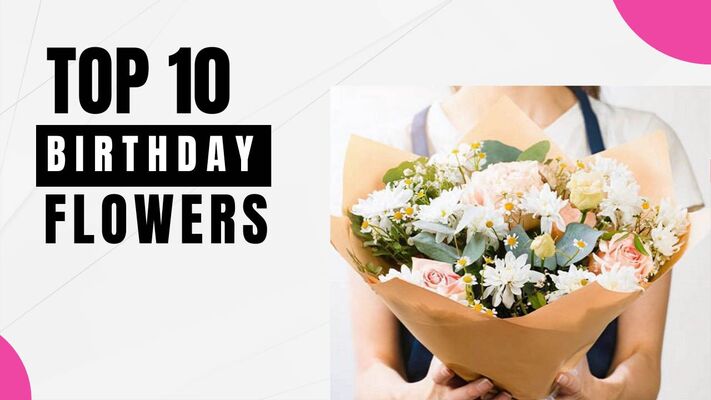
Birthday flowers nearly always work, and most of the time they are being sent because the person doing the sending cannot be there in person. The buyer is usually interstate, overseas, working late, or simply not where the birthday is happening, and they still panic about getting it wrong. We have a flower shop in Kingscliff, my partner Andrew and I bought it in 2006 (long story, mostly funny in hindsight, the brand came later in 2009), and out of every order type that runs through our system, birthday flowers carry the highest concentration of last-minute calls. Most weeks at least one comes from someone scrolling at 11:47pm. Plenty more land on Sunday afternoons when the buyer suddenly remembers Tuesday is the birthday. Then the emails at 1:23pm on Friday saying "I forgot, can you fix this" for a birthday set for the next morning.
I am writing this for the version of you who has the calendar reminder going off about tomorrow morning's birthday, your niece turning twelve or your friend's 40th on Saturday, who opened a tab to find the right flowers and got hit with three pages of search results all looking the same. The decision fatigue is real. Most birthday flower posts you'll find are listicles. Ten products, three bullet points each, a price, an Order Here button, good luck. Not the post you'll find here.
The expert in our business is Anna. She is a qualified florist trained in North Carolina, fifteen years of bench experience, and she ran our inbound call line from a home office in Pottsville for three years between 2010 and 2013. Around ten thousand calls came through that landline. Birthday calls were the bulk of them. What Anna learned over those years was that birthday buyers fall into a small number of recognisable patterns and the right answer is rarely "what's the most popular product" but "tell me about the person."
What follows is the decision framework Anna would walk a caller through if you rang us today. Five questions in the order she would ask them: WHO, WHERE, WHEN, WHAT, WHY. After that, a vase life table for the actual climate the flowers are landing in. Then the part nobody puts on a birthday flower page, which is what we tell people might go wrong, and how to plan for it. By the end of the post, what to send will be clear. The exact bunch can wait. Format, budget tier, delivery context: those become straightforward once you know who the flowers are for.
In this guide
The five questions Anna asks before recommending a single stem
When the call line was running out of Pottsville, Anna had a script in her head that she would walk through with every birthday caller. She did not announce the questions. They were woven into the conversation. By the end of a two minute call she had usually figured out exactly which product fit, often before the caller had finished describing the recipient. The framework below is those five questions in the order Anna asked them. WHO comes first because everything else hangs off it.
1. WHO is the birthday person?
Not their name. Their relationship to the buyer. A daughter sending to her mum has a different anxiety than a partner sending to a partner, and both differ from three friends chipping in for someone they've all known since uni. The relationship sets everything that follows: budget ceiling, format choice, what "getting it right" looks like. From thousands of calls, six profiles came up over and over again.
Partner sending to a partner
Overwhelmingly male sender, female recipient (this is shifting). What's running through their head: is this enough, will she think I put thought in or that I clicked the first thing. Budget usually sits between $80 and $150. The default click is roses, and Anna has views on that.
Roses are a shortcut. Sometimes shortcuts are fine, sometimes they're lazy. If you actually know her favourite colour, a mixed seasonal bunch in that palette says more than twelve reds. Twelve reds is the most literal product in the catalogue. The customer expects what the photo shows: twelve stems, all red, matched as closely to the website image as possible. Any deviation reads as failure. A Florist's Choice Birthday Bunch in a colour brief gives the florist room to use their best stock from that morning's market and pick the strongest stems available. A fair number of the calls that started with "I want twelve red roses" ended with the customer ordering a Florist's Choice in her colour after I asked what colour she wore most. The dozen-red-roses order is the default click. It is rarely the right answer.
One thing I'd add for this profile specifically. The photo back from the recipient does not always come fast. She might be at work, the bunch sitting on her kitchen bench until she gets home, the text coming through that evening. Silence in the first hour means nothing about the bunch. It is just her day.
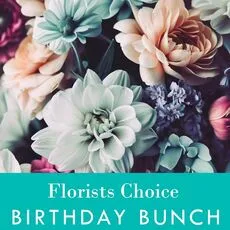
The photo here is a mood board for the colour and feel. Buyers are really paying for the palette and the price point, and the florist builds from whatever came in strong at market that morning, which is why this is the bestseller across nearly every birthday profile we ship to.
Parent sending to an adult child
Often interstate. The flowers are standing in for the parent who cannot be there. They are doing two things at once, celebrating the birthday and apologising for the distance, and the buyer usually knows it but does not say so out loud. Every one of these callers asks the same two questions: will it arrive on the day, will she know it came from me. Budget $100–$200. This is where the bear-and-balloon bundles make sense, even though anyone designing flowers would tell you a Teddy is not a flower. The bear echoes childhood gifts. The balloon creates a physical presence in the room after the flowers fade. This is also where "I sent her something similar last year" becomes a problem. Three years of mum's birthday flowers and the photos start blending together in the family group chat. Mum-buyers click pink and white most often. The brighter mixed bunches usually come when the daughter is the one ordering, not the partner or the son. Birthday flowers for Mum is its own category for this reason.
Friend sending to a friend
Often a group contribution. Three of us chipping in, four of us, sometimes more. They want the gift to feel planned and intentional, which is why the photo gets sent to the group chat the moment it's ordered. Budget $60–$120 across the group. The unboxing moment IS the gift. Birthday flowers for a friend tend to skew brighter and bolder than partner gifts. Pinks, oranges, hot magentas. The colour is the point.
Group orders had their own failure mode. The deciding voice usually wasn't the person paying. Three friends chipping in meant one was placing the order, two were texting from work, and the colour the buyer chose was rarely the colour the recipient actually liked. I'd ask on the phone: has someone in the group seen what she usually wears or what's on her bench at home? Often the answer was no, and we'd land on a Florist's Choice in a bright palette which gave the florist room to read the bunch right. The bunches that landed best from group orders were the ones where one person briefed and the rest paid.
Colleague or professional gift
Office birthdays, the boss turning 50, the new client whose admin sent us their date. These come with the trickiest read of all. The buyer needs to land somewhere between too personal and too cheap, without going so try-hard it reads as overdone. Budget $70–$100. Boxed arrangements dominate here. The format works because it sits on a desk without needing a vase, and it does not look out of place in a professional setting.
Corporate offices are flower graveyards. Aircon running all day, humidity stuck around thirty percent, fluorescent lights on for twelve hours straight. A rose lasts three days in those conditions. Chrysanthemums sit at reception looking unbothered for a week. If the flowers are heading to a desk and you want them still going strong when the recipient leaves on Friday, ask for chrysanthemums in the mix. A boxed birthday arrangement is the format you want here. The foam holds enough water for the week. Box doubles as the vase, which means no scramble to find a container before the flowers droop. One thing about corporate addresses worth knowing: in most cases the actual person handing the bunch to the recipient is the office reception. The card message has to make sense to whoever signs the receipt as well as to the person whose desk it lands on. We tell callers to assume one stranger reads it before the recipient does.
The milestone birthday
30th, 40th, 50th, 60th, 70th, 80th, 90th. The pressure on these orders is matching the spend to the milestone, because a $70 bunch for a 50th feels wrong. There is also usually an audience. The bunch arrives at a party or dinner where everyone watching is also doing the same mental math about whether the gift matches the milestone. Budget scales accordingly. A 30th might land at $80, a 70th can run $200 or more. The celebration packages with sparkling become relevant at 40th and above. Milestone calls came with their own failure modes Anna would train people to watch for. Surprise-party deliveries where the timing window mattered down to the hour. Address mismatches because mum had moved and the daughter was using an old contact. Recipients who'd asked for "no fuss" but the buyer wanted to ignore that and still be thoughtful. The audience-at-the-party variable was real on these calls, and the briefing took longer than a standard birthday call. Anna would route these to celebration flowers or directly to age-specific products like 50th birthday flowers or 60th birthday flowers.
The "oh no it's tomorrow" buyer
Same-day panic buyer. 11pm scrolling, sudden realisation. These callers are basically checking we can get flowers there by tomorrow at all. Budget is whatever it costs. Price sensitivity drops when guilt is high. Florist's Choice products are designed for this buyer. No decisions required. The card message guides the florist. Buyers worry that Florist's Choice means whatever didn't sell. It's the opposite. The florist building one that morning is using the strongest stock at market because the brief gives them freedom to pick the best of what arrived.
2. WHERE will the flowers land?
Plenty of birthday calls Anna took had the wrong format for the delivery address before she'd asked the WHERE question. A hand-tied bunch heading to a workplace with no vase. The boxed arrangement going to someone who'd asked for stems she could arrange herself. Something heavily scented aimed at a hospital ward where the strong perfume would be a problem. The format question gets asked second because format is where the most fixable mistakes live.
If you are not sure whether the recipient has a vase, do not send a bunch. Sounds obvious. I used to take call after call from people who had sent a beautiful hand-tied bunch to an office and the receptionist stuck it in a coffee mug because there was nothing else on the floor that held water. A boxed arrangement arrives finished. No scissors, no vase, no bench space. For offices, hospitals, and any address where you are less than 100% sure there is a vase ready to go, boxed is the answer. Foam holds enough water to survive a few hours on a porch in January, which a bunch wrapped in cellophane on a hot doorstep does not.
Hospital deliveries are the one place birthday flowers stop being a celebration and become a small lifeline. Sending flowers to a hospital when you cannot visit yourself is a particular kind of helpless. From what our florists have seen, most wards take flowers, oncology and ICU often do not, and ward clerks tend to prefer a box on the bedside table over a vase they have to find and fill. Lilies are the one stem to skip across the board. The pollen is airborne, stains fabric, and bothers patients with respiratory sensitivities. Roses, gerberas, chrysanthemums, and carnations are the safer picks. Anna fielded plenty of calls about hospital deliveries that didn't sit right. A hand-tied bunch ending up in a kidney dish or a coffee cup because the ward had no vase. The recipient sending a photo that the buyer hadn't planned for. Her policy on hospital orders converged: send a boxed Florist's Choice unless the buyer has confirmed there's a vase already on the ward.
3. WHEN is the birthday?
Most birthday calls landed in two timing buckets. Same-day was a big share, buyers who'd realised that morning. Two-to-five days out was another big share, buyers who knew the date was coming and had finally sat down to deal with it. The smaller share were week-or-more advance orders, almost always milestone birthdays where the buyer wanted Anna to have time to brief the partner florist. Same-day delivery is possible if you order before 2pm weekdays or 10am Saturdays. Tomorrow gives the florist room to source the best stems for your brief. A week's notice means the florist can check whether the specific stems you want are in season.
There's a reason I preferred Tuesday-to-Friday deliveries when the caller had flexibility. The wholesale markets run Tuesday through Saturday. Stems delivered on a Tuesday were at market that morning or the day before. Best stems of the week. Monday arrangements use Saturday stock, which is still fine but two to three days older. Saturday morning market is picked over by 9am. The florist who gets there at 5am has the best of it. By 10am they're building with what's left. We do not deliver Sundays. The markets close Saturday afternoon. Any florist offering Sunday delivery is using Friday stock, and Friday stock by Sunday is already three days old before it reaches the vase.
4. WHAT is the budget?
The full breakdown of what each price tier actually buys is in the next section, because it deserves its own treatment. Quick version: $70 to $80 buys you a solid bunch from good stock. The $120 to $160 range is where the florist starts adding premium focal flowers. Past $200, the spend tips from "flowers" to "an event at the door" with bundled add-ons.
This was the question I'd ask second if the caller was already nervous and last if they weren't. Buyers who lead with budget are usually anxious about overspending. Buyers who lead with the recipient are anxious about underspending. The right answer is rarely the price they thought they wanted. It's a tier or two off whichever direction the recipient profile actually fits. A dozen-red-roses caller at $80 wanted to spend $120. A Florist's Choice caller at $200 was usually fine at $120. Budget conversations work better when the caller has answered the WHO and WHERE questions first.
5. WHY are you sending flowers?
This is the question that decides the rest. Anna's most common answers, ordered by how often she heard them. "Because I forgot" was the leading one, usually a mid-week panic call. The next most common was "because I'm interstate and can't be there." Then "because she's turning a big number this year," usually for milestones from 30 onwards. The calls where the buyer wanted to bridge a drift in the relationship without naming it sat next on the list. Then habits, apologies, and the half-dozen reasons people don't say out loud. Often it is two of those at the same time. Affection plus apology, habit plus distance, celebration crossed with the awareness that another year has passed without seeing the recipient. Whatever the why, that answer tells the florist what the flowers are doing. The card message turns it into something specific.
Andrew, Co-Founder The Florist's Choice Birthday Bunch has been our number one seller for years. That was a little surprising to us at first because we expected the dozen-red-roses to top everything. The pattern in the data is consistent though. Buyers prefer the version where they trust the florist and write a thoughtful card over the version where they pick exact stems and worry the substitution will let them down. The card message ends up doing more work than the stem selection. Florist's Choice consistently outsells the dozen-red-roses by a wide margin across our birthday orders. Anna has been telling me that since 2010 and the photos coming back from recipients agree with her.
The card message IS the brief. When you write "Happy 18th Birthday Jenny," the florist reads that and builds young, bright, high energy. A line like "Happy 90th Birthday Grandma, love from all of us" gets soft, elegant, classic instead. Same product code, completely different arrangement.Anna, Qualified Florist, on the card the recipient reads first
What the money actually buys at each price tier
Most birthday flower posts list a price next to a product and stop there. The catalogue gets you the SKU; it does not explain what the dollars actually do. The honest version: above the entry-level price point, every additional twenty or thirty dollars buys you something specific. Could be a different kind of stem, a bigger flower head sitting at the front of the bunch, an upgrade to the wrapping, or an add-on that turns the delivery into an event. Knowing what you are paying for keeps the spend honest. The relationship is what should set the budget.
At $70 to $80, the florist is covering stems, wrapping, cellophane, and a slice of the delivery cost. You get a good bunch. Solid. Presentable. The $120 mark is where the florist starts adding premium focal flowers: larger roses, oriental lilies, dahlias in season, peonies in their narrow window, stems that cost more per piece but give a different visual weight. Past $180 you are into bundled territory. Chocolates, a Teddy, a balloon, sparkling. The flowers themselves are not necessarily better at $250 than $120. The experience is bigger. Both are valid. The buyer just needs to know what they are buying.
The $70–$90 tier: the workhorse bunch
This is the volume price point on Australian flower delivery sites, and three of our long-running bestsellers live here: Florist's Choice Birthday Bunch ($74.50), Bright Mixed Gerberas Bunch ($80.75), and Rose, Gerbera & Lilies Bunch ($80.95). These products have been bestsellers for fifteen years for a reason. Genuinely good stems, a forgiving format, and a price that clears the "this looks like a real gift" bar without needing the buyer to think too hard.
If the recipient has a vase and lives in a temperate climate, a bunch at this tier gives you seven to ten days of vase life with normal care. Add water changes every two days and you can stretch that. The Florist's Choice Birthday Arrangement ($81.75) is the boxed version of the same idea. Identical stem selection, set in foam so the recipient does not need a vase.
Anna's read on the $74.50 build: a handful of focal stems (typically roses, gerberas, or oriental lily depending on what was strongest at market that morning), a layer of secondary stems sitting behind them (alstroemeria, chrysanthemum spray, or stock are the usual three), and filler greenery to bind the bunch (eucalyptus and ruscus do most of the work). The stem count varies with what came in. The variability is the point. A fixed-stem bunch at this price would mean using whatever specific stems were available regardless of quality. The Florist's Choice brief lets the florist build to the strongest stock that morning instead of forcing through the photo.
Bunch format  Boxed arrangement
  Bunch with chocolates
 The $90–$120 tier: chocolates and small upgrades
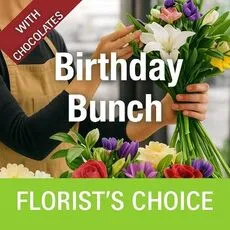
This tier adds a chocolate component to the same flower base. Florist's Choice Birthday Bunch with Chocolates at $90.95 is the most direct example. The flowers are the same as the entry tier; the chocolates double the perceived gift size. On most partner-florist bundles the chocolate component is a boxed assortment in the 100g to 150g range rather than a supermarket bar. Unit cost is higher and the box itself looks like a gift, which is the operational point: the bundle reads as two gifts at the door instead of one gift with a snack. For colleagues, friends, or recipients you're not sure about flowers-alone, this tier reduces the risk that the gesture lands flat. The chocolates give the recipient something to share, which turns the moment into a small office event.
The $120–$180 tier: bundled experiences
This is where the Teddy-and-balloon bundles start showing up. Anna would put these in front of the parent-to-adult-child profile or the long-distance partner. The reasoning is volume and presence at the door, with stem quality holding steady at the same wholesale-stock level as the entry tier. A Teddy in a hospital room, on a desk, or in a kitchen is a physical presence the day after the flowers begin to wilt. People keep them. Children name them. The flowers fade and the Teddy stays on a shelf. Birthday flowers and gifts for him sit largely in this tier.
The dozen-red-roses-plus-Teddy buyer is almost always male, sending to a partner, and a bit nervous about whether twelve roses is enough on its own. The Teddy is insurance. I would talk these callers through whether the recipient actually liked Teddys, and about a third of the time we'd switch them to a Florist's Choice or a celebration package because the bear was solving an anxiety the flowers had already solved. The other two thirds were sure they wanted the bear. We sent the order.
The $180–$300 tier: milestone and event
Premium territory. This is where celebration packages with sparkling, twelve-rose-plus-Teddy bundles, and premium roses in a vase live. Milestone-birthday money: 50th, 70th, the significant relationship moment that needs to match. The vase that comes with a celebration package is real glass, keepable, and adds a physical object to the gift that survives the arrangement. Premium rose ranges fall into this bracket, and milestone-specific pages like birthday gifts for him are designed around this spend.
One honest note on this tier: the flowers are not necessarily better than the $80 tier. Same wholesale stock for the stems. What you're paying for is more of them, premium focal varieties, a vessel that the recipient gets to keep, and the bundled add-ons. If the question is "which arrangement gives the longest vase life per dollar," the answer is the $80 bunch in a clean vase the recipient already owns. For "what gives the biggest moment at the door," the spend lives up here.
The under-$60 question
People ask. Lily's keeps a flowers under $60 category for the cases where the budget genuinely needs to land there: a casual friendship, a thank-you that doesn't need volume, the third birthday in a fortnight. Anna's honest take: under $60, the florist is making the maths work on tight margin. The product is real, the stems are real, but the flex you have on stem selection narrows. A $42 single rose is what it says: one rose, wrapped, delivered. Lovely as a gesture. Not a birthday gift on its own unless the recipient has explicitly asked for it.
Vase life by Australian climate zone
Australia spans from a Hobart living room at 15 degrees in July to a Darwin kitchen at 32 degrees in January with humidity that won't budge. A generic "your flowers will last 7 to 10 days" answer treats Hobart and Darwin as the same room. They are not. Every extra day of vase life is one more day the recipient looks at the bunch on the kitchen bench and remembers who sent them. Climate decides how many of those days you actually buy. The biggest single factor in how long a birthday bunch survives is the temperature of the room it lands in, and that varies by climate zone, season, and whether the recipient has air conditioning running.
The figures below come from Anna's bench experience and from cross-referencing wholesale vase-life data against actual reports we've collected over fifteen years of deliveries. These figures match what we actually see across deliveries. Wholesale spec sheets list higher numbers because they assume cool-storage conditions a home rarely provides.
| Stem | Cool room (15–18°C) | Typical room (20–24°C) | Warm, no AC (28–32°C) |
|---|---|---|---|
| Rose (hybrid tea) | 10–14 days | 7–10 days | 3–6 days |
| Gerbera | 10–18 days | 5–12 days | 3–7 days |
| Chrysanthemum (disbud) | 18–30 days | 14–24 days | 10–14 days |
| Carnation | 18–24 days | 14–21 days | 7–14 days |
| Oriental Lily | 12–21 days | 8–14 days | 4–10 days |
| Sunflower | 10–14 days | 7–12 days | 3–8 days |
| Protea | 14–24 days | 10–18 days | 7–10 days |
| Leucadendron / native | 21–42 days | 14–28 days | 10–16 days |
What this tells you about which stems to choose
Everything lasts longer down here. Tulips, ranunculus, hydrangeas. Stems I'd qualify with a warning in Brisbane I recommend without hesitation in Hobart. A rose in a Hobart living room in July at 15 to 17 degrees gives you twelve to fourteen days easily, sometimes longer. The cool air slows the flower down and the petals hold colour a week longer than they would in a Sydney summer.
The humidity keeps petals hydrated, which helps. Warm temperatures speed the flower's metabolism, which doesn't. A gerbera that lasts a week in Melbourne gives you four or five days here. Chrysanthemums and carnations are the smart picks for longevity in this climate. They were bred for warm rooms and they hold up.
The heat compresses every timeline. Roses give you three to five days. Gerberas bend at the neck within forty-eight hours unless they're internally wired. Chrysanthemums, leucadendrons, proteas. Those are the birthday stems for tropical deliveries. Australian natives in particular were built for this climate. Some leucadendrons hold for two weeks even in a 30-degree kitchen.
The construction secret nobody puts on a flower delivery site
Gerberas are the birthday workhorse. The colour range is unmatched. Hot pink, sunshine yellow, burnt orange, white, pale pink, cream, every shade in between. Buyers go for them because of the colour. Florists pick them because they sit beautifully in a mixed hand-tie. The big round heads photograph beautifully on the front of a bunch, which is why every florist's website has a gerbera as a hero shot somewhere. They are also the most fragile commercial stem on the market, and the difference between a gerbera that lasts three days and one that lasts ten is a piece of fine wire.
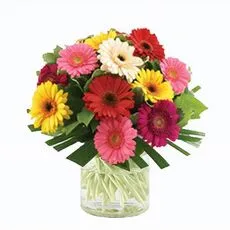
Every stem in this bunch has been internally wired. The flower heads sit upright at delivery, and they stay upright for a week or more in a cool room. Without that wiring, half of these would be drooping at the neck inside 48 hours.
Gerbera stems are hollow. Without internal wiring, an 18 or 20 gauge wire threaded up through the inside of the scape into the base of the flower head, the stem cannot hold the weight of the bloom past about forty-eight hours. The head bends at the neck, drops forward, and once it's drooped you cannot revive it. Re-cutting buys you maybe ten percent of cases. The other ninety percent are done.
That ten seconds of wiring at the bench is the difference between a gerbera bunch that photographs well on arrival and one that photographs well on day three. You cannot see the wire from the outside. But the recipient sees the difference by day three when the heads start to bend.
What Anna tells callers before they order
This is the section nobody puts on a flower delivery site. Most birthday flower posts are pure pitch. Here are the products, the prices, ten reasons they're great, click to order. A genuinely useful guide includes the parts where things go wrong, why they go wrong, and what to plan for. Florists know all of this and tend to keep it to themselves. Anna has different instincts. She wants the buyer to know what they are signing up for before the order goes through.
The photo is not the product
This is the single biggest source of birthday flower disappointment. The product photo on every flower delivery site was shot by a stylist on a single specific morning, often retouched, and signed off as the brand asset for that SKU. It is collateral, not a stem inventory. The buyer sees a styled product photo and expects exactly that arrangement to land at the recipient's door. What lands is a seasonal interpretation of it. Three stars, because the lilies in the photo are missing. The florist scored the order five stars internally because they used the strongest stock at market that morning. Both sides are correct from inside their own logic. The gap is in expectation. The delivery did its job.
The product photo was shot on one specific day with whatever was at market that morning. Your delivery uses whatever is at market the morning the order is made. The colour energy carries through; the exact stems rotate with the season. A January birthday bunch will have different flowers in it than a July birthday bunch. Both will be beautiful. Neither will be identical to the website photo. Buyers who understand this give five stars. Memorising the photo and counting the stems gets you three. The product hasn't changed, only what the buyer was expecting.
The biggest single example is peonies. People see them on Instagram and want them in June. They do not exist in June in Australia. October to early December is the window. I can get similar colours, similar shapes, but I cannot create peonies from thin air. A good florist explains all this. The bad ones promise and substitute without telling the customer until the bunch lands.
The pattern that taught me to check seasonality before confirming any specific stem on the phone: a customer mentions a flower from the website photo, I take the order, and what lands is something in the same colour palette but completely different in shape. Hyacinths go off in early spring. Sweet peas finish by November. Stock peaks in winter. After enough of those calls I added a step to my script. If a customer mentions a specific stem from a photo, I confirm it's in season before I take the order. Otherwise I steer them to a Florist's Choice in the same palette and explain why.
What is in season when
Spring (Sep–Nov): Peonies arrive Oct–early Dec. Tulips, ranunculus, sweet peas. Full colour palette available. Best value tier of the year for variety.
Summer (Dec–Feb): Sunflowers, gerberas, chrysanthemums, tropical stems. Roses available but heat-stressed. Tulips and ranunculus are gone until autumn.
Autumn (Mar–May): Chrysanthemums peak. Dahlias (Mar–Apr). Roses recovering as temperatures cool.
Winter (Jun–Aug): Tulips, ranunculus, anemones, stock, sweet peas, freesias, all peak winter. Roses excellent because cool weather gives longer stems and better colour. Sunflowers and peonies unavailable.
The card message is doing more work than the stems
This is the single most overlooked variable in birthday flower orders. For Florist's Choice products, the card message literally determines what the florist builds. The florist reads it before they pick the first stem.
When you write "Happy 18th Birthday Jenny," the florist reads that and builds young, bright, high energy. A line like "Happy 90th Birthday Grandma, love from all of us" gets a softer, more elegant, more classic arrangement instead. The card message IS the brief. Three lines of message and the florist has a clear picture of who the bunch is for. A few that work consistently: "Happy birthday Mum, we love you, see you Sunday" for family; "Happy 50th, here's to the next decade" for a milestone; "Wish I could be there for the cake" when the buyer can't be there in person. Each one decides how the bunch gets built. The default "Happy Birthday" submission gets whatever the florist's default arrangement is. Leaving the card field blank means the recipient sometimes has no idea who sent it.
Common mistakes I'd flag on the phone: putting the recipient's age on a card going to an office (HAPPY 50TH! visible to everyone), submitting nothing at all, trying to cram a paragraph onto a card the size of a business card, and the worst one of all, slipping instructions to the florist into the message ("please include yellow roses") which we'd then print on the card itself. Read the message back before you submit. Imagine the recipient reading it out loud at the door.
If you are stuck for what to write, write it the way you would say it out loud if you were handing the flowers over yourself. Be specific about who it's from, name the milestone if there is one, and skip the generic.
Why we don't deliver Sundays
This one frustrates people. They've found the perfect flowers, the birthday is Sunday, and we're saying no. The honest answer is that the wholesale flower markets close Saturday afternoon and don't reopen until Tuesday morning. Any florist offering Sunday delivery is using Friday stock, which means by the time the flowers arrive on Sunday they are already three days old before they reach the recipient's vase. We made the call early on that Sunday flowers built from Friday stock would not last long enough to be worth the buyer's money. So we don't offer them. Saturday cutoff is 10am and after that the next available delivery is Monday using Saturday stock. Sunday-birthday calls Anna took typically resolved one of three ways: shifting to a Saturday delivery before the cutoff, accepting a Monday delivery to a Sunday-birthday recipient with an apology in the card, or cancelling and going elsewhere.
Andrew on what to do if it goes wrong Most of the time the photo comes through and the flowers look right. The exceptions are the calls I want. If the flowers do not look right when they arrive, email or ring us the same day with a photo. 1300 360 469. I'll ring the partner florist myself. Once I know what happened, the fix gets sorted before the day is out. Most issues come down to a substitution the florist made without flagging it. Fixable if we hear about it early. Not three days later.
Care: the five things the recipient does that decide vase life
This part is for the buyer to forward to the recipient. Or for the recipient who's just unwrapped a bunch and wants to know what to actually do with it. Forwarding the care guide with the order is a small move that extends the gift, because the difference between a bunch that lasts five days and one that lasts twelve is mostly what the recipient does in the first hour. Vase life numbers in the table above assume good care. Skip the basics and you'll lose 30% off every figure. Done properly, the upper end of those ranges is reachable. From years of follow-up calls, Anna's read on care-step compliance: most recipients do some of the steps and skip others. The first cut is the most-followed step. Water changes are the most-skipped, which is why bunches that get re-cut on day one but never have water changed start clouding by day three. The five things that decide it:
1. Re-cut every stem at 45 degrees
This is the single most important step. The flower has been out of water in transit, even if briefly, and the cut end has started to seal. A new angled cut opens the stem back up. The 45 degree angle prevents the stem sitting flat against the bottom of the vase, which would block water uptake. Use a sharp knife or florist scissors. Blunt blades crush the stem fibres and reduce water uptake. The most common mistake is kitchen scissors that haven't been sharpened in two years, which tear the stem cells rather than cutting them cleanly, and the bunch loses two or three days of vase life before the recipient knows it.
2. Strip every leaf below the waterline
Every single one. Submerged leaves rot, which feeds bacteria. The bacteria colonise the stem ends. Once the stems can't drink, they wilt fast. The most common cause of an early-wilting bunch is leaves left underwater that nobody bothered to strip.
I've seen $150 arrangements last four days because nobody stripped the leaves. The water goes cloudy by day two, you can smell it by day three, and the stems start to soften and brown at the cut end. By day four the buyer is ringing us asking what went wrong. Nothing went wrong with the flowers. The recipient skipped the foliage step. Strip every leaf that sits below the waterline. Even the small ones.
3. Change the water every two days
Bacteria load doubles roughly every twelve hours in standing water. After two days the water is bacterial enough to start clogging the cut ends of the stems. Tip the water and give the vase a rinse. Then refill with clean cool water. If the supplied flower food sachet is still around, use a new dose with each water change. Without flower food, a small drop of bleach (literally one drop in a litre) keeps the bacteria in check. Sugar in the water is a folk-remedy myth. It feeds bacteria more than the flowers.
Commercial flower food sachets are roughly 4% sucrose for the flower's metabolism, an acidifier (citric acid usually) to bring the water pH down to around 3.5 where stems drink most efficiently, and a low-dose biocide to slow bacterial growth. The bleach-drop method gets you the biocide. Skipping the sugar matters less than people think for a bunch that's already at delivery, because by then the flower has stored enough sugar in its stems to last most of its vase life. The acidifier is the bit nobody substitutes at home, and it's the bit that makes the biggest difference past day three.
4. Keep the flowers away from fruit bowls
Ripening fruit produces ethylene gas. Ethylene is the chemical signal that tells a flower it's time to die. Carnations are especially sensitive; one banana on the same benchtop will cut two days off carnation vase life. Apples emit even more ethylene than bananas. Avocados, tomatoes, and pears sit in the same high-ethylene group. Citrus and most berries are low-ethylene and won't bother the bunch. Roses, lilies and chrysanthemums are also vulnerable. Move the vase to the dining room or a side table. Not the kitchen counter where the fruit bowl lives.
5. Pull the dying stems early to save the rest
Mixed bunches often have stems that fade at different rates. Gerberas usually go first, around days three to five, while roses tend to hold their shape until day seven or eight. The second week is carried by lilies and carnations. As stems fade, pull them out. A dying flower releases that same ethylene as it fades, and the chemical accelerates the decline of the stems still alive in the vase. One soft rose on day five can take two days off the carnations carrying the second half of the arrangement. Anna's read from years of follow-up calls: a small portion of recipients actively manage the bunch through to day twelve. The rest let it run on its own and ring us around day six wondering why something looks off. The five things above are the difference between those two outcomes.
For a deeper version of this, including how to revive a wilted stem with a hot water dip and how to spot early warning signs of bacterial blockage, the flower care guide goes through it step by step.
Further Reading
If this guide helped, three companion birthday posts plus the full care guide cover angles we deliberately skipped or only touched on here. The cannibalisation across our birthday content is real and we work hard to keep each post on its own ground.
If you've read this far, the product choice is much narrower than when you opened the tab. Birthday flowers are at the link below. Order before 2pm weekdays for same-day delivery, before 10am Saturdays. Anna or someone in the team will pick up if you ring.
Browse Birthday Flowers
Lily's Florist delivers Australia-wide through a network of 800+ partner florists.
23,362+ verified reviews on our reviews page.
Same-day delivery when you order before 2pm weekdays or 10am Saturdays.
Questions? Ring 1300 360 469
About the Authors
This post was written by Siobhan Thomson with Anna's expert framework woven through and a contribution from Andrew on what to do when an order goes wrong. Read our full story.

Andrew, Ivy, Siobhan and Asha. Hobart, June 2024.