

I took thousands of hospital flower orders during my years on the phones, first in the Kingscliff shop and then from our home office in Pottsville. The calls were always the same shape. Someone would ring up, voice tight, and say something like "my mum's just gone in" or "my mate had surgery" or "the baby came early." They knew they wanted flowers. They had no idea what to choose.
I used to think the flower was the important part. After five years of those calls, I realised the flower was almost secondary. What mattered was the flowers being there when they woke up. That was the whole point of the call.
But. The flower still matters. Get it wrong and you've sent lilies that stain the hospital sheets orange, or something so fragrant the patient across the room complains, or a glass vase that gets knocked off the table during a midnight obs check. So we asked Anna, because she's the one who actually knows.
One thing before any of it, because most people arrive here braced for a no: you are almost certainly allowed. Every Epworth hospital in Victoria bans exactly one flower by name, and their own visitor information finishes the sentence with "all other flowers are welcome." That is a hospital group giving you permission. The rest of this is about getting it right, not about whether you can.
Do Flowers Actually Do Anything? The Trials Say Yes, and Not for the Reason You'd Think
Florists have been claiming flowers help sick people for as long as there have been florists, which is exactly why you should not take our word for it. So here is somebody else's.
There is a randomised trial where surgical patients recovering in rooms with flowers and plants took fewer painkillers and had lower blood pressure than the ones in the same ward without. Lower heart rate. Less reported pain and anxiety. That is not a florist's line, that is a controlled trial with a control group.
And there is a second one, on heart attack patients, and this is the one that changed how I answer the phone. The flowers in the room were fake. Plastic roses in a pot. The patients still came out of it with a quarter of the depression rate at discharge compared to the ones with an empty windowsill, and it was still there three months later. Fake flowers.
Which tells you the thing doing the work is not the pollen and it is not the scent and it is not anything biological. It is that the room stopped looking like a hospital room for a minute. That is the whole mechanism, and once you know that, everything else about a hospital order falls into place. Keep it small. Keep it where she can see it from the bed without sitting up. The big expensive one on the floor behind the visitor's chair is doing nothing at all, and I mean nothing, because she cannot see it.
Park & Mattson (2008, 2009). Randomised controlled trial, 90 patients recovering from surgery, rooms with plants and flowers against a control group. The flower-room patients used fewer post-operative analgesic doses and recorded lower systolic blood pressure and heart rate, and reported less pain, anxiety and fatigue.
Koh et al. (2019), the A-FLORA-ACS trial. Artificial potted roses placed in the rooms of acute coronary syndrome patients. 6.6% met depression criteria at discharge against 24% of controls, and the reduction was still measurable at three-month follow-up.
Ali Khan et al. (2016). Wards greened with plants and flowers throughout recorded more normal vital signs, less reported pain and fewer opioid analgesics. A weaker design than the trials above, so treat it as support rather than proof.
See sources 7, 8 and 9 below. We have not reproduced the percentage figures from Park & Mattson here because our two reference sources report them differently and we have not yet checked the primary paper.The practical version of all that is short. The flowers are not medicine. They are a change to what the room looks like from the pillow, and the evidence says that change is worth something measurable. So the job is not to send the most impressive arrangement. The job is to send one she can actually see.
Where You Can and Can't Send Flowers in Australian Hospitals
Most Australian hospitals accept flower deliveries. This is different from the UK, where the NHS removed flowers from most wards years ago. In Australia, general wards, surgical wards, rehabilitation and maternity almost universally allow them. But not every ward does, and where the answer is no, the reason is medical rather than bureaucratic.
The mechanism is a fungus most people would walk past without blinking. Aspergillus grows in soil and decaying plant matter, and it colonises the stagnant water inside a flower vase within days. Healthy lungs flush the spores out without noticing. In a patient whose immune system has collapsed after surgery, chemotherapy or a transplant, the same spores can cause invasive pulmonary aspergillosis, and the infectious diseases guidelines are unambiguous about it: no plants and no cut flowers in immunocompromised rooms. The same logic covers potted plants everywhere in a hospital, because the soil is the problem, not the flower.
Source 1: Infectious Diseases Society of America practice guidelines for aspergillosis.Those bans are real and they are not negotiable. The ones further down the list are a different story, and that is the next section.
Named policies worth knowing
Andrew runs the partner network, so the current institutional detail is his department rather than Anna's. Every Epworth hospital in Victoria bans lilies by name, and their published explanation is better than any florist's: lilies carry their pollen on the outside, where roses, carnations and chrysanthemums carry it inside. Peter MacCallum tells stem cell transplant patients that flowers and plants are an infection risk and cannot stay in the room. Royal Hobart advises against strong-smelling flowers because of other people's allergies. Royal Melbourne excludes flowers from ICU, oncology, haematology, bone marrow transplant and emergency, and has a florist on site at Shop 2, 300 Grattan Street. Mater in Brisbane runs its own florist with free in-hospital delivery on weekdays if you order by 2pm.
And one small collision that nobody seems to have noticed. Royal Adelaide starts visiting at 2:30pm, which is the latest start of any major hospital in the country. Our same-day cutoff is 2pm. Order at one o'clock and the flowers are sitting at reception before the first visitor gets through the door.
The ward nobody writes about
Palliative care is different. Flowers are welcome there. The staff understand what they mean, and if anything, palliative is the ward where flowers matter most.
The Honest Bit: Half Those Signs Aren't About Infection
This section does not help us sell flowers. It is here because it is true and because you can check every line of it, which is more than you will get from the other nine results you are choosing between.
Here is the part that surprises people, and it does not do me any favours to tell you. The evidence that flowers cause hospital infections is thin. The American CDC's own environmental infection control guidelines say there is minimal or no evidence that plants in normal patient care areas raise the infection risk. The UK health department told the florists' association back in 2007 that they had never traced a single hospital infection to cut flowers on a ward, and the follow-up work has not turned one up since. And yes, the water in a vase is teeming. Ten thousand to ten billion bacteria per millilitre, mostly Pseudomonas. But the CDC's own note is that hospital flowers are no more contaminated than the flowers on the table at your local pub, and nobody is catching anything from those either.
So why the signs? Talk to nurses and you get a different list to the one on the poster. Water gets spilled and somebody slips on it. A glass vase goes over. There is a vase sitting exactly where the IV pole needs to be at three in the morning and someone has to shift it one-handed while doing something that actually matters. Somebody has to change that water and it is not going to be the nurse. In mental health units it is the glass itself, and the balloon strings.
The wards where it is genuinely medical are not being precious. Intensive care, haematology, transplant, burns. Those patients have no immune system and there is a fungus in soil and stagnant water that does not care how nice your intentions were. That one is real and I would never argue it. But the general ward with the handwritten no-flowers sign taped to the door? That is usually a workflow decision wearing a medical coat.
Which is why I say send the box, not the bunch. Half the reason those signs exist is the vase, and a box does not have one.
The practical upshot: on a general ward, the objection to your flowers is almost never the flowers. It is the vessel, the water and the workload. All three of which are solved by sending something that arrives finished and does not need a jug.
Spot the difference
Two wards. The same sign. Two completely different reasons.
Nobody tells you which one you are standing in front of, so here is how to tell.
ON THIS WARD Thank you
Intensive care, burns, haematology, transplant
This one is real.
These patients have no immune system worth the name. Aspergillus lives in soil and in the stagnant water inside a vase, and it colonises it within days.
Healthy lungs flush the spores out without noticing. A collapsed immune system does not, and the result is invasive and frequently fatal.
There is no arguing with this one and Anna does not try.
Source 1: IDSA aspergillosis guidelines. No plants, no cut flowers in immunocompromised rooms.ON THIS WARD Thank you
The general ward down the corridor
This one is usually workflow.
Water gets spilled and somebody slips. A glass vase goes over. There is a vase sitting exactly where the IV pole needs to be at three in the morning.
And somebody has to change that water. It is not going to be the nurse.
The evidence for an infection risk here is thin, and the people who publish the guidelines say so themselves.
Sources 2 and 3: the CDC finds minimal or no evidence that plants raise infection risk in normal patient areas. The UK health department told the florists' association in 2007 they had never traced a ward infection to cut flowers.The wards where it is genuinely medical are not being precious, and I would never push it. But the general ward with the handwritten sign taped to the door? That is usually a workflow decision wearing a medical coat.
Which is why I say send the box, not the bunch. Half the reason those signs exist is the vase, and a box does not have one.
The general ward with the handwritten no-flowers sign taped to the door? That is usually a workflow decision wearing a medical coat.Anna, Qualified Florist, 15+ Years
Colour: The Part Nobody Tells You
If the sight of the arrangement is what is doing the work, then what it looks like from the bed is not a decorating question. It is the whole product. And colour is the biggest lever you have, which is odd, because no other flower guide in this country mentions it at all.
The University of Sheffield's landscape architecture department ran 670 people past flower images in eight colours in 2023. Blue and white came out most relaxing. Orange, yellow and red came out most uplifting. White was the only colour to score highly as both.
Separately, Ikei and colleagues in 2021 wired participants up and showed them red, yellow and white flowers for three minutes each. Red and yellow produced higher alpha wave activity and a stronger parasympathetic response than white.
Sources 10 and 11. Sheffield's follow-up work on colour combinations is the basis of Anna's mixing rule below, and we are still chasing the primary paper on it, so she has framed it as a bench rule rather than a finding.The research does not perfectly agree with itself, which is worth saying out loud rather than tidying away. Ask people which colour looks relaxing and they say blue and white. Wire them up and measure what the nervous system actually does, and yellow and red come out ahead. Those are two different questions and they got two different answers, and anyone telling you otherwise has read one of the two studies.
What I take out of it is this. White is the only colour that came top of both lists. So white is the answer when you do not know the person well, and that is most hospital orders. It is not a cop-out, it is the one colour the evidence cannot find a bad word for.
| Colour | What it does | Who to send it to |
|---|---|---|
| White and green-white | The only colour rated both relaxing and uplifting. Reads clean and neutral. | Shared wards, colleagues, anyone you don't know well. The default. |
| Soft pink | Gentle. Nobody has ever objected to it. | Post-surgical recovery, anyone at all. |
| Yellow and orange | Uplifting, raises alertness. | The patient who's bored and flat. Long convalescence. Morale. |
| Blue and lavender | Rated most relaxing. Personal preference splits this one hardest. | Frightened rather than unwell. Pre-op, post-op, waiting on results. |
| Red | Highly stimulating. Also reads romantic. | Partner only. Awkward from a colleague, and I would skip it for anyone frail or anxious. |
Here is the one that will actually change what you order. If you want a mixed bunch to feel calming, the warm colours will take the whole thing over. One orange gerbera in a bunch of blue and white and the bunch reads bright, not restful. It does not work the other way around. The blues will not calm down the orange. So decide which one you want first and then commit, because half and half gets you bright whether you meant it or not.
I could not have told you why for the first ten years. I just knew the calming ones stopped being calming the moment you put something hot in them. Turns out the research says the same thing.
One honest catch on the blue advice, and it is a florist telling you something against her own interest. There is barely a true blue flower in commercial floristry, so a "blue" arrangement is almost always built around delphinium, which is fragile and drops fast, or dyed stems. For a room nobody maintains, that is the wrong trade. If blue and white is genuinely what you want, browse the blue and white ranges and ask us to keep it to the durable stems. But for most frightened-rather-than-sick orders, the safer answer is soft pink, which the same research rates gentle and universally appropriate, and which we can send in a sturdy box that lasts.
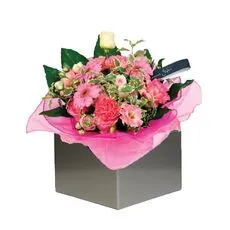 When she's anxious, not just unwell Stunning Pink Arrangement $83.95 Same Day Delivery · soft pink, sturdy box, no vase to find
 What Actually Survives a Room Nobody Maintains
Forget symbolism, think survival. A hospital room is not a living room. Nobody is changing the water. The temperature swings when windows open and close. The bedside table is about forty centimetres by thirty-five, near enough, and by the time you take away the water jug and the phone there is not much left. The arrangement has to fit what's left of that surface and still be standing five days later. Nurses would bump those tables at two in the morning checking obs. It has to survive that too.
So when somebody asks me how long flowers last, my answer is a question. Last where? The number on the wholesaler's sheet assumes clean water, flower food and somebody who cares. A hospital room is the opposite of all three by definition. Read the numbers below and take the bottom of the range, because that is the room you are sending into.
Vase life at the 20 to 24 degrees a ward runs, with the failure mode attached. This is the ranking Anna gives on the phone, in order.
Chrysanthemums
Chrysanthemum morifolium · 14 to 24 daysNothing else survives an unmaintained room like a chrysanth. Pollen enclosed inside the ray florets, virtually no scent, and the longest vase life of almost any cut flower in the trade. Insensitive to ethylene, which matters more than you'd think. The foliage yellows before the bloom fails, so it looks tired before it is.
White chrysanthemums read as funeral flowers in much of East Asia. We've had callers ring back upset about that. Go yellow or pink if you're unsure.
Carnations
Dianthus caryophyllus · 14 to 21 daysThe most underrated stem in the trade. People think cheap and they're wrong. A fortnight where a rose gives you five days, waxy petals that shrug off the dry air a hospital pumps through the room, and pollen that stays inside where it belongs. The buds keep opening, so it fills out in week two rather than fading. A second act, which no other stem here gives you. One catch, and it's the only one: very high ethylene sensitivity. See the fruit bowl, below.
Roses
Rosa · 5 to 8 daysPeople pick roses because they think low scent means low risk. The scent is almost gone in modern varieties anyway, bred out for stem length and vase life. What actually makes a rose safe is that the pollen stays locked inside the flower. Nothing airborne, nothing on the sheets. Stick to soft colours: pale pink, peach, soft yellow. Red reads romantic, which gets awkward fast when it's going to a colleague or your mate's wife.
Lisianthus
Eustoma grandiflorum · 10 to 17 daysThe one I recommend and nobody ever orders, because most people cannot name it. Virtually no scent, reads expensive, and multiple buds on each stem keep opening so the display extends itself. If you like the look of a rose but want it to last twice as long, this is the answer, and it's the flower I steer people to when they've got their heart set on lilies. The stems are delicate and it bends toward the light, so it wants a florist who accounts for that.
Australian Natives
Banksia, Leucadendron, Protea, Telopea · 2 to 3 weeksWoody, lignified stems that hold their shape without needing to drink the way a hollow scape does, which is exactly what you want in a room where nobody touches the water. Two to three weeks and nobody lifts a finger. Low airborne pollen, barely any scent. They also solve the problem of sending flowers to a man who would rather chew his own arm off than be seen with a pastel rose arrangement.
Skip the wattle. It sets off serious allergic reactions, and that caveat is about wattle specifically rather than natives generally.
Gerbera Daisies
Gerbera jamesonii · 5 to 7 days, realisticallyNear-zero pollen, no scent, and the best colour-carry of anything in the range. The yellows and oranges hit you from the door. In a four-bed ward the patient doesn't have to sit up to see them, and per the evidence above, being seen is the entire job. The honest number is below, though. Gerberas are not the longevity play.
Orchids
Phalaenopsis · 6 to 12 weeks in bloomFor a long stay, a potted phalaenopsis ignores neglect for months and goes home with the patient still blooming. No pollen worth mentioning, no fragrance. But potted means soil, and soil is the Aspergillus problem from Part Two. Potted plants are excluded from most clinical areas outright, and Calvary Lenah Valley says so in writing. Ring the ward first, every time.
The gerbera, honestly
The trade sheet will tell you a gerbera runs five to twelve days, and that spread is almost entirely about bacteria. Clean water and flower food gets you the top of it. A dirty vase gets you the bottom. A hospital room is the dirty-vase scenario by definition, and this page has spent two thousand words telling you nobody changes that water. So I am not going to turn around and quote you the top of the range. Expect five to seven good days.
Which is fine, because that is not what they're for. Gerberas are for the first week and they are for being seen. Nobody sends gerberas for endurance. And if they arrive with a floppy neck, that is not the flower, that is a florist who could not be bothered wiring them or cutting them low into a box so the stem has something to lean on. The scape is hollow. There is no lignin in it. It cannot hold itself up and it was never going to.
If you want the thing still standing on day twelve, the gerberas are not doing that. The chrysanths are.
The bedside table is a fruit bowl
Everyone tells you to keep flowers away from the fruit bowl at home. Nobody thinks about the fact that a hospital bedside table is a fruit bowl. Every visitor brings grapes. That is what visitors do, it is practically the law. So the bananas somebody dropped off on Tuesday are sitting fifteen centimetres from your carnations, gassing them with ethylene, in a small warm room with the window shut.
That is why the carnations curled. It was not the florist and it was not the water. It was Aunty Val's fruit basket. Carnations are very high ethylene sensitivity, delphiniums drop every floret at once, waxflower shatters. Chrysanthemums do not care in the slightest. Put them next to whatever you like. They are the cockroach of the flower world and I mean that as the highest compliment I have.
So if you want the arrangement alive when you visit next weekend, the answer is the two-act build: roses for the photograph on day one, carnations for the fortnight. It's also, as it happens, two of the three flowers Epworth named as the ones that are fine.
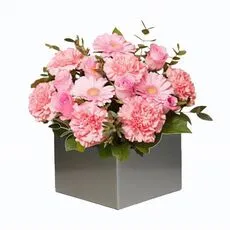 When you want it alive next weekend Rose & Carnation Arrangement $89.95 Same Day Delivery
 The Lily Question
Lilies are the most popular hospital flower and the most problematic. The pollen is a fine orange dust that transfers on contact and bonds with fabric instantly. Hospital bed linen, gowns, hands. Water makes it worse rather than better. And oriental varieties fill a small room with scent in minutes. For someone on post-surgical pain medication, or a new mum whose morning sickness has not quite finished with her, that sweetness tips straight into nausea.
Anna dealt with this every week during her years answering the phones in Pottsville. Someone would call wanting lilies because lilies were their mum's favourite, or because the lily arrangement online looked the nicest. She explained the pollen problem every single time.
If your heart is set on lilies, I'll note on the order that they need to be de-anthered before they go out. But honestly, for the same money I'd recommend roses and lisianthus. They last longer and you won't get a call from the hospital about orange stains on the pillowcase.
About half the callers took the suggestion and switched. The other half wanted lilies anyway, and she made sure the de-anthering note was on the order before it went to the florist.
A hospital group did the arguing for us
For years that was a florist's opinion and you'd be within your rights to discount it. It isn't any more. Every Epworth hospital in Victoria bans lilies by name. Their published reason is the same one Anna gives on the phone, and their phrasing of the mechanism is better than ours: lilies are a known allergen and they carry their pollen on the outside, where roses, carnations and chrysanthemums carry it inside. A hospital group worked its way to the same shortlist as our florist, independently, and then finished the sentence with "all other flowers are welcome."
What de-anthering actually is
The anthers are the little pods in the centre of the lily that hold the pollen. You catch them early, before the sacs split open, and pull them out with your fingers or tweezers. Once that orange dust is loose it stains whatever it touches on contact. Experienced florists do this before the arrangement leaves the shop. Not all of them bother.
And then there's the cat
Everyone talks about lilies in hospitals like the problem is the pollen on the pillowcase. The pillowcase is the small problem. The arrangement does not live in the hospital. The patient carries it out to the car on discharge day and by Friday it is sitting on their kitchen bench.
If there's a cat in that house, a true lily is a kidney-failure risk and there is no antidote. Not just the pollen. The petals, the leaves, the stem, and the vase water will do it on its own. The cat brushes past, grooms its fur, and that is enough. Twenty-four to seventy-two hours and you are into irreversible kidney failure, and the only thing that helps is fluids started before the shutdown begins. The RSPCA treats it as an emergency and so should you.
So I would not take that chance on a house I have never been to. That is not me being dramatic about a flower I do not like. That is me not knowing whether there is a cat.
The bit every other guide stops short of
The arrangement does not live in the hospital
What actually happens to a lily bouquet sent to a ward on a Tuesday.
Tuesday
It arrives on the ward
Everyone worries about the pollen. Orange dust, bonds to linen on contact. A good florist de-anthers it before it leaves the shop. Not all of them bother.
Friday
She's discharged
She carries it out to the car one-handed, along with the bag and the paperwork. This is where every other article on the internet ends.
Friday night
It's on the kitchen bench
In a house you have never been to. Still in its water. The water is now the most dangerous part of the gift.
Any time after that
The cat brushes past
It grooms its own fur. That is the entire exposure. No chewing, no drinking, no contact with the flower at all.
Four of the five steps happen after we stop being involved. Which is exactly why Anna will not send one to a house she has never been to.
What a true lily does to a cat
- Every partPetals, pollen, leaves, stem, and the vase water on its own
- 24 to 72 hrsTo irreversible kidney failure once exposed
- No antidoteOnly fluids, and only if started before shutdown begins
- Grooming is enoughPollen on the fur, licked off. No ingestion of the plant needed.
This is Lilium and Hemerocallis, which means Asiatic, oriental, stargazer, tiger and daylilies. The RSPCA and the ASPCA both classify it as a veterinary emergency rather than a caution.
If a cat has been near lilies, that is a vet trip today, not tomorrow. The window closes before the symptoms are obvious.
Not every "lily" is a lily. Peace lilies and phalaenopsis orchids are not Lilium and carry no kidney risk. They are mildly irritant, which is a different and much smaller problem. The full list is in our guide to flowers that are harmful to pets.
This applies to true lilies, Lilium and Hemerocallis, which includes daylilies. It does not apply to peace lilies or phalaenopsis orchids, which are not lilies at all despite what the names suggest. If you want the full list, our guide to flowers that are harmful to pets covers the rest of them.
The Rest of the Avoid List
Lilies get the headlines. These are the ones that catch people out.
| Flower | Why people send it | What actually happens | Verdict |
|---|---|---|---|
| Stock (Matthiola) | Beautiful scent, good price | Heavy fragrance in an enclosed shared room. Nausea, migraine, and the patient in the next bed cops it too. | Avoid |
| Gardenia, jasmine, hyacinth, tuberose, freesia | They smell lovely at home | Same problem. A ward room has the window shut and no air movement. | Avoid |
| Daffodils | Cheap and cheerful | The sap is an irritant, and it kills every other flower sharing the vase | Avoid |
| Sunflowers | Bright, no scent, reads friendly | Genuinely contested. Florist guides love them for the near-absent scent, allergy sources flag the pollen load. Anna's answer: ask the florist for de-anthered stems and it stops being an argument. | Ask first |
| Anything potted | It lasts, and it goes home | Soil carries Pseudomonas, Aspergillus and Fusarium. Excluded from virtually all clinical areas even where cut flowers are fine. | Ring first |
| Balloons | Cheers the room up, cheap add-on | Latex allergy, and the strings tangle with equipment. Restricted in many paediatric, psychiatric and intensive care settings. | Ring first |
Roughly 18% of Australians have a pollen allergy, and chemotherapy sharpens the nausea response to scent considerably. Which is why the oncology restriction is about more than infection, and why Royal Hobart's advice about strong-smelling flowers is worth taking seriously even on a ward where nobody has told you to.
Anna's Four
Four arrangements, chosen for four different situations rather than four different colours. Every product in our hospital range was put against the same four questions: does the pollen stay inside, is the scent going to fill a shared room, does it need a vase or glass, and how long does it really last in a room at 23 degrees that nobody maintains.
Nothing here is above about $140 and that is deliberate. A two-hundred-dollar arrangement on a forty-centimetre bedside table is a worse gift, not a better one. It gets moved to the floor because there is nowhere to put it, and per the trials, the one on the floor is doing nothing. Small is not the budget option in a hospital. Small is the correct option. Spend the difference on a second delivery in a fortnight if you want to do something.
Anna's answer, in one click
Tell me the situation and I will tell you what to send
These are the six versions of the call I took most often. Pick the one that sounds like yours.
Let the florist decide, and tell them it's a hospital.
It's the only one where the person choosing the stems knows which hospital you're sending to. Tell us it's going to a ward and the florist builds for a ward: low, compact, nothing with pollen on the outside, nothing in glass. People think Florist's Choice means whatever was left in the bucket. For a hospital order it's the opposite. It means the florist gets to avoid the things that will get knocked back at the door.
Soft pink, in a box. Calming, and it lasts.
People reach for blue when the person is frightened rather than just unwell, and the research does say blue and white read as relaxing. Here's the catch nobody tells you: there's barely a true blue flower in the trade, so a blue box leans on delphinium, which is fragile and drops fast in a room nobody maintains. The same research rates soft pink gentle and universally right, and I can send you that in a sturdy box that holds its water. If your heart's set on blue and white, browse those ranges and ask us to keep it to the stems that last.
Carnations. And keep them away from the fruit.
A carnation gives you a fortnight where a rose gives you five days. Waxy petals that shrug off the dry air, pollen inside where it belongs, and the buds keep opening so it fills out in week two. You're getting two acts: the roses do week one and they're what she photographs, the carnations do week two and they're why it's still on the table when you come back on Sunday. Epworth banned lilies across every one of their hospitals and named roses, carnations and chrysanthemums as the ones that are fine. That's a hospital arriving at my list.
Natives. Not as a workaround. They're just better for the job.
Half the hospital calls I took about a man started with an apology. "He'd think it was silly." Woody stems hold their shape without needing to drink the way a gerbera does, which is exactly what you want in a room where nobody changes the water. Two to three weeks and nobody has to touch them. If he's in for a fortnight there's nothing else in the range I'd send. One thing, and it's the only one: no wattle. It'll set off an allergic reaction in a room where that's the last thing anyone needs.
Don't send flowers. Send a card and wait.
Intensive care, burns, haematology, transplant. Those patients have no immune system and there's a fungus in soil and stagnant vase water that does not care how nice your intentions were. That ban is real and I'd never argue it. Calvary Lenah Valley publishes the useful version: not permitted in critical care, but delivered to you once you're on the ward. So the flowers aren't refused, they're early. Wait for the transfer and order then.
Nothing to buy here today. Ring the ward and ask when the patient is likely to move. If you want to send something now, a card gets through where an arrangement won't.
Send it to the house, not the ward.
Two things people get wrong. First, ask which part of maternity, because NICU and the special care nursery sit inside it and they're an absolute no. "She's in maternity" and "the baby's in special care" are completely different orders, and people say the first when they mean the second because they're exhausted. Second, address the card to the mother, not the baby. A newborn has no chart or bed number for the ward clerk to look up. I've seen cards addressed to a newborn go round a hospital for two days.
Probably not the hospital. Most mums are home within 24 hours of a vaginal birth, so day-two flowers sit at reception. And the bedside table is already covered in baby gear. They'll mean more on the kitchen bench. New baby flowers, sent to the house.
Two of those six answers are "don't buy anything from us today." That is not modesty, it is the honest answer to those two calls, and I gave it on the phone for three years.
The four we won't send you
Our hospital range currently has four lily arrangements in it. I would not send you any of them, and I have just spent a section of this page explaining why, so it would be strange of me to stop short of saying it plainly. If you want one anyway, ring us and we will note the de-anthering on the order, the same way I did for the callers who wanted lilies regardless. But I would not choose one.
Three others I'd steer you off. Anything with three roses in a glass vase fails on the glass, fails on the red, and fails on being three stems. The rose and carnation bunch that comes with its own vase has exactly the right flowers in it and then puts them in clear rectangular glass, which is the one vessel I have told you not to send. And a single wrapped rose is a bunch with no vessel at all, which is the whole problem this page is about.
That is seven products in our own range that I would not put on a bedside table. I would rather tell you that than have you find out on a ward.
If price is the constraint rather than the choice, our flowers under $60 range starts at $42.95 and there is nothing wrong with it. A $45 box of bright gerberas on the bedside table does the same job as a $130 showpiece that ends up on the floor because there was nowhere to put it. That isn't a consolation. It is the argument this whole page has been making.
Everything assessed here lives in our hospital flowers range, and delivery is a flat $16.95 anywhere we go.
Anna's Hospital-Proof Arrangement
Every blog post about hospital flowers says the same two things: bright colours, mild scent. Anna's thinking goes further, because she's working through what happens to the arrangement on the bedside table at three in the morning, and then what happens when the patient has to carry it to the car five days later, and then what happens when it gets home.
Send it in its own container
Australian hospitals do not supply vases. Our Townsville partner florist confirmed this years ago and it has held true everywhere since. A hand-tied bouquet without a vase lands on a nurse's desk and becomes somebody else's problem. Finding a jug, cutting the stems, getting water, and then hoping nobody knocks it over. Send a foam-based box arrangement or flowers already in a sturdy container. The foam holds water for days and the whole thing arrives finished.
Never glass
This is not only about breakage, though that's real enough with groggy medicated patients and tables that get bumped. Glass vases and balloon strings are restricted outright in mental health and high-monitoring units, and a glass vase is the thing that goes over when someone needs the IV pole moved at three in the morning. Plastic, ceramic, a lined basket. All fine.
Size it for the table, not for the gesture
Low and compact. If it can't share that bedside surface with a water jug and a phone, it's too big, and too big means it goes on the floor or the windowsill where she can't see it. Which, per Part One, means it's doing nothing at all. This is the one people get wrong most, and they get it wrong by spending more.
Drawn to scale
The showpiece fits the table. It does not fit the table with a jug and a phone on it.
A hospital bedside table, viewed from above, at actual proportions.
- What we send. Low box, own water, sits in the clear strip along the front edge where she can see it from the pillow.
- What people buy. Collides with the jug (1) and the phone (2). Something has to move, and it is not the jug.
So it goes on the floor. And in the trial where the flowers were artificial, the patients still did better, because the mechanism is that the room stops looking like a hospital room. An arrangement behind the visitor's chair is not doing that. It is not doing anything. Which is why a $45 box on the table beats a $130 showpiece on the floor, and why small is the correct answer here rather than the cheap one.
Table dimensions are Anna's estimate from the bench, about forty by thirty-five, near enough. Jug, phone and arrangement footprints are indicative and drawn to the same scale.
Design for the discharge
When the patient goes home they have to carry it out. Someone post-surgery can't manage a heavy glass vase. A new mum has a capsule, a bag, and possibly a wheelchair. A low box or a basket with a handle is something a patient can carry one-handed.
Think about the house it's going to
The chain doesn't end at the ward door. It ends on someone's kitchen bench. Which is where the lily meets the cat, and why Anna's answer to "can I send lilies" is about a house she's never been to rather than about a pillowcase.
When Anna Redesigned for a Cancer Ward
During her years on the phones, Anna had a regular caller, around 2012, who ordered flowers weekly to a cancer ward in Brisbane. The caller's sister was in treatment. Flowers weren't allowed on the ward itself, only in the visitor lounge. So Anna started writing notes on the orders for the partner florist. Handled basket, not a vase, because the family needed to carry it from the lounge to the bed and back again each visit. Natives and chrysanths because they'd last the week between orders and the ward wouldn't complain about the smell. The partner florist ran with it.
That caller ordered for about ten weeks. Anna never asked how the sister was doing. You learn not to on those calls.
What Actually Happens After You Order
This is the bit that worries people most and the bit every florist explains least, so here is the whole chain, including the part where we hand over.
The flowers go to reception, not to the ward. Our florist does not walk through the hospital, and I want to be straight about that because I have seen it claimed. Reception checks the patient is actually admitted and which ward they're on, then the ward clerk takes it at ward level. Flowers and gifts are literally part of a ward clerk's job description. It is not a favour, they do it every day of their working lives. Then a nurse or a volunteer walks it to the bed, and some hospitals run a trolley round for exactly this.
Which is why the ward number matters more than anything else on the order. Without one, the arrangement sits at the front desk and nobody knows whose it is. If you do not have it, ring the switchboard, give the patient's name, and they will tell you. Two minutes on the phone saves the whole order.
Andrew Your order goes, based on postcode, to a partner florist near the hospital. Not a warehouse. A shop where somebody makes the arrangement by hand from flowers sourced at their nearest wholesale market that morning or the day before, and who knows which entrance takes deliveries and when the volunteer desk shuts. We ask for a mobile number on every order and there is a reason for it: patients get discharged early, constantly, and when that happens we ring you and ask for a backup address rather than leaving the flowers to die at a reception desk. That policy exists because we needed it to. The flowers still arrive, they just arrive at the house.
Before you order
Wait until the patient has actually been assigned a ward. Not before admission, not while they're in emergency, not during recovery from surgery. An arrangement ordered too early sits uncollected at reception and that is the single most common way a hospital delivery goes wrong. Have the full name and the ward. Hospitals won't disclose a patient's location to an unknown caller, which is a privacy rule and a good one, so the information needs to come from the family rather than from us.
Our cutoff is 2pm on weekdays and 10am on Saturdays, and we don't deliver Sundays because the wholesale markets shut on Saturday afternoon and fresh stock lands Monday. A Sunday delivery is Friday's flowers with a day and a half of vase life already gone. Anna would rather you waited. And if you're sending to Royal Adelaide, remember visiting doesn't start until 2:30pm, so a 1pm order beats the first visitor through the door.
If you'd rather just tell somebody the situation and let them sort it, ring 1300 360 469. We've heard every version of "I don't know what to choose" and honestly, that's most hospital calls.
Maternity Is Its Own Problem
If you're ordering for a maternity ward, honestly consider waiting until the new parents are home. Maternity stays are short and overwhelming. Most mums are out within 24 hours of a vaginal birth, sometimes three or four days after a caesarean, and that window catches people out constantly. Order for day two and she's gone home by the afternoon, and the flowers sit at reception. I learned to ask every maternity caller the same question: do you know how long she'll be in? Half the time the answer was no, and I'd gently suggest sending them to the house instead. Less romantic. More practical.
They mean more on the kitchen bench anyway, because the bedside table in a maternity room is already covered in baby gear and water bottles and paperwork. I learned that early from a new dad who walked into the Kingscliff shop looking panicked. He'd been staring at the big displays thinking he needed to spend $150 to prove he was happy about the baby. I put together something compact, mostly pale pinks with some greenery, deliberately small because I knew Tweed Hospital maternity rooms were tiny. He spent $55 and his wife loved it.
When someone tells me she's in maternity, I ask which part. Because NICU and the special care nursery sit inside maternity and they are an absolute no. Premature infants have underdeveloped lungs and no immune system to speak of. "She's in maternity" and "the baby's in special care" are two completely different orders and people say the first when they mean the second, because they are exhausted and not thinking about flowers.
And address the card to the mother. Not the baby. The baby does not have a chart, a bed number, or a name the ward clerk can look up. I have seen cards addressed to a newborn go round a hospital for two days.
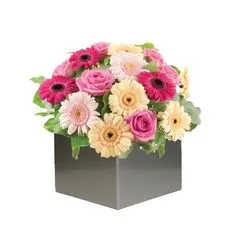 New baby, and probably send it to the house Pastel Gerberas Arrangement $85.75 Same Day Delivery · soft, no lilies, sits in its own box
 More options in new baby flowers and gifts, and the same advice applies to all of them: small, no lilies, no strong scent, and probably the house.
Hospital Flowers: What People Actually Ask Us
Do flowers actually help patients recover?
Yes. Park and Mattson found surgical patients in rooms with flowers used fewer painkillers and had lower blood pressure than controls. Koh's A-FLORA-ACS trial used artificial roses: 6.6% of heart patients met depression criteria at discharge against 24% of controls. The flowers were fake, so the mechanism isn't pollen or scent. It's the room not looking like a hospital room, which is why small and visible beats large and on the floor.
What colour flowers should I send to hospital?
White, if you don't know the person well. A Sheffield study of 670 people rated blue and white most relaxing, orange and yellow most uplifting, and white the only colour scoring highly on both. Blue for someone frightened. Yellow for morale on a long stay. Red reads romantic and is awkward from a colleague. And warm colours take over a mixed bunch: one orange stem turns blue and white bright rather than restful, and it doesn't work in reverse.
Are lilies bad for cats?
Yes, severely. True lilies (Lilium) and daylilies (Hemerocallis) are acutely toxic to cats, including the vase water. Irreversible kidney failure in 24 to 72 hours, no antidote, and a cat can be poisoned grooming pollen off its own fur. The RSPCA treats it as an emergency. The hospital catch: the arrangement goes home with the patient on discharge day. Peace lilies and phalaenopsis orchids aren't true lilies and aren't a kidney risk.
Can I send flowers to a maternity ward?
Usually yes, with no lilies and no strong scent. Two catches. NICU sits inside maternity and is always a no, so ask which one she's in, because exhausted people say "she's in maternity" when they mean the baby is in special care. And address the card to the mother: a newborn has no chart or bed number for the ward clerk to look up. Better still, send it to the house. Most mums are home within 24 hours.
How long will flowers last in a hospital room?
It depends entirely on the stem, because nobody changes that water. At the 20 to 24 degrees a ward runs: chrysanthemum 14 to 24 days, carnation 14 to 21, lisianthus 10 to 17, rose 5 to 8, gerbera realistically 5 to 7. Natives run two to three weeks untouched. Want it standing next weekend? Ask for chrysanthemums or carnations, and keep them away from the fruit. Ripening fruit gives off ethylene, and that's what curls the carnations.
Are flowers allowed in Australian hospitals?
On most wards, yes. General, surgical, rehabilitation, maternity and palliative all normally accept them. Intensive care, burns, haematology, oncology and transplant almost universally refuse, because those patients have no immune system. Every Epworth hospital bans lilies specifically while stating all other flowers are welcome. Ring the ward if you're unsure.
What flowers should I avoid sending to a hospital?
Oriental lilies first: pollen stains linen on contact, the scent turns post-surgical stomachs, and Epworth bans them by name. Gardenia, jasmine, hyacinth, tuberose, freesia and stock are all too strong for an enclosed room. Wattle sets off allergies. Daffodil sap kills every other flower in the vase. And anything potted, because the soil is the infection risk rather than the flower.
Do hospitals provide vases?
No. We've never found one that does. A bouquet with no vase becomes the nurse's problem: finding a jug, cutting stems, fetching water. Send a foam-based box or something already in a sturdy, non-glass container. This is also why the no-flowers signs are more common than the medical evidence justifies. Half the objection is the vase, not the flowers.
Can I send flowers to someone in ICU?
No. Flowers and plants are excluded from intensive care in virtually every Australian hospital, and the same goes for burns, haematology and transplant. The mechanism is Aspergillus, a fungus living in soil and stagnant vase water: healthy lungs clear the spores, a collapsed immune system doesn't. Wait until the patient moves to a general ward. Calvary Lenah Valley says it plainly in their visitor information: not permitted in critical care, delivered to you once you're on the ward.
Why do some wards ban flowers when others don't?
Because there are two different bans wearing the same sign. On ICU, haematology, transplant and burns it's genuinely medical. On a general ward it's usually workflow: spilled water, broken glass, vases where the IV pole needs to go, and somebody has to change that water. The CDC's own guidelines say there's minimal or no evidence that plants raise infection risk in normal patient areas, and the UK health department told the florists' association in 2007 they'd never traced a ward infection to cut flowers. Send a box and most of the general-ward objection disappears.
What size arrangement is right for a hospital room?
Small. A bedside table runs about forty centimetres by thirty-five in Anna's experience and already has a jug and a phone on it. If it can't share that space without getting bumped off at 2am, it's too big, and too big means the floor, where she can't see it. Being seen is the whole mechanism. Small isn't the budget option here. It's the correct one.
Can I send balloons or a potted plant instead?
Ring the ward first for both. Potted means soil, which carries Aspergillus, Pseudomonas and Fusarium, and plants are excluded from clinical areas even where cut flowers are fine. Calvary Lenah Valley asks visitors not to send them at all. Balloons are restricted in many paediatric, psychiatric and ICU settings: latex allergy, and the strings tangle with equipment. Neither is a safe default just because it lasts longer.
What if the patient gets discharged before the flowers arrive?
We ring you for a backup address and deliver there instead, which is why we ask for a mobile on every order. The other half is at your end: only order once the patient has a ward. Never before admission, never while they're in emergency. Ordered too early, it sits uncollected at reception, and that's the most common way a hospital delivery goes wrong.
Why no Sunday delivery?
The wholesale markets shut Saturday afternoon and fresh stock lands Monday. A Sunday delivery is Friday's flowers with a day and a half of vase life already gone, heading into a room where nobody will change the water. Anna would rather you ordered Monday.
Sources
External claims in this guide and where they come from. Everything else is our own call history and delivery experience, and it's attributed to whoever it belongs to.
- Infectious Diseases Society of America. Practice guidelines for the diagnosis and management of aspergillosis. Source of the exclusion of plants and cut flowers from immunocompromised rooms.
- US Centers for Disease Control and Prevention. Guidelines for environmental infection control in health-care facilities. Source of the finding that there is minimal or no evidence that plants in immunocompetent patient-care areas increase infection risk, and that hospital flowers are not more contaminated than flowers elsewhere.
- UK Department of Health, letter to the British Florist Association, 2007. Source of the statement that no healthcare-associated infection had been traced to cut flowers in a ward setting. We are quoting the substance rather than the wording, pending sight of the original.
- Epworth HealthCare, visitor information. Source of the group-wide lily ban, the pollen-outside versus pollen-inside mechanism, and "all other flowers are welcome." Verified 18 July 2026.
- Peter MacCallum Cancer Centre. Source of the exclusion of flowers and plants from patient rooms following stem cell transplant. Verified 18 July 2026.
- Calvary Lenah Valley. Published visitor information: flowers not permitted in Critical Care or Post-Operative Care but delivered to the ward, and the request that visitors not send potted plants.
- Park, S.H. & Mattson, R.H. (2008, 2009). Randomised controlled trial, surgical recovery in rooms with plants and flowers. Analgesic use, blood pressure, heart rate, self-reported pain and anxiety.
- Koh, K.W.L. et al. (2019). A-FLORA-ACS trial. Artificial potted roses in acute coronary syndrome patient rooms; depression at discharge and at three-month follow-up.
- Ali Khan, M. et al. (2016). Greened wards: vital signs, reported pain, opioid analgesic use and length of stay. Supporting evidence only; weaker design than the trials above.
- Ikei, H. et al. (2021). EEG, heart rate variability and skin conductivity responses to red, yellow and white flowers.
- University of Sheffield, Department of Landscape Architecture (2023). Survey of 670 residents across eight flower colours; relaxing and uplifting ratings.
Where our sources disagree, we've said so rather than picking the tidier number. The Park and Mattson percentages are reported differently by two of our reference sources, so we have not published them.
Further Reading
If you've sorted the ward and you're stuck on the arrangement, these are where to go next.
Siobhan and Andrew bought a flower shop in Kingscliff in 2006 and started Lily's Florist in 2009. It's still the two of them, now with more than 800 partner florists across every state and territory. If you're not sure what to send, ring us. Tell us the hospital, the ward and the situation, and we'll sort it out.
See the hospital range
Lily's Florist delivers Australia-wide through a network of 800+ partner florists.
23,000+ verified reviews on our reviews page.
Same-day delivery when you order before 2pm weekdays or 10am Saturdays. Delivery $16.95.
Questions? Ring 1300 360 469
Lily's Florist. ABN 17 830 858 659. [email protected]
Who Wrote What
The floristry on this page is Anna's. The phone calls and the maternity advice are Siobhan's. The delivery network and the current hospital policies are Andrew's. Where we've relied on somebody else's research, it's numbered in the sources above. Read our full story.

Andrew, Ivy, Siobhan and Asha. Hobart, June 2024.

The Kingscliff shop where it started. Lime green walls and all.