
If you have read this far, you have probably already pictured it. Your own shop. Your name over the door. Buckets of stock you actually chose, and a life spent making things people cry over, in the good way. You have probably also had someone tell you not to, an accountant, a parent, or just a small voice at 2am. I know both of those feelings, because we had them at the same time. Before you spend a dollar, here is the honest version, the one we wish someone had handed us.
Hi, my name is Siobhan and I am one of the owners of Lily's Florist. This is my honest take on setting up a florist shop, and I mean honest, not the version you get from a business coach who has never had refrigerated stock die on them overnight. We bought our first flower shop in Kingscliff in 2006 with zero floristry experience, a baby seven months from arriving, and an accountant who looked us in the eye and said do not do it. We did it anyway. Nearly twenty years later, a lot greyer, we run a network of more than 800 partner florists, and I have watched hundreds of people start shops the same way we did, some who made it and some who did not.
So this guide is long, and I make no apology for that. Everything a decent business plan skips over is in here, the tax you will owe, the wages the award sets, the science of what you are actually handling all day, the cash-flow trap that catches people every single Valentine's week. And if you are not starting from scratch at all, if you already run a shop and lie awake wondering whether to change tack or move it online, plenty of this is written for you too. Andrew, my other half and the one who built the systems side of all this, drops in throughout with the numbers and the legal bits, because that is his patch and honestly he is better at it than me (in accounting anyway).
Grab a coffee. This is the whole thing.
The market you are walking into
Before you spend a cent, know what you are buying into. IBISWorld puts flower retailing in Australia at about $1.2 billion, and here is the part nobody puts on the brochure: it is flat. The count grew a little in 2024 and then shrank 1.6 per cent in 2025, and there are roughly 2,807 florist businesses trading. When I started I assumed a whole industry was quietly booming. It is not. What is booming sits inside that flat number, and it is online. The flower delivery slice is forecast to grow around 10 per cent a year while the shopfront side barely moves. So the money is not appearing, it is shifting, and it is shifting toward whoever gets the digital side right.
Who is spending it matters as much as how much. Mother's Day is the giant, about $995 million nationally in 2024, and the year I dug into the numbers flowers were named by 41 per cent of shoppers, up from 27 the year before. Valentine's Day is a $465 million day, and the people who did buy spent more, roughly $135 a head. Weddings are the high end, with the average Australian couple spending around $2,639 on flowers and the elaborate ones running past $15,000. Around 80 per cent of florists sit in New South Wales, Victoria and Queensland, and New South Wales leads the spending. If you are anywhere else, you are working a thinner room, which is not a reason to stop, just a reason to know it.
Koch and Co, who have been in this trade a long time, break the market into rough thirds. Supermarkets take about 30 per cent of flower sales. Online retailers and order-gatherers take about 30 per cent. Independent florists take about 30 per cent, with the last slice going to markets, gifting stores and DIY. Sit with that for a second, because it is the whole competitive picture on one line. You are not fighting other florists for the market. You are fighting Coles, Woolworths and a set of websites that do not own a single bucket, and two of those three thirds barely existed a generation ago.
Two of those three big slices barely existed a generation ago.
One more figure to hold onto while you plan. The average Australian online basket fell to about $95 in the 2025 financial year, the lowest in a decade, according to Australia Post. Cost-of-living is doing its work there, and it means your product and your words have a job to do before anyone reaches checkout: they have to make the case for spending $120 on flowers when the whole country is tightening up. We wrote about the wider spending picture in our 2024 consumer spending analysis if you want the detail.
Pick your legal vehicle first
Before a single bucket of stems gets bought, you have to decide how the business exists at law. We did not think hard enough about this early on, and it is one of the few regrets I would actually name. Three structures cover almost every florist in the country, and the difference between them is basically how much of your own life is on the line if it goes wrong.
| Structure | The upside | The catch |
|---|---|---|
| Sole trader | Cheapest and simplest. Free ABN, trade under your name, report the income on your own tax return. | Unlimited personal liability. If the business is sued or fails, your house and savings are exposed. Fine for testing a concept or a home studio. |
| Partnership | Suits two or more founders sharing the money and the load. Profits flow to each partner's own return. | Still unlimited liability. Without a written agreement, the Partnership Act decides how you split up, and it rarely matches what you actually wanted. |
| Company (Pty Ltd) | Limited liability. The company is its own legal person, so generally you only risk what you put in. Company tax is 25 per cent under $50 million turnover. | More setup and more paperwork through ASIC. Worth it once you hire, sign a lease, or take on real risk. |
A sensible path is to start as a sole trader for speed, then move to a company as the turnover and the risk climb. If you trade under any name that is not your own, you register a business name with ASIC, and that costs $45 for one year or $104 for three. Registering the name does not protect your brand, mind you. Locking your brand against a copycat is a separate trademark job through IP Australia, and I only learned that distinction the annoying way.
Our accountant told us not to buy the shop in 2006. We thought we knew better, which we write about now with a chuckle, because he was mostly right. Here is the version of that lesson worth keeping. The ATO publishes benchmarks built from actual florist tax returns, and if your own projected margins come out miles better than those benchmarks, one of two things is true. Either your numbers are wrong, or you have a genuine edge worth understanding cold. Usually it is the first one. Build the company structure when you start hiring, not after something goes wrong. Retrofitting protection is a worse job than setting it up on day one.
The tax and regulatory checklist
Good news first. There is no florist licence in Australia. Anyone can legally open a flower shop tomorrow, which is a low bar to clear and, honestly, part of why quality is so uneven. The registrations you do need are mostly tax and employment, and they are not optional once you cross the thresholds.
An ABN is free through the Australian Business Register, and you want it before you deal with other businesses. GST registration becomes mandatory once your turnover hits $75,000 a year. Below that it is your call, but registering voluntarily lets you claim the GST back on your wholesale flower purchases, and at roughly 45 cents of cost of sales in the dollar, those credits are not nothing. Once you are registered you lodge a Business Activity Statement each quarter and add 10 per cent to your sales. The moment you employ anyone, PAYG withholding and Single Touch Payroll come into play, which in practice means payroll software reporting every pay run to the ATO.
Then there is super, and this one has teeth from now on.
The superannuation guarantee is 12 per cent of qualifying earnings, and under the new Payday Super rules it must be paid at the same time as wages, not quarterly the way it used to be. For years small florists quietly used that quarterly gap as a short-term cash-flow buffer. From 1 July 2026 the buffer is gone. Even a casual you bring in for a single Mother's Day weekend needs their super paid then and there. If your cash-flow plan still assumes quarterly super, rebuild it before you open, because this is the kind of thing that catches people out in exactly the week they can least afford it.
A few more that people forget. Workers compensation is compulsory for every employer, run through WorkCover in Queensland, icare in New South Wales, and WorkSafe in Victoria. Council permits vary wildly, from use-of-premises approval to signage (which alone can top $1,000 in the Sydney CBD) to footpath-trading licences if your buckets spill onto the pavement. The Australian Business Licence and Information Service is a single tool that lists every permit for your exact business and postcode, and it is worth an hour of your time.
And do not skip the Australian Consumer Law. Flowers have to be of acceptable quality and match their description, which for fresh stems means genuinely fresh with a reasonable vase life. Misleading claims about freshness, origin or species are prohibited. If you sell online, your terms need to spell out what happens when a flower is unavailable and you substitute, when a delivery fails, and what your freshness guarantee actually promises. From what we have seen across the network, substitution and delivery are where nearly every complaint starts, so write those terms like you mean them.
Refrigeration, the non-negotiable
Your flowers are only ever as good as your cold chain, and I mean that without any wiggle room. We learned it fast when the calls started, more than forty a day at the Kingscliff shop, thanks to a Yellow Pages ad the previous owner had taken out right before selling to us. We could not afford air conditioning in the shop either, so for six months of the year it was torture, and the cool room was the only thing between us and a bin full of money.
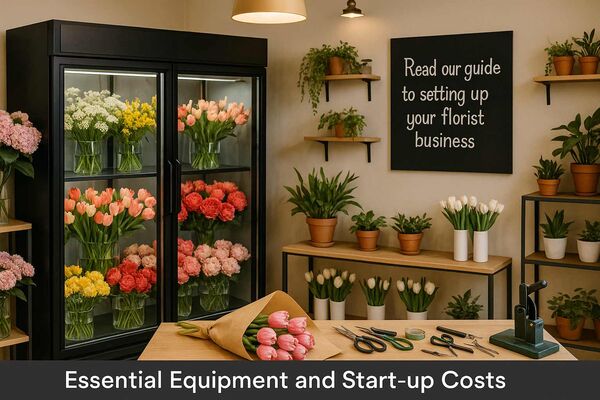
Small display coolers run $3,000 to $8,000. A walk-in cool room, if you are doing any real volume, runs $15,000 to $35,000, and you want a minimum of two metres by two. Portable units for mobile or event work add $2,000 to $8,000. The window you are holding to is 2 to 6 degrees at 75 to 80 per cent humidity. Miss it and you throw stock away daily, which is the fastest way to turn a good week into a bad month.
One thing I did not think about until a partner florist mentioned it, and now I would put it on every checklist: equipment breakdown cover. Treat it as essential, not an add-on. A compressor that quietly dies overnight before Mother's Day can cook thousands of dollars of pre-prepared stock while you sleep, and there is no heroics that gets it back. The message came loudest from our partners in Darwin and Far North Queensland, which makes complete sense given the heat they fight.
The equipment that actually matters
After watching people succeed and fail at this for nearly two decades, here is what you truly need against what someone will happily sell you.
Display and storage
Professional display systems run $1,000 to $8,000. You need bucket display stands, around $130 to $300 for twelve, plus the buckets themselves at $8 to $25 for metal and $5 to $15 for plastic. Budget for fifty to a hundred of them. Mobile display units on wheels are $200 to $800. Storage is not glamorous and nobody photographs it, but wire shelving at $80 to $300 and conditioning trolleys at $150 to $500 are where the good operators quietly invest from the start.
Display systems
$1k to $8k
Bucket stands, individual buckets and mobile units on wheels.
Storage
$230 to $800
Wire shelving and conditioning trolleys. Quietly essential from day one.
Professional tools
$500 to $2k
Sakagen scissors, pruners, florist wire, tape and foam.
Monthly supplies
$500 to $2k
Foam, ribbon, wrapping and vases. Scales straight up with sales.
The tools that pay for themselves
A professional toolkit costs $500 to $2,000. Quality scissors and pruners run $25 to $85 for basics and $45 to $120 for premium Sakagen, florist wire is $8 to $25 a roll, floral tape $3 to $12, and foam a couple of dollars a block (more on foam later, because it turns out to be a bigger topic than it looks). Then there is a workbench and sink at $500 to $3,000, often custom-made, a florist POS with GST and delivery handling at $50 to $300 a month, and an ecommerce site anywhere from $42 a month on Shopify up to $30,000 for a proper custom build. Monthly supplies, foam and wire and ribbon and wrapping, run $500 to $2,000 and scale straight up with your sales.
The real start-up cost breakdown
Based on current rates and what we watched our own partners put in when they started, here is where the money actually lands at each level.
| Model | Setup cost | Best for |
|---|---|---|
| Home studio or market stall | $15,000 to $30,000 | Testing the concept, a part-time start |
| Minimum viable online or delivery | $30,000 to $50,000 | Digital-first, low overhead |
| Mid-range retail shopfront | $70,000 to $150,000 | A residential or local commercial strip |
| Premium retail, full fit-out | $150,000 to $450,000 | A shopping centre or CBD flagship |
The step from a home studio to a shopfront is not a step. It is a cliff.
The hidden costs are the ones that sting because you did not plan for them. Insurance is not optional (there is a whole section on it below). Council permits and registration nibble away. And your bookkeeping and accountancy fees are real unless you are a numbers person, which I am cheerfully not.
I saw the premium end for myself. I was in Sydney one August to watch the Wallabies, and I wandered into one of those top-shelf florists tucked around a corner off the main run. Wow was my first word, honestly. My second thought, standing there, was the sheer stress of it, the rent, the fit-out, the risk of being hidden away like that with a lease that size hanging over you. Beautiful shop. I would not have slept.
There is no middle ground in floristry. You are either profitable or you are dying slowly.Siobhan Thomson, Co-Founder
The ATO numbers that decide it
This is the section I wish someone had shoved under my nose in 2006. The Australian Taxation Office publishes small business benchmarks for florists, built from real tax returns, and they are the most honest picture of this trade you will find anywhere. No spin, because they come from what shops actually declared. I have checked them against our own books more than once over the years, and they hold. Here they are by turnover band.
| Annual turnover | Cost of sales | Total expenses | Labour | Rent |
|---|---|---|---|---|
| $65k to $300k | 40 to 51% (avg 45%) | 68 to 82% (avg 75%) | 13 to 23% | 8 to 14% |
| $300k to $600k | 43 to 50% (avg 47%) | 78 to 88% (avg 83%) | 14 to 22% | 7 to 11% |
| Over $600k | 45 to 53% (avg 49%) | 83 to 91% (avg 87%) | 16 to 23% | 4 to 8% |
Read the top row slowly, because it is the one most new shops live in. At the small end, every dollar of revenue leaves you only 18 to 32 cents of gross margin before a single fixed cost is paid. Once rent, wages and the van come out, the net margin in a typical small florist is often 12 to 17 per cent of turnover. In plain money, that is roughly $10,000 to $50,000 net on turnover in that band. SEEK's salary data backs it up: the average florist earns $65,000 to $75,000 a year, which is about what a well-run small shop throws off as the owner's income. Nobody puts that on the "follow your passion" poster. But get those numbers under control and the same small shop gives you a proper wage and your hours back. A life you actually chose. Modest, and completely real.
Out of every dollar through the till, a small shop keeps about fifteen cents. The rest is already spoken for.
To hit those benchmarks, the pricing has to hold up. The general rule is that stems sell to the customer at three to four times wholesale:
- Fresh stems: three to four times wholesale cost.
- Wrapped bouquet: add 20 to 30 per cent for materials and labour.
- Arrangement in a vessel: add 40 to 60 per cent for the vessel, foam and design time.
- Hard goods: around 2.5 times wholesale cost.
- Keep cost of goods under 35 per cent of retail, and aim for a 50 to 70 per cent margin.
If those multiples do not work in your market, your costs are too high or your prices are too low. There is no third option. The figure I would track weekly, not yearly, is cost of goods as a share of retail. Keep it under 35 per cent and you feel a bad month coming while there is still time to fix it. Let it drift and no amount of turnover saves you, because you are selling a perishable that writes itself off in the bucket. We ran the shop for years before this clicked. Once it did, everything downstream got easier. Run it like a real business and it pays like one. We started with none of the answers and a baby on the way, and it still worked.
Location makes or breaks you
Of every number in this guide, rent is the one I would lie awake over. It varies more than almost any other cost, and it can quietly decide whether the whole thing works before you sell a single stem.
| Location | Approx annual rent per square metre |
|---|---|
| Sydney CBD and inner suburbs | $1,200 to $1,400 |
| Melbourne CBD | $700 to $1,000 |
| Brisbane inner | $500 to $800 |
| Regional and suburban strips | $200 to $400 |
Do the sum before you fall in love with a shopfront. A 60-square-metre shop in the Sydney CBD at $1,300 a metre is about $78,000 a year in base rent alone, before outgoings, which in retail leases usually add another 20 to 40 per cent on top. It becomes a crushing weight on a business that, at $65,000 to $300,000 turnover, might net $10,000 to $50,000 for the year. The rent can eat the whole margin and then some. Before you sign anything, get an independent legal read on the make-good clause (what it costs to restore the place when you leave), the permitted-use wording, and whether it actually covers early-morning deliveries and refrigeration noise. Shopping centres bring the highest foot traffic and the longest list of obligations: centre fees, set trading hours, promotion participation, fit-out standards, and often a base rent plus a slice of your turnover.
Which is exactly why so many good operators go the other way. When we moved from Kingscliff to Pottsville, and then online entirely, we saved thousands a month in rent. Some of our strongest partners run from industrial units with no foot traffic at all and a killer website doing the selling. We learned that the hard way. Our first June in the Kingscliff shop, back in 2007, I watched a Wednesday afternoon go by without one person walking the length of the street, and we took twenty-five dollars for the day, most of it discounted soap. The building drives awareness. It does not, on its own, drive orders.
The business models that work
Traditional shopfront
The highest investment, $120,000 to $210,000, and established customer patterns come with it. You need display fridges, a cool room, a proper fit-out, a POS and real foot traffic. Revenue swings hugely from what I have seen: small shops turn over $65,000 to $300,000, medium ones $300,000 to $600,000, larger ones beyond that. Online florists reach into the millions.
The cheapest way in is a van or a stall. The dearest is a shopfront, several times over.
Online-only
Lower overhead, $30,000 to $87,000 to start, but it lives or dies on digital skill. A website runs $5,000 to $30,000 for proper ecommerce, and a Google Ads budget of roughly $1,000 a month tends to bring in $3,000 to $5,000 if it is run well. A rough steer, not a promise. This is what we became, and it took us years to find the formula. We are still refining it, and it has turned into a science so complex it makes your eyes water.
Mobile and event specialists
Vehicle fit-outs cost $5,000 to $15,000 and portable refrigeration adds $2,000 to $8,000. You chase weddings, corporates and funerals. Higher margins, but the seasons throw you around. A lot of our partners started here before growing.
Home-based studios
The cheapest way in, $15,000 to $30,000, but check your council zoning before anything else. You are limited on signage, foot traffic and staff, and it suits testing the waters or specialising in delivery and events.
Here is why I bang on about zoning. Our first Valentine's Day in the Pottsville home office was 2011, and I was close to nine months pregnant with Ivy and still on the phones. We had two ex-florists, Anna and Will, three others and a couple of friends crammed in. Cars up and down a tiny neighbourhood street, you can picture it. A man from Tweed Council knocked on the garage door, clearly after a complaint, and I opened it to utter chaos, paper everywhere, eight people taking calls like maniacs, desks jammed at every angle. Befuddled does not cover his face. I explained we were online only, not open to the public, and he said thanks and meekly took off. If you plan on customers coming to a home studio, ring your council first.
I will do a follow-up on this down the track, because a florist we know in Casuarina made exactly this move with great success: how to go from owning a shop to running online only.
Where your flowers come from
Australia runs several major fresh-flower markets, and nearly all of them trade in the small hours, which is your first lifestyle adjustment. Sydney Markets at Flemington moves over $150 million a year through 60-odd stand holders, trading roughly 5am to 9am on weekdays. Melbourne's National Flower Centre at Epping serves more than 700 florists across a 67-hectare site. The Brisbane Flower Market sits inside the markets at Rocklea, opening from 4:30am on Monday and Thursday. Flower HQ runs sites in Adelaide, Canberra and across New South Wales and Queensland besides. New accounts usually start on cash terms with a $500 to $1,000 minimum order, and once you have proven you pay, Net 30 to 60 day terms open up, which changes your working capital more than people expect. The big national names to know are Tesselaars, in the trade over 70 years, and Koch and Co, 90-plus years and based in Auburn.
Australia is a net importer of cut flowers, and by a mile. For the year to June 2024, imports ran to $96.7 million against just $9.0 million in exports, with Malaysia, Kenya, Ecuador, Colombia and China leading the source countries, and domestic wholesale supply worth about $404 million (Hort Innovation). Here is the part that connects to your staff's health later on. Imported flowers have to clear one of the strictest biosecurity regimes on earth, run by the Department of Agriculture through the BICON system, and commercial cut flowers undergo pre-export treatment, including devitalisation with chemicals such as glyphosate, to stop anything propagating here. So a bunch that flew in from overseas has, by design, been treated. Hold that thought for the science section.
Staffing, the award, the wages
If you hire, you step into a world of awards and penalty rates, and getting it wrong is expensive. First, a picture of who works in this trade, from Jobs and Skills Australia. There are roughly 5,600 florists employed nationally. About 67 per cent work part-time, which fits the seasonal swings. Around 84 per cent are women, one of the highest rates of any trade. The median age is 46, employment is shrinking by about 300 roles a year, and the workforce is ageing faster than the training pipeline replaces it. What that means for you as an employer is simple and often missed: trained florists are getting harder to find and keep, so retention is not a nicety, it is a survival tactic.
The recognised qualification is the Certificate III in Floristry, and it runs 21 units across design, plant recognition, stock care and sales, offered at TAFEs in every state. There is no licence, so you can hire whoever you like, but the certificate is the standard employers lean on. Wages sit under the General Retail Industry Award, which names florists directly. After the Fair Work Commission's 3.5 per cent rise from 1 July 2025, the minimum rates look like this.
| Classification | Full-time / part-time (hourly) | Casual (hourly) |
|---|---|---|
| Retail Level 1 (entry) | $26.55 | $33.19 |
| Retail Level 2 | $27.16 | $33.95 |
| Retail Level 3 (qualified trade) | $27.58 | $34.48 |
| Retail Level 4 | $28.12 | $35.15 |
| Retail Level 5 (supervisor) | $29.27 | $36.59 |
Then come the penalty rates, and they are the part that blows peak-day budgets. From what employers work to under the award, Saturdays typically run at 125 per cent of the ordinary rate, Sundays 150, and public holidays 250. Valentine's Day and Mother's Day fall in exactly the windows where you are begging for extra hands, so the labour cost has to be modelled into your peak pricing, not discovered afterwards. Super is 12 per cent, paid on payday from 1 July 2026 as noted earlier. And the Right to Disconnect rules, which reached small businesses on 26 August 2025, let staff decline out-of-hours contact unless it is unreasonable, so if you are firing off midnight wedding questions to your florist, you need clear on-call protocols instead.
Run the numbers on a single peak day before it arrives. Five casuals at the Level 3 rate of $34.48 an hour, ten hours each, is $1,724 for the day, and that is before super and any Sunday loading. Add the stock you pre-bought, the fuel, the packaging, and you are a long way out of pocket before the first sale rings up. I have seen good shops turn over a fortune on Valentine's Day and still finish it tight, because they priced the flowers and forgot to price the day. The wages are not the surprise. Forgetting to build them into the price is.
Insurance you cannot skip
A florist without proper cover is one wet floor, one blown compressor, or one delivery prang away from real trouble. This is the standard set of covers, with rough annual costs a Brisbane broker put to us.
| Cover | What it protects against | Approx annual cost |
|---|---|---|
| Public liability ($20M) | A customer slip in the shop, damage at a delivery address, venue incidents | $600 to $1,200 |
| Business package | Fire, theft, storm, contents and business interruption | $1,500 to $3,500 |
| Equipment breakdown | Refrigeration failure and the stock spoilage that follows | $300 to $600 (add-on) |
| Commercial motor | At-fault delivery accidents (personal policies exclude business use) | $1,200 to $2,500 |
| Workers compensation | Employee injuries, mandatory for all employers | Varies by payroll |
These are not abstract. A customer slipping on water dripped from a display bucket and fracturing a wrist can run past $38,000 once you add medical costs, legal defence and settlement. A refrigeration failure before a peak weekend that destroys pre-prepared stock can total $11,500 or more, a figure a Brisbane insurer verified from their own records. And if you take on wedding or event work, confirm in writing that your public liability covers off-site installations at third-party venues, because plenty of standard retail policies quietly exclude it. Venues routinely want a Certificate of Currency before they let you in the door, and some want to be named on the policy.
The science they do not mention
I did not know most of this when we started, and it bothers me that no guide told me. These are real, documented occupational risks, and if you are going to spend your life with your hands in flowers, or ask staff to, you should know them. There is a contradiction here that took me years to sit with. You are selling people the most beautiful thing in the shop, and it is also some of the most heavily treated stock in the country. Both true. I would rather you knew it going in.
Start with pesticides, because it is the one people flinch at. Unlike food, there is no upper limit on pesticide residue in cut flowers, here or anywhere. A peer-reviewed Belgian study of twenty volunteer florists found that those handling large numbers of flowers daily were at real risk of exposure to residues with potential health effects. The Guardian ran a long investigation into it in early 2026. As covered earlier, imported stems arrive treated by biosecurity design. Dr Ian Musgrave, a pharmacologist and toxicologist at the University of Adelaide, recommends gloves as standard practice simply because of the range of chemicals in play, and Safe Work Australia requires employers to keep a register of hazardous chemicals with Safety Data Sheets and provide PPE. A box of nitrile gloves is the cheapest sensible thing you can put on the bench on day one, and I wish we had done it sooner.
The green foam every arrangement seems to sit in is phenol formaldehyde, one of the oldest synthetic plastics, and it contains formaldehyde and phenol. Research by Dr Charlene Trestrail at the University of Technology Sydney found that crushing it creates microplastics that reach waterways, and that phenol leaching from foam in landfill can kill aquatic life. Melbourne florist Rita Feldmann, part of the no-floral-foam network with around 40,000 Instagram followers, put it plainly: the foam is everywhere, supermarkets, races, weddings. Sustainability-minded couples increasingly ask for foam-free work, and the alternatives (chicken wire, floral frogs, moss, compostable bricks) are here now. If you are setting up fresh, going foam-free is both a genuine position and a real point of difference.
Two more that quietly end careers if you ignore them. The physical side is brutal over years: hours standing on hard floors, repetitive wrist work with scissors and wire, and lugging water-filled buckets and stock. WorkSafe expects risk assessments, manual-handling training and tools kept in safe condition, so build that in from the start rather than after someone's back gives out. And allergies are real, not theoretical. Florists commonly develop sensitivity to chrysanthemums, alstroemeria and various latex-heavy species, and sustained daily exposure without protection can build into a sensitisation strong enough to force a change of trade. I have seen it happen to people who loved this work.
Seasonality and cash flow
Floristry is one of the most violently seasonal small businesses there is. The peaks are the whole year compressed into a few weeks, and they will make or break your year in about a fortnight of trading. Valentine's Day brings a 15 to 25 per cent price surge and inventory costs that can triple, on 18-hour days. Mother's Day is the big one, 20 to 30 per cent price rises and that near-$995 million national spend. Wedding season runs September to April at premium prices, and Christmas is a moderate, mostly corporate lift.
The dangerous truth is that a big chunk of your annual money lands in two to four weeks, and you have to run the other forty-eight on what you set aside. Best practice for seasonal businesses is to hold 20 to 30 per cent of peak-season profit in a separate account, enough to cover three to six months of fixed costs, the rent and wages and BAS that turn up whether the shop is busy or dead.
Two weeks make the year. The other fifty are what you plan for.
Say you turn over $20,000 across a single Valentine's weekend. At roughly 45 per cent cost of sales, that is about $9,000 of stock you had to pre-buy, from suppliers who want faster payment during the rush. Five casuals at the Level 3 rate across a ten-hour day is another $1,724, before super and penalty loadings. Fuel, packaging and sundries add $500 to $1,000. So you are $11,000 to $12,000 out the door before you ring up one sale. That has to come from reserves or a pre-arranged overdraft, and the shops that come unstuck on the biggest day of the year are almost always the ones that assumed the sales would fund the day as it went.
I will never forget Valentine's week 2011 in that Pottsville office, eight and a half months pregnant, phones going from 6:30am, friends we had dragged in looking absolutely staggered at what we had built. It works, but only if the money is sitting there first.
The competition, honestly
You already saw the thirds. Here is what each one actually means for you. Coles and Woolworths hold about 30 per cent of flower sales, and the threat is structural, not a passing thing. They have poured money into supply chains and in-store presentation, they get weekly foot traffic no standalone shop can touch, and their offering improves every year. You will not beat them on price, so do not try. Your edge is expertise, customisation, genuine same-day capability, and the emotional weight of getting it right when it matters.
The online order-gatherers are the quieter threat, and I know this one from the inside, because we started inside it. When we bought the Kingscliff shop in 2006 the previous owner had left a Yellow Pages ad running, and the phone rang more than twenty times a day for flowers to towns we did not cover, Taree, Coffs Harbour, even Canberra. The old wire-order way. Think Interflora. The modern version is slicker but the shape is the same. These are sites that collect a customer's order, keep a commission of around 30 per cent, then hand the fulfilment to a florist. A $100 order reaches the shop that actually makes it as roughly $70, and $70 cannot support good product and a profit at the same time. Lean on relay work and you are effectively funding your competitor's marketing while your own name never reaches the customer. If you are already trading and half your orders come through a relay service, this is the first number to run: what you would keep if those customers found you directly.
The relay model is built to commoditise you, and it works because it trains your customer to care about price instead of you. Capture the order directly, through your own site or your Google Business Profile, and you keep all of it, not 70 cents. That is the entire argument for treating digital as a core skill rather than an optional extra. It is also, for what it is worth, why we built our network the way we did, sending each order straight to the florist in that area rather than skimming the middle. Our very first partner, back in 2009, kept the whole order and just added a few extra stems to cover a commission we were up front about. No fee, no haircut, and it is still how the network runs. A trade publication even wrote up that early work when we were still grinding it out from a spare room. We wrote a whole separate guide on turning online attention into actual orders if that is the problem you are trying to solve.
The wedding and events prize
If you have the skill and the nerve, weddings are the highest-value work in the trade. The average couple spends around $2,639 on flowers, but that number hides the ceiling. Full floral styling for a big wedding commonly reaches $15,000 to $20,000 and beyond, and couples typically put 8 to 15 per cent of the whole wedding budget into florals, more like 20 to 30 for the flower-heavy aesthetic with hanging installations and arches. Most established wedding florists set a minimum spend around $4,000, because the consultation, design, logistics and on-site install of a once-in-a-lifetime day demand it.
| Item | Typical price |
|---|---|
| Bridal bouquet | $250 to $400+ |
| Bridesmaid bouquets | $180 to $300 each |
| Ceremony arch or arbour | $800 to $3,000+ |
| Reception centrepieces | $100 to $400 per table |
| Buttonholes | $20 to $40 each |
| Large installations | $2,000 to $8,000+ per feature |
The season runs September to April, busiest in the spring months, so the income arrives unevenly and you manage it with advance bookings and deposits. And you document everything. A wedding contract needs to spell out substitution rights when a specific flower is not available, cancellation and postponement terms, the delivery and install timeline, and the deposit schedule. Weddings are where the money is, and also where a handshake and a good intention will eventually cost you badly.
Sustainability is now expected
Ten years ago barely anyone asked us where the flowers came from. Now it is one of the first questions wedding couples raise, sometimes before the price, and a shop that can honestly say "grown here, picked this week" has an answer the supermarket cannot match. It runs across a few fronts. Locally grown against imported is the big one: domestic supply is worth about $404 million against roughly $96.7 million in imports, and local flowers mean fewer air miles, no mandatory chemical treatment, and often a longer vase life from a shorter chain. It is a story worth telling at the counter, and it justifies a premium honestly.
Native Australian species (banksias, proteas, leucadendrons, billy buttons, wax flowers) keep climbing in demand, and they are drought-tolerant, pesticide-free and unmistakably ours. Sourcing from local growers or native nurseries gives you a supply chain a supermarket cannot copy. Then there is foam, covered in the science section, moving from niche advocacy to something couples now specify. And packaging, where kraft and recycled paper and unwrapped options are quietly replacing single-use plastic, with some venues demanding plastic-free supply outright. Pick the ones you genuinely believe in and build them into how you work, rather than bolting a leaf logo onto the website.
Buy or build, and what it is worth
Buying an existing shop can shortcut the hard part, established customers, supplier accounts, trained staff and a real revenue history. We bought ours, so I am biased, but do the due diligence properly. Ask for the raw POS transaction data for the last 24 months, not the vendor's tidy summary. Check that the peak-period takings are actually what they claim. Confirm the key staff will stay. Get a trades assessment of the refrigeration and equipment, because that is where a nasty surprise hides. Read the lease for remaining term, options and make-good. And confirm the business name, domain and social accounts are included, because I have seen a sale close without them and the buyer inherit a shop with no way to be found online.
On what a florist is worth, three lenses help. The common one for small retail is an earnings multiple: a shop netting $80,000 offered at $240,000 is a 3x multiple, and small employing florists typically trade at 2 to 4 times net profit. The second is asset value, the refrigeration and fit-out and stock at cost plus goodwill. The third is cost to recreate, which sets a ceiling on what a rational buyer pays. Goodwill (the loyal customers, the brand, the systems) is real but hard to keep through a change of hands, and shops with a strong online presence and diversified income across retail, weddings and corporate attract better multiples than a pure foot-traffic shopfront. Franchises are an option too, with brand and system support traded against ongoing fees and less freedom on suppliers, and those agreements want careful legal reading before you sign.
Will you actually survive
You have heard that 90 per cent of small businesses fail in two years. It is wrong, at least for businesses that employ people. The ABS numbers, tracking real cohorts to June 2025, tell a very different story, and they line up with what we have watched across more than 800 partners over the years.
Even the riskiest florist, the solo operator, beats a coin toss over four years.
The risk is sharpest for the sole operator, who has roughly a one-in-two chance of still trading four years on. Bring on staff and the odds improve markedly. Floristry sits close to hospitality on the risk scale, for the same reasons: perishable stock, heavy lease dependence, wild seasonality and thin margins. From nearly twenty years of watching it, here is what actually kills florist businesses, in rough order of how often I have seen it.
- Under-capitalisation. Not enough refrigeration, working capital, or money to fund peak-period stock.
- Foot traffic treated as a business model. A busy street is awareness, not revenue.
- Rent that eats too much of turnover. The lease that looked fine on a good week, not a slow one.
- Underpricing the true cost of labour, especially on peak days.
- Order-gatherer dependency with no plan to win customers directly.
- Poor cold-chain management turning fresh stock into daily waste.
We survived, and I will be honest about why. Not because the original business case was compelling. It was not, our accountant said as much. We survived because we adapted, went digital, and built a network that changed our model entirely. The ones who did not survive largely did not adapt.
Where to start
Starting a florist business in Australia takes real capital, but the opportunity is genuine. The market is worth about $1.2 billion, and the money is moving online fast enough to reward anyone who sets up right. Success comes down to the same handful of things every time: proper refrigeration, strong supplier relationships, enough working capital to ride the peaks, the right legal and tax structure, and a clear-eyed read on your local market and your true costs.
Most of all, be ready for how hard it is. The 18-hour days we pulled in the early years were not unusual, they were the job. But nail your systems and price for your true costs. Look after the people doing the physical and emotional work. Adapt when the market shifts. Do that, and you can build the thing you pictured back at the start of this guide, the shop that becomes the first place the town rings. Our partner in Toowoomba has posted us a hamper on our birthday for more than a decade. A florist in Townsville once told us, plainly, that we had changed her life. The hard years read differently once someone says that to you.
Just remember what our accountant told us in 2006. Don't buy it. We ignored him and built a network of more than 800 florists. He is still our accountant, nineteen years on, and yes, we remind him. Sometimes the best decisions you make are the ones that terrify you at the time.
More from two people who learned this the slow way, the seasons, the numbers, and the trade from the shop floor.
Read more from the Florist LoungeCommon questions
How much does it cost to start a florist business in Australia?
Plan for $15,000 to $450,000 depending on the model. A home studio or market stall runs $15,000 to $30,000, a minimum online operation $30,000 to $50,000, a mid-range retail shopfront $70,000 to $150,000, and a premium fit-out in a shopping centre or CBD $150,000 to $450,000.
Do florists need a licence or qualification in Australia?
There is no florist licence, so anyone can legally trade. The recognised qualification is the Certificate III in Floristry, which most employers look for, but it is not compulsory to operate.
When does a florist have to register for GST?
GST registration is mandatory once annual turnover reaches $75,000. Below that it is optional, but registering voluntarily lets you claim GST credits on wholesale purchases, which matters at roughly 45 per cent cost of sales.
What is the biggest start-up expense?
Refrigeration. Small display coolers run $3,000 to $8,000 and a walk-in cool room $15,000 to $35,000. Flowers need 2 to 6 degrees at 75 to 80 per cent humidity, and getting the cold chain wrong means daily waste.
What are the award wages for florists?
Florists sit under the General Retail Industry Award. As of 1 July 2025, entry Level 1 is $26.55 an hour full-time or $33.19 casual, and qualified-trade Level 3 is $27.58 or $34.48 casual. Saturdays, Sundays and public holidays carry penalty rates.
How much profit does a florist actually make?
The ATO benchmarks show a small shop at $65,000 to $300,000 turnover keeps only 18 to 32 cents in the dollar as gross margin, netting roughly 12 to 17 per cent, or about $10,000 to $50,000. SEEK puts the average florist income at $65,000 to $75,000.
Is floral foam safe to use?
Floral foam is a phenol formaldehyde plastic. UTS research found that crushing it creates microplastics that reach waterways, and phenol leaching in landfill can harm aquatic life. Many florists now work foam-free using chicken wire, floral frogs, moss or compostable alternatives.
Do most florist businesses fail?
The 90 per cent failure claim is a myth. ABS data shows a sole operator has a 56.8 per cent four-year survival rate, while an employing florist with 5 to 19 staff sits at 78.5 per cent. Under-capitalisation and poor cold-chain management are the most common causes of failure.
About the authors
This guide was written by Siobhan Thomson, with the legal, tax and numbers sections from Andrew Thomson. We bought a struggling flower shop in Kingscliff in 2006, taught ourselves the trade, and grew it into a network of more than 800 partner florists. Read our full story.

Andrew, Ivy, Siobhan and Asha. Hobart, June 2024.

Lily's Florist delivers Australia-wide through a network of 800+ partner florists, with 24,204+ verified reviews on our reviews page. Questions about the business? Ring 1300 360 469, 7am to 6pm weekdays, from 10am Saturdays.
Sources
Market size and business counts: IBISWorld Flower Retailing in Australia and IMARC Group. Online delivery growth: Grand View Research (2024 to 2026). Market share thirds and structural threats: Koch and Co. Cost structure benchmarks: ATO Small Business Benchmarks for florists (2023 to 24). Salary: SEEK. Legal structure, consumer law and due diligence: Sprintlaw and business.gov.au. Super and Payday Super: ATO. Award and wage rates: Fair Work Ombudsman, Retail Award MA000004. Workforce data: Jobs and Skills Australia. Import and biosecurity: DAFF and Hort Innovation Horticulture Statistics Handbook. Pesticide exposure: peer-reviewed research (PMC) and The Guardian (2026). Floral foam: University of Technology Sydney research and the Sustainable Floristry Network. Business survival: ABS Business Survival (8165.0). Wedding costs: EasyWeddings and Polka Dot Wedding. Cost ranges, equipment pricing and revenue bands also draw on our own experience in the trade since 2006 and figures reported across the partner network, and are directional rather than guaranteed.