
Here's the thing about running a flower shop in Australia. You're either drowning in Valentine's roses or wondering where your next customer's coming from. Sound familiar?
I get it. Those massive spikes around Valentine's Day and Mother's Day can account for roughly 40% of your annual sales. One Aussie florist told the ABC that Mother's Day alone makes her shop "three, four times busier than normal." These peak moments are absolutely essential, and as she put it, "We need our Valentine's Day and we need our Mother's Day." But wow, those quiet months that follow can really test your nerves and your bank balance.
The reality? If anything disrupts one of these big days, remember when COVID lockdowns hit right on Valentine's 2021 and one grower lost 80% of her stock, the dry spell afterwards becomes even harder to navigate. That said, for all florists the COVID period, especially between April 1 2020 and December 2020 it felt like Mother's Day every day of the week as people were sending flowers in place of seeing friends and family, it was crazy! I recall walking into Brisbane Flower Market one morning and there were more flowers on the ground than there were in the stalls, never, ever, had I ever seen anything like that before. After chatting with one of the staff there, it had been happening day on day, for months.
Seasonality hurts when all your revenue lands in a fortnight and nothing in July. Start by mapping last year's quiet months and adding a small product for the quieter periods, think of things such as workshops or subscription refills that could possibly cushion the drop in flower sales or foot traffic. Think about pairing it up with a lean cash flow plan and those peaks and troughs won't feel so rough. A few focused tweaks beat scrambling twice a year.
The team and I want to walk you through how to turn those famine stretches into something you can plan for. Not two frantic peaks and a lot of holding your breath in between. And I'm not speaking from theory here.
We've Lived The Famine

June 2007 in our little shop on Marine Parade in Kingscliff was brutal. I remember standing at the front door around 3pm on a Wednesday, looking up and down the street, and there was not a single person walking in either direction. Ghost town doesn't even come close. We had maybe $25 in the till for the entire day, and that was probably from someone buying a loaf of organic bread that morning.
The thing that made it worse, or better depending on how you look at it now, was that the phone just kept ringing. Over and over. But it wasn't locals wanting flowers delivered down the road, it was people asking us to send arrangements to Taree, or Townsville, or Canberra. Places we had no way of servicing. So we'd say sorry, we can't help you, and hang up. Then it would ring again. Same story. Sorry, no, we don't deliver there.
Andrew and I sat down that night after closing up, maybe $30 total in takings, exhausted and honestly a bit scared, with the accountant's words still ringing in our ears from months earlier. Don't buy it. But somewhere in that exhaustion, staring at each other across the tiny back room of the shop with our baby asleep in the pram, we started asking a different question. What if we stopped saying no to all those calls?
That moment, that exact famine moment when the till was empty and the street was dead, ended up being the spark for everything Lily's Florist became.
Getting Real About Your Numbers
First up. and yeah, this might not be the fun part, you need to know exactly where your money's going. I am talking about calculating your monthly break even point and mapping out when cash flow typically gets tight (hello, winter months and especially June which stinks). Here is the cruel twist most people outside the trade never see: wholesale prices tend to climb through winter even as customers stop spending, so your worst-selling months are also some of your dearest to buy stock in. The folks over at MM College have written about this too. Your fixed costs do not read the calendar.
Planning is honestly your best bet for maintaining cash flow across the entire year. Start by creating a cash flow forecast using last year's data. Be conservative about those off-peak periods, better to be pleasantly surprised than caught short. We learned that one the expensive way, more than once.
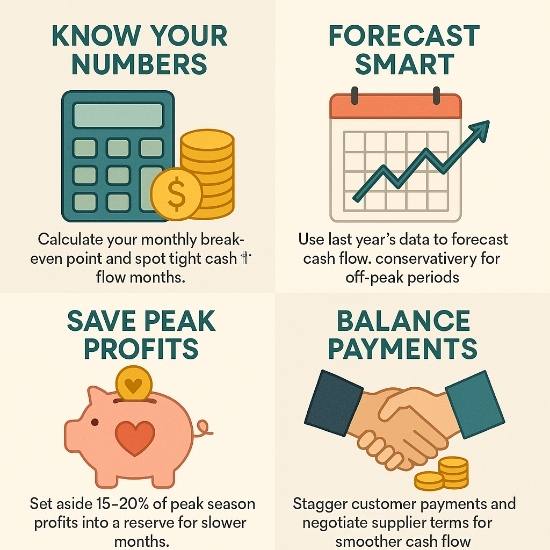
Here's a game changer: when those Valentine's and Mother's Day windfalls hit, resist the urge to spend every dollar. Set aside a chunk of those peak season profits (from my experience thinking 15-20% minimum) into a separate account earmarked for the slower months. Think of it as paying your future self. While this is a topic for a different day, I would do the same for a GST account, just pump a small amount into it every week over the quarter, so you barely notice it, but of 90 days it all adds up. If you GST is less, well beauty, you win!
And speaking of payments, try to spread things out more evenly. If you do weddings, break payments into deposits and progress installments. On the flip side, negotiate with suppliers for extended payment terms during busy periods, and consider prepaying some expenses when you're flush with cash.
Diversifying Your Income From Flower Sales
One of the smartest moves you can make? Stop putting all your eggs in the traditional flower basket.
I will jump in here, because this part is about numbers and I am the numbers one. The flower dollar in Australia now splits about three ways: roughly a third to the supermarkets, a third to online sellers, and a third to florists like you. There are fewer than four thousand flower shops left in the country. And an order that comes in through one of the big online gatherers can reach your bench worth about seventy dollars in the hundred, once they have taken their slice. None of that is meant to scare you off. It is the whole reason a shop that only sells bouquets, and only spikes twice a year, is standing on one leg. Everything Siobhan lists below is the second leg.
Weddings and Events
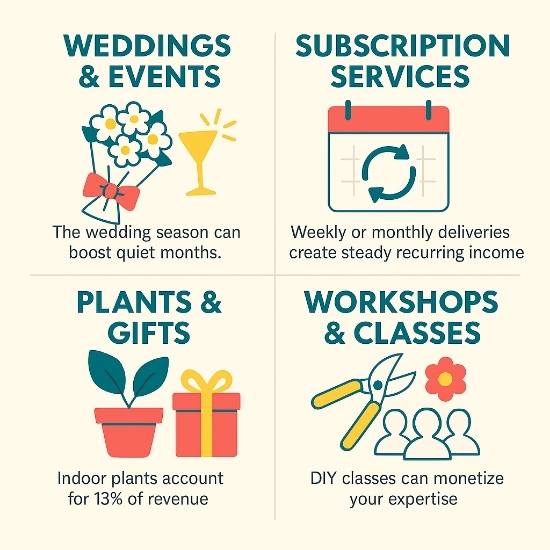
The wedding season often fills those retail gaps beautifully. Spring and early summer can boost what might otherwise be quiet months, and even winter has corporate galas and holiday parties that need florals.
Subscription Services
I love this one. Weekly office arrangements or monthly home deliveries create that steady recurring income regardless of season. Don't be afraid to get on the blower and start ringing local businesses in your area and sell, sell, sell. Always think to yourself, the worst thing that can happen is someone just says 'NO', the best thing is "yes, that would be awesome, thanks for calling...". As Business Victoria suggests, offering subscriptions or memberships can spread income across the year and "flatten" those revenue dips. You could provide incentives for subscribers (like a free vase on the first delivery, or a slight discount compared to one off orders) to encourage sign-ups.
Here is the part that surprised even me. Subscription customers tend to spend three to four times more across a year than one-off buyers (that figure comes from the floral subscription people at Oasis), and the money lands before the flowers do. One small trick that works: do not call it a "subscription" on your website. Some people read that word as a trap they will forget to cancel. "Bloom Club", "Petal Pass", "seasonal flower service", all of it sells better for the exact same thing. And if you want the version that really steadies a winter, let a good customer pre-pay their whole year of gifting. Five arrangements at three hundred dollars, billed at a hundred and twenty five a month on autopay. Twenty five customers on that plan is over three thousand dollars landing every single month, for five deliveries each across the year. That is a wage through June, right there.
Plants and Gifts
Indoor plants, succulents, terrariums, they're having a moment and account for about 13% of Australia's flower retail revenue. They last longer (customers see great value) and have a longer shelf life in your shop. Win-win.
Workshops and Classes
Use your expertise during quiet periods. A "DIY winter arrangement class" or Christmas wreath workshop brings in extra revenue while moving inventory. Plus, people love experiential gifts, you might sell workshop tickets as presents.
Smart Marketing Beyond the Big Days
When Valentine's is a distant memory and Mother's Day feels ages away, it's time to get creative. The goal? Give customers reasons to buy flowers "just because."
Don't overlook smaller occasions, International Women's Day, Easter, Father's Day (yes, flowers for dads!), even quirky celebrations like Christmas in July. One Victorian gift store had such success with their "Christmas in July" event that they temporarily had to close online orders due to demand.
Keep an eye on your local calendar too. Spring garden shows, food festivals, sports finals, these are golden opportunities to set up stalls or create themed bouquets. Align your business calendar with local events like Toowoomba Flower Festival; it's a smart way to stay visible during off-peak periods.
To make that concrete, here is the year I actually plan around. Not two big days and a lot of hoping in between, but a reason to pick up the stems in most months of it.
The florist's year, month by month
Twelve reasons to pick up the stems, not two. The pink months are the giants, the teal months are the winter bump, the rest is steady work if you go looking for it.
- The two-and-a-bit peaks
- The winter bump
- Steady, if you work it
The online side is Andrew's patch, not mine. He taught himself all of this back in 2007, while I was up to my elbows in flower buckets, so I'll let him take the next few.
Online Sales and Delivery Reach
Andrew here again. If you're only selling through your brick-and-mortar storefront, diversifying might mean expanding online. Setting up an online ordering system can help capture sales beyond foot traffic. For instance, some rural florists join platforms like Buy From The Bush to reach customers looking to support regional businesses. Online channels can generate orders even when your physical shop might be quiet. Just ensure you manage delivery logistics and quality carefully to maintain your reputation if you expand your reach.
Build Location Pages
If you have an existing online store servicing flowers to just your immediate area, you may want to consider expanding your reach by making florist location landing pages, I wrote a very honest, and very high-level article recently on this that I highly recommend you read, I can assure you that nobody, not any SEO anywhere, has anything like the details I provided on how to do this. But to summarise that article, if your florist shop is in Bondi and for the last 10 years you have only every sent flowers to Bondi, you are missing out. For your standard delivery fee, you could be delivering in a much larger radius around your shop, like to within 10 kilometres, or even more if you have dynamic pricing on your website based on postcode.
We applied this 'Evergreen' logic to suburbs where we knew people needed a reliable local hand. For example, our pages for Ashbury and Dural were built specifically to help people find real florists instead of warehouse boxes.
And if you are wondering whether this works when you do not have a shop on that street, it does. We have never set foot in half the suburbs we deliver to. The partner florist network carries it. A Canberra florist who leaned into suburb pages and their Google listing was reported to have moved from page three to page one of search inside ninety days, with foot traffic up around forty per cent off the back of it (that one is a Canberra digital marketing team's case study, not ours, but it matches what we have watched happen over and over). Google is not checking whether you have a shopfront on that street. It is checking whether your page is genuinely useful to the person searching. Be useful and honest about where you can actually deliver, and it works.
Onsite Flower Categories
From my 17 years in the flower game, mostly in the marketing side of things, this is the single most overlooked, untapped, side of most florist businesses that simply should be pushed. For consistency, let's go back to the Bondi example.
Also note, I will be doing an article that goes into much greater detail on this later this month, so stay tuned in our Florist Lounge.
So in brief, typical website structure I would see for a local florist shop in Bondi is: Homepage, Birthdays, Funerals, Bouquets, Arrangements, New Baby's.
You job, is to try to capture other searches outside of the big peaks. Think about expanding your categories to ones like: Hospital Flowers, 60th Birthday Flowers, Graduation Flowers or even Flowers for Job Promotions. This way, you may start to acquire, over time, traffic from people who are looking to send flowers for searches outside the norm, I like to call them 'evergreen categories', that is, categories that can provide income all year round and that are not seasonal.
The categories most florist sites are missing
The usual menu chases the same seasonal peaks everyone else does. Evergreen categories quietly pull orders in the flat months.
The usual set
Peaks everyone competes for
- Birthdays
- Funerals
- Bouquets
- Arrangements
- New Baby
Evergreen categories
Traffic all year round
- Hospital Flowers
- 60th Birthday Flowers
- Graduation Flowers
- Flowers for Job Promotions
- Get Well & Thinking of You
Most shops stop at the left column. The orders in your quiet months live in the right one, searches that are not tied to a single date on the calendar.
Promotional Strategy Performance Analysis
Effectiveness scores based on customer engagement and ROI metrics
The Feast Hits Different When You're Ready For It
Valentine's Day 2011. I was 8.5 months pregnant with Ivy, our second daughter, and we had converted our double garage in Pottsville into a proper office by then. Two permanent desks had become six, and for that week we had dragged in two extra temporary desks and planted a couple of friends there to help answer phones. These were friends who had a vague idea of what we did. Something about flowers, they probably thought, how busy could it get?
From about 6.30am on the Monday of Valentine's week, the phones exploded. Not busy. Exploded. Every line ringing constantly, orders coming through the website faster than we could process them, the fax machine spitting out confirmations to partner florists like it was possessed. It did not stop. Not for a lunch break, not for a breather, not for anything.
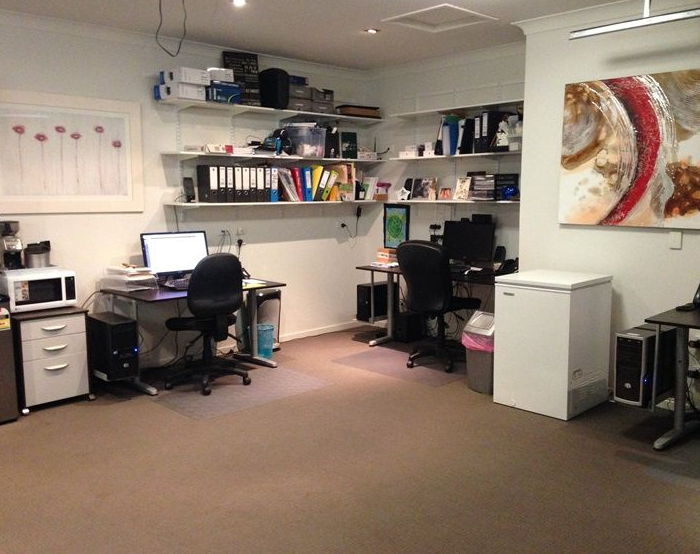
By the end of that week, I genuinely thought I might go into labour right there at my desk from the sheer intensity of it. Our friends who had come to help looked absolutely shell shocked. Bedraggled. Spent. One of them, Jody, turned to us on that Friday afternoon and said something I'll never forget. "OMG, what have you created?"
OMG, what have you created?Jody, a friend roped in to help, Valentine's week 2011
The feast, when it comes, is relentless. But the only reason we survived that Valentine's week was because we had used the quiet months before it to build systems, train people, expand our florist network, and frankly just prepare for the onslaught. If we had walked into that week with the same setup we had 12 months earlier, it would have broken us.
The Mysterious July to August Bump
I know right, or as my 14 year old likes to type on SnapChat, IKR. What the heck is the 'mysterious July to August bump' We've all seen it, felt it, and we have all thought, at least at some point, what is it, where did it come from. Or, if you have 'been asleep at the wheel', perhaps you have no idea what I am talking about.
Historically, from my experience, November is the worst month of the year in terms of flowers sales, closely followed by June, sometimes they switch. But then, by some form of miracle, something usually swings in mid-July and the sales bump happens and gathers even more momentum in early August and powers through to early September.
But why?
Looking through and analysing the data, it's almost like clockwork, year on year, and the only explanation is this: Tax returns are rolling in, and new financial year optimism. There is no feasible other explanation. So, be prepared, embrace it, acknowledge it, staff for it and plan for it.
A florist's year, in one line
Typical monthly order volume across a trading year, indexed to the busiest month at 100. Directional, from our own order data.
- The two giants. Valentine's Day and Mother's Day can be 40% of the year in a couple of fortnights.
- The floor. November is usually the weakest month, June close behind.
- The bump. Orders swing up from mid-July and carry through August into early September.
Tools That Make Life Easier
If the word "software" makes your eyes glaze over, you are in good company. I put this off for years. But a few tools genuinely hand you time back, and time is the one thing the quiet months are meant to give you.
Accounting software like Xero, MYOB or QuickBooks plugs into your bank and does the reconciling you would otherwise be doing by hand at ten o'clock at night. That is the boring one. Worth it anyway.
The one that actually moves the needle for a florist is inventory, because you are buying things that die. Flower shops have been found to lose around twenty hours a week to managing stock, a figure the automation crowd like to quote, and it sounds about right to anyone who has done a Monday market run on no sleep. A florist-specific POS that tracks what sells and flags what to reorder turns a chunk of that guesswork, and a chunk of that bin, into a number you can actually trust.
The other one worth a look is anything that quietly remembers your customers' dates. A nudge that a regular's wife has a birthday in ten days, sent to him before he has even realised, is an order a competitor can never win, because they do not know the date exists. That is not clever marketing. It is just remembering, at scale.
Don't forget about government support either. The Grant Finder tool on business.gov.au can help you find funding for everything from digital upgrades to energy-efficient fridges. Even if you don't score a grant, these sites offer heaps of free resources and templates.
Using the Quiet Time Wisely
One more "resource" to mention is time. When you're not slammed with Valentine's, Mother's Day or Christmas orders, use that downtime productively. It's an opportunity to work on your business (planning, organising, learning) rather than in the day to day rush. Tidy up your workspaces, update your website, update your socials, refine your pricing strategy, train your staff, or even take a well deserved break to recharge yourself for the next peak.
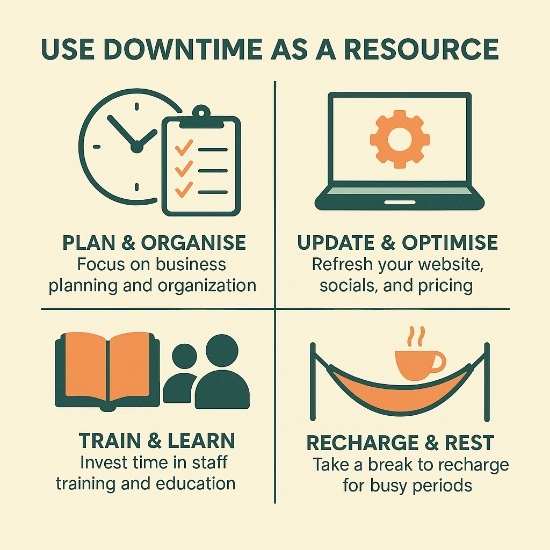
Try and think of the off season as a valuable resource in itself. it's when you can set aside some time lay the groundwork that will make the next feast period even more successful and the famine potentially less painful, especially if you take some of my suggestions on board. Many savvy florists I have bumped into since 2008, treat the slow months as their time for strategy and maintenance, ensuring they emerge each season stronger and more prepared.
Building Partnerships When Things Are Quiet
I'm going to hand this next one straight to Andrew, because it is his story to tell. His drive, his sweaty palms, his broken trinket to pay for. Over to him.
So, Andrew here. One blisteringly hot summer day in early 2009, with the shop still struggling, I packed our daughter Asha into the car seat and drove the 25 minutes west to Bray Park, just outside Murwillumbah. My mission was to visit a florist in Murwillumbah called The Flower Shed and somehow convince the owner to help us with our flower orders.
I rehearsed what I was going to say the entire drive. Over and over. Siobhan and I had workshopped it for days. But pulling into the car park, sweating from the heat and nerves, I had serious doubts. What would she say? Was this even a thing people did? Would she laugh me out the door? We were not florists, we barely knew what we were doing, and here I was about to pitch some half baked partnership idea to a proper professional.
I grabbed Asha from the back seat and walked in. Now here's the thing about babies, they break the ice whether you want them to or not. I put her down on the floor of the shop so I could talk to the owner, and within about 30 seconds she had pulled herself upright using one of the display stands and yanked an ornament off the shelf. Smashed it on the floor. Pieces everywhere.
So there I was, face red, apologising profusely, offering to pay for the broken gift, and then somehow mumbling through my pitch. We would send her orders, no fees, just add a few extra flowers to cover our small commission. She smiled and said yes. Just like that.
That single conversation, born out of desperation and a broken trinket, became the model for our entire business. The quiet periods are when you have time to pick up the phone, drive to meet someone, have the conversations that would be impossible during Valentine's week. Use them.
The Bottom Line
The feast or famine cycle doesn't have to control your business and please, don't let it. By planning ahead financially, diversifying your products both in store and on your website, and marketing creatively year round, taking charge and staying on top of your social media presence, you can build something much steadier and more sustainable throughout the flatter periods of the year.
Use those quiet periods wisely. They are perfect for working on strategy, updating your website, training your staff, or simply recharging for the next busy season.
Remember, you already know how to bring joy through your creations. With these business tactics, you can ensure that joy (and revenue) isn't confined to just two dates on the calendar.
Here's to a year that earns in the flat months, not just the loud ones. Map your quiet season before it turns up. Your future self, the one standing at the front door on an empty Wednesday, will thank you for it.
Feast or Famine FAQ
How do I manage the "Wednesday afternoon anxiety" when the shop is empty?
I used to spend it all on new equipment or fancy vases, but I learned the hard way that you need a 'winter fund.' Now, I tell everyone: set aside 15-20% of your Mother's Day and Valentine's profit into a separate account. Think of it as paying your future self so you don't have to sweat the June slump.
I'm a florist, not a numbers person. Where do I even start with a "break-even point"?
Forget the fancy accounting terms. Your break even is just one number. How much do you need to take each week to cover rent, wages, utilities, stock, and keep the lights on? Add it all up, divide by four, that's your weekly target. Write it on a sticky note and put it somewhere you'll see it. Once you know that number, the quiet weeks feel less scary because you know exactly what you're working towards.
I feel like I'm "bothering" people if I call local businesses. How do I get past that?
I used to think the same thing. But here's what shifted it for me. You're not asking for a favour, you're offering to make their reception desk look better and their staff feel appreciated. The worst they can say is no thanks. That's it. No one has ever yelled at me for offering flowers. Ring ten local businesses this week. You might get eight rejections and two yeses. Those two yeses could be worth hundreds a month in recurring revenue.
Will location pages actually work if I don't have a physical shop in that suburb?
Yes. We built Lily's Florist on this exact model. We started with one shop in Kingscliff and now deliver through over 800 partner florists across Australia, all from location pages targeting suburbs we've never set foot in. The key is being honest about your delivery radius and making sure you can actually service the area. Google cares about relevance and usefulness, not whether you have a shopfront on that specific street.
How do I find the energy to "work on the business" when the peak season has left me totally spent?
You don't. Not straight away. Give yourself a week or two to recover first, genuinely recover, not just collapse in front of Netflix feeling guilty about all the things you should be doing. Then pick one small task. Just one. Maybe it's updating your homepage banner or writing a single new product description. The quiet months are long enough that you don't need to do everything in the first week. Pace yourself and the momentum will build.

Lily's Florist delivers Australia-wide through a network of 800+ partner florists, with 24,204+ verified reviews on our reviews page. Questions about the business? Ring 1300 360 469, 7am to 6pm weekdays, from 10am Saturdays.
Sources
Market size and growth (approx USD 811 million in 2026, growing to nearly USD 990 million by 2031): Mordor Intelligence, Australia Floriculture Market (2026). Three-way market split and the sub-4,000 shop count: Koch & Co, industry commentary. Winter wholesale prices rising through the off-peak: MM College (Gregory Milner). Subscription customers spending three to four times more annually: Oasis Floral Products. Production by state figures: Australian Horticulture Statistics Handbook, Hort Innovation (2024-25). Location-page and local SEO results, including the Canberra page-three-to-page-one case study: Canberra digital marketing (Mulwaree Online) and Flowerstoreinabox geo-targeting guidance. Inventory time burden (around twenty hours a week): florist automation and CRM vendor estimates. Seasonal small-business strategy: Business Victoria, 6 Seasonal Strategies for Small Businesses (2025). Regional online reach: Buy From The Bush. Government support: Grant Finder, business.gov.au. Peak-season demand and Mother's Day trade: ABC News interviews with Australian florists. COVID-era flower market disruption: first-hand account, Brisbane Flower Market (2020). External figures are attributed to their source and are directional, not guarantees. Break-even, cash-flow, the July to August tax-return bump, and the evergreen-category logic draw on Lily's Florist in-house order data across seventeen years of trading.