
Cart is empty
 Shop By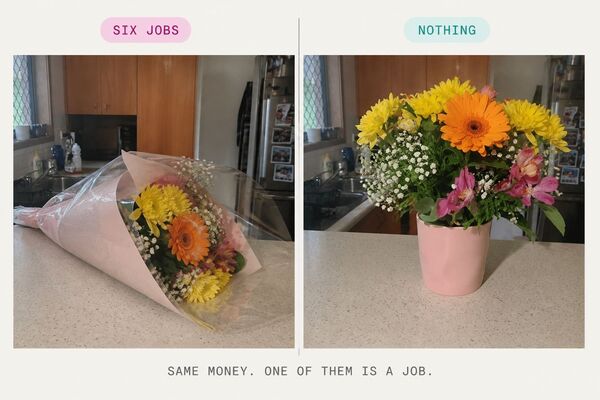

Kellie sent us a photograph of a pink pot on a kitchen bench. Yellow daisy chrysanthemums, one orange gerbera doing all the shouting, a pink disbud the size of a fist, orchids, and gypsophila that had travelled packed tight. Her review ran to thirteen words. One of them was thank you.
Her aunt had come through surgery and Kellie was somewhere else, which is the part I understand best, because you order flowers at the exact moment you would give anything to be in that kitchen making the tea yourself, so you send a thing to stand in for you and then sit at home wondering whether it did the job. Look at the bench in that photo. The cellophane on the floor, the scissors, the ten minutes at the sink that somebody has to find: all of it missing. It landed and it was finished.
We have sold both formats since 2009 and I will not pretend the pot wins every time, because it does not. It wins on the single measure that counts when the person is home, sore and on their own until someone knocks off work. Which, when you sent it from three states away, is about the only thing you actually control.
Flowers do not mend anything. You know that, and so does whoever opens the door. What they do is sit in the room and say the thing you would be saying if you were standing in it.
The evidence
"The flowers were beautiful and cheered my Aunt up after surgery thank you"
Kellie D, QLD · read it on ProductReview.com.au
01
The first hour home is the whole problem
A wrapped bouquet is a kit. Someone has to assemble it, and after surgery that someone is usually the patient. Six separate jobs, and the one people skip is stripping every leaf that would otherwise sit under the water and rot, which is why the water clouds by Thursday. The last of them is getting the finished thing safely onto a bench that already holds a pill organiser, a water glass and a discharge sheet.
Picture who is doing it. Somebody two days out of a ward, told not to lift and told not to reach up. In most houses I have been in the vases live in the top cupboard, and a filled 30cm vase runs close to three kilos.
There is a step before all of that and senders forget it: someone has to answer the door. A person moving at half speed is slow to it, and a driver who gets no answer leaves the flowers wherever looks sheltered, which on a west-facing porch in February is a long way from safe. Put a mobile in the delivery notes so the driver can ring instead of knocking twice.
Then the bunch stays where it landed, in its wrapping. It was the ending I heard most often on the phones: the flowers were lovely, they just did not get into water until the daughter came round after work on the Wednesday.
Andrew Thomson
Co-founderDrove the deliveries himself in 2008
I made this exact mistake myself, in 2008, and the woman on reception had to explain it to me.
We had an order for John Flynn at Tugun and I chose the wrapped bunch, because at that money it looked like more flowers and I thought I was doing the customer a favour. Drove it up from Kingscliff with Asha on one arm, which is how I did most things that year. Handed the bunch over at the desk with the other.
She looked at the bunch, then at me, and asked what she was meant to put it in. I had nothing. She went off and found a jug.
A hospital at least has somebody on a desk who can go and find a jug. A house has whoever gets home at five.
Anna
Qualified florist15 years on the bench
Look at what the florist put in that pot. Chrysanthemums and a disbud for the body, one gerbera to carry the eye, orchids for the delicate bit, gyp to fill. The gerbera will be the first of them to go, which is a separate conversation. Every one of those holds for a fortnight and none of them shouts. Whoever built it was picturing a room someone is stuck in for a fortnight, and they were right to. Colour and volume are what land first, in that order. Nobody has ever thanked a florist for the spiral in the binding. Worth knowing about the gyp: it is almost all imported and it ships compressed and dry, so it can look flat for a day before it opens out.
I built these for years, so here is what sits under the flowers. A brick of phenolic foam, dropped in a bucket and left to sink under its own weight instead of pushed down, then cut to sit below the rim. Stems go in short. No loose water to slop about, which is why it arrives upright and why nothing in it needs a pair of scissors.
It holds less water than the vase you would have used, and that is the trade. Pour water in at the edge every second day until it stops taking it, since a brick that dries right out will not take water back. It goes water repellent, the next pour runs round the outside and out the bottom, and the stems above it are going by then.
One caveat
Two trials get quoted in flower advertising, both by Park and Mattson, both with 90 patients: appendectomy in 2008,1 hemorrhoidectomy in 2009.2 In both, the group with greenery in the room took less pain medication and rated their pain, anxiety and fatigue lower. Read them before quoting them, because both used potted plants and the researchers preferred plants to cut flowers for lasting longer. Koh and colleagues went further in 2019 and put artificial potted roses in the rooms of heart attack patients: 6.6 per cent met the criteria for depression at discharge against 24 per cent of controls.3 Whatever is doing the work there, freshness is not it.
02
Potted means two different things
One of them has soil in it. The difference is academic in a kitchen and it decides the answer on a ward.
There is no soil anywhere in Kellie's pot. A potted plant has roots and a bag of dirt in it; a pot arrangement is cut stems in soaked foam inside a ceramic container. Both get called potted by the person ordering, which is how people end up with the wrong one.
If the surgery has not happened yet, get that difference straight before you order flowers to a hospital. Epworth publishes its rule in plain English: no lilies into any of their hospitals, because the pollen is a known allergen, and everything else is welcome.5 Calvary Lenah Valley in Hobart answers the other half, asking visitors to skip potted plants because soil "can contain infectious substances", while cut flowers go through to the ward.6
Anna
Qualified floristStems and construction
Soil is the thing wards are wary of, and the risk runs through the lungs, not the wound. It holds Aspergillus, a mould that leaves you and me alone and can put someone with a wrecked immune system on a ventilator. It is why the wards treating those patients tend to refuse anything organic at all. On a general surgical ward the picture is calmer than most people assume, and the infection-control guidance is that cut flowers there are no more of a problem than the ones on a restaurant table. From what our florists have seen, a ceramic pot of cut stems goes through the same way a vase does.
Lilies are the separate question and the pollen is the whole of it. It sits out on the stamens where it can move, lands on a sleeve, and travels to the next room on somebody else's clothes. Roses, carnations, gerberas and chrysanths hold theirs in tight. If they have their heart set on the lily look, ask for a pollen-free Asiatic or a roselily, bred with no anthers at all. The florist has to be told. It is nobody's default.
03
Where the pot wins, and what it costs you
What each format leaves for whoever opens the door
Doorbell to display, six jobs Format Unwrap Container Fill it Cut stems Leaves Move safely Verdict
Pot arrangement
foam, ceramic Done on arrival Done on arrival Done on arrival Done on arrival Done on arrival Done on arrival Nothing
foam, ceramic Done on arrival Done on arrival Done on arrival Done on arrival Done on arrival Done on arrival Nothing
Vase arrangement
glass, loose water Done on arrival Done on arrival Done on arrival Done on arrival Done on arrival Left to them One job
glass, loose water Done on arrival Done on arrival Done on arrival Done on arrival Done on arrival Left to them One job
Wrapped bouquet
paper, hand tied Left to them Left to them Left to them Left to them Left to them Left to them Six jobs
paper, hand tied Left to them Left to them Left to them Left to them Left to them Left to them Six jobs
- Done before it arrives
- Left to them
A filled glass vase is close to three kilos and it slops, which is why moving it counts as a job. All three want topping up after a few days, and only the pot takes water at the edge with nothing lifted.
Now the costs, and there are three. You pay for the ceramic, so at the same money a wrapped bunch carries more stems, since the container is on the bill for a pot or vase arrangement and a bunch has none to pay for. The foam fixes the shape on day one, so nothing can be re-cut as stems tire. And the pot lives on in a cupboard afterwards whether anybody wanted a pink pot or not.
For someone well, mobile and fond of the fifteen minutes with the good scissors, the wrapped bunch is the better gift. Send that and enjoy being right.
Anna
Qualified floristThe part that undercuts me
There is a fourth cost and it is mine to own, because it argues against my own advice. The gerbera is the neediest stem in that pot. Hollow stem, so bacteria block the plumbing faster than anything else in there, and the fix is to lift it out and cut two centimetres off the bottom. In foam you cannot. If a gerbera drops its head around day eight, that is a gerbera doing what gerberas do, and the rest carries on without it.
Same with the water. I have just told you to top the foam up every second day, and the entire reason you are sending a pot is that the person receiving it struggles with jobs like that. So do not hand them the instruction. Put it in the card, or tell whoever is calling in on Thursday. The person you are buying this for is the person least able to look after it, and pretending otherwise helps nobody.
Andrew Thomson
Co-founderTook the calls 2006 to 2013
A bloke rang in 2012, a week out from Christmas, then we were still at our home office in Pottsville, wanting to know why the pot he had sent his mum had fewer flowers in it than the supermarket bunch his sister took round for half the money. Fair question. He was right about the stem count and I told him so. Y
The other half is the photograph. We shoot the premium size and run it as the default image, and as far as I can tell so does most of the industry. On a pot it catches people out worse than anything else we sell, since the container takes up frame the stems would otherwise fill.
He rang back after the weekend. His mum had a knee done in the November and could not stand at the sink. The pot was on the table. The bunch was in the sink.
The person you are buying this for is the person least able to look after it.Anna · Qualified florist
04
What to send, and where to put it
One sort before the list. If the news was good and the recovery is routine, go bright, because that is what the moment is. If the pathology is still coming and nobody is saying much, go quieter: soft colour, low scent, nothing that arrives shouting. The format below holds for both. Only the register moves.
Then the order of operations, most decisive first.
Decisive
Format before flowers. A pot or a vase, and a wrapped bunch only when someone else is in the house to deal with it.
Decisive
Say where to stand it, on the card. Away from the fruit bowl first: ripening bananas and apples give off ethylene, and same-room proximity is enough to bring a mixed arrangement forward by days. Out of the sun second, because respiration roughly doubles for every ten degrees. A pot that gives a fortnight in a cool room gives about half that in a room sitting at 28, which is most Australian houses between November and March with the air off.
Major
Ask about chrysanthemums before you send them. Toughest and longest-holding stem in Kellie's pot, best value on the bench, and also funeral flowers in Chinese culture and cemetery flowers in Italian culture, where sending them to a sick relative reads as something you never meant.
Major
Go warm. Yellow and red flowers measure better than white on relaxation and mood,4 which is an argument for the yellow end of the range that most senders never hear, when instinct says pastel for illness. Kellie's aunt got yellow and orange, which was the right call whether or not anybody in that transaction knew why.
Major
Keep the scent down, and name the alternative rather than just the exclusions. Post-operative nausea is common enough that a heavy perfume in a small bedroom is no kindness, so skip stargazers, freesias, tuberose. Lisianthus, alstroemeria and the daisy family carry almost no fragrance and hold for a fortnight.
Minor
Size it for a bedside table, not a hall table. Low and front facing, because it reads from a pillow and shares the surface with a water jug and a box of tablets.
Anna
Qualified floristIf you want one answer
If you would rather I just picked, here it is. An arrangement in a box or a pot, mixed instead of all one stem, somewhere around eighty dollars. The Starburst is the closest thing we sell to what Kellie's aunt got, and it is the one I would send.
Mixed matters more than people think: when one stem gives up at day eight, the rest of the box does not go with it. Every line on that list is worth asking for, and a florist reads the delivery instructions before they start building.
If you would rather not choose at all, the Deal Of The Day Arrangement hands it over entirely. On a recovery order that means the florist builds from whatever came in freshest that morning, so you get the best stems in the bucket instead of the ones that match a photograph shot two seasons ago. It costs less than people expect it to.
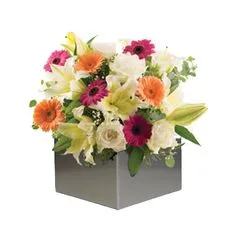
Starburst Arrangement
$83.95 · box and foam · no vase neededGerberas and roses carrying the warm end of the palette, set in soaked foam inside a box, which is the format this whole page has been arguing for. It arrives finished and it goes straight onto the bedside table.
There are lily stems in it. If the room is small or you would rather not think about pollen at all, write "no lilies please" in the delivery instructions and the florist will build it without them.
See the Starburst ArrangementOn the card, write less than feels right. "No hurry. Sleep in." does more than a paragraph and asks nothing back from a person in no state to answer. If you want to offer help, offer one specific thing with a day on it, because "let me know if you need anything" quietly makes the sick person do the asking.
Flowers that are finished when they get there
Ours go out in a container with the water already in it, built that morning by a florist near them, from stems that were in a cool room at 4am rather than in a box since Tuesday. From $42.95 plus $16.95 delivery, and the middle of that range is where most recovery orders land. Order before 2pm on a weekday or 10am on a Saturday and it goes that day.
See the get well rangeSunday is the one day nothing moves, because the growers and the markets are shut and a Sunday delivery would be Friday's flowers in disguise. Phone 1300 360 469, 7am to 6pm weekdays and 10am Saturdays.
05
After you order
The gap between ordering and hearing anything is where most of the worrying gets done, so here is what fills it. The order goes to a florist near the delivery address. They build it that morning out of whatever the market had at five, and it goes out on their run the same day if the order was in before 2pm on a weekday or 10am on a Saturday. Nobody boxes it and posts it.
The florists are people we picked one at a time. Our first in Sydney was Kylie, who covered the whole city on her own in 2008. There are around 800 of them now, and more than 24,000 verified reviews sitting on Feefo, which is independent, which means we cannot edit a word of it.
Andrew Thomson
Co-founderStill on the phone most days
Most of what we send after surgery is an adult child ordering for a parent from another state, so here is the part nobody warns you about. You have paid, the flowers are somewhere, and you have no idea. Ring 1300 360 469 between 7am and 6pm on a weekday and we will tell you where the order is. That is what the number is for.
The handover itself takes about ten seconds. Knock, smile, flowers, gone. Whatever happens emotionally happens after the door shuts, which is why you never hear about it while it is happening.
The other one is the silence. People ring us because the recipient has not sent a photo, it has been four hours, and they have already decided the flowers were terrible. In my experience the photo comes when it comes. A person two days out of surgery is asleep, or on something, or has not got up to find their phone. Silence is not a verdict on the flowers.
And if it did go wrong, tell us the same day. On the same day we can send a florist back out. Three days later all we can do is apologise, and I would rather do the first one.
The stems are the part that goes. A year on, nobody remembers which flowers were in the pot; they remember the colour, roughly, and who sent it, and what the card said, because the card ends up in a drawer and the flowers end up in the bin. Whatever you typed into that box outlasts everything else you paid for.
06
Questions we get asked
How long does one of these actually last?
Ten days to a fortnight in a cool room, and the gerbera sets that ceiling. The chrysanthemums will still be going a week after the rest have been pulled, and their foliage yellows while the bloom is still fine, which is normal and fools people into binning the lot early. Strip the yellow leaves and leave the flower alone.
Should I send to the hospital or wait until they are home?
If they are going home inside two days, send to the house with the delivery date on the order. Post-operative units are the awkward case: Calvary Lenah Valley bans flowers in Critical Care and Post-Operative Care and delivers them once the patient reaches a ward, and other hospitals take it case by case. Anything sent to a ward gets carried out again at discharge, along with the bag and the pillow. Our guide to hospital flowers covers that side.
Can I send a pot to a ward, or only to the house?
A ceramic pot of cut stems in foam is not a potted plant, and general wards tend to treat it the way they treat a vase arrangement. Soil is what gets refused. Give the ward and room number when you order, since reception cannot look a patient up for a caller and an arrangement with no ward on it waits at the front desk.
How do I get the water topped up if they cannot do it themselves?
Give the job to whoever is visiting. A line on the card does it: "top the water up at the edge while you are here". Failing that, a pot goes about five days on its first soak before the foam starts pulling away from the stems, so one visit inside that window buys another week.
Is a living plant a better idea than either?
Different gift. A plant is a small ongoing obligation, welcome once they are back on their feet and a nuisance before that. Send one to mark going home, not the surgery, and not to a ward, where the soil turns it away.