
Australian Native Flowers: A Complete Guide
Forty Million Years of Getting Tougher and They Still Fit in a Vase
If you are reading this, you are probably trying to send flowers to someone and you have landed on natives without quite knowing why. Or you bought a native bunch once, watched it outlast everything else in the house by two weeks, and now you want to understand what you stumbled into. Either way, you are in the right place.
Our native flower range has been our best seller for ten years running. Not by a small margin. By a lot. And I could not have predicted that when we started (honestly, I could not have predicted anything in 2009), because back when we were building out the Lily's Florist network from our garage in Pottsville, natives were the quiet option. The thing people ordered when they did not want roses but could not quite articulate what they did want.
Something changed. The drought years played a part, and so did the slow realisation that a native bunch could hold its shape for three weeks while a rose bouquet collapsed in five days. The texture helped too, all that wildness, the banksia cones and the kangaroo paw velvet and the waratah sitting there like it owns the room. Underneath all of it, something most people never learn: Australian native flowers are the product of one of the harshest evolutionary environments on the planet. Every adaptation that makes them survive bushfire, drought, and soil with almost no nutrients is the same adaptation that makes them outlast a dozen roses in your vase.
This guide is the one I wished existed when we started. The real science, translated by our florist Anna into language that actually makes sense. The species you will encounter at a florist, not in a botanical textbook. And a few things the industry would rather you did not ask about, like where your "native" flowers were actually grown.
Anna
Qualified florist, 15+ years hands-on, 10,000+ customer calls from the Lily's Florist officeBetween 2010 and 2013 I answered over ten thousand inbound calls from our Pottsville office, processing orders right across Australia. Before that I had been on the tools in North Carolina and at a small boutique florist at Salt in Kingscliff. Andrew and Siobhan hired me because neither of them had any floristry background and they needed someone who could talk to partner florists as a peer. Natives were already part of the conversation back then, but a small part. One in fifteen calls, roughly.
The pattern changed over the years. People would ring asking for roses, I would steer them toward a native arrangement, and then they would call back weeks later asking for the same thing again. The reorder rate on natives was noticeably higher than anything else we sold. The science in this article explains why. I can tell you what I observed across thousands of those calls and fifteen years working with flowers. The two line up.
What Makes Native Flowers Fundamentally Different
Australia separated from Antarctica roughly forty million years ago. That separation created one of the most punishing plant laboratories on the planet: ancient soils almost completely stripped of phosphorus, extreme ultraviolet radiation, recurring bushfire, and drought cycles that go on for years. The plants that survived did not do it by being delicate. They did it by becoming, in a biochemical sense, extraordinarily tough.
The technical word is sclerophylly. Hard leaves. Small, stiff, leathery foliage covered by a thick waxy layer that holds water in. Short gaps between leaves to reduce exposure. Woody tissue packed dense with lignin and cellulose, the same structural compounds that make timber hard. When you cut a banksia, you are cutting through something closer to a twig than a flower stalk. The plant evolved that way because in the Australian interior, a soft structure meant death.
For cut flowers, that toughness translates directly. A rose stem in vase water is being colonised by bacteria within hours. The soft tissue breaks down and the structure collapses inside three days. A banksia stem barely changes. Dense, lignified tissue resists the bacterial rot that kills European flowers, and the thick cell walls hold their shape long after the water runs out. Some natives can survive up to six weeks without water. Try that with a tulip.
Many natives also evolved fire-dependent reproduction. Banksias carry serotinous follicles, woody seed pods sealed shut until bushfire heat cracks them open, releasing seeds into ash-enriched soil. Up to 87% of viable banksia seed can survive a fire and germinate within a hundred days. Waratahs grow from lignotubers, large underground storage organs packed with energy, allowing the plant to resprout after the above-ground parts burn completely. Proteoid root clusters let banksias mine nutrients from sand that would starve any European species. These plants do not give up.
Anna on woody conditioning
The single most important thing I can teach you about native flowers is how to get water into them. A 45-degree cut works on roses because rose tissue is soft and the angled surface exposes enough vascular fibre to drink. Banksia, protea, waratah, grevillea: the woody tissue is so compressed that a clean angle barely opens it. You have to crush the bottom few centimetres with the back of the secateurs, or make two vertical splits up the base. The fibres separate and the water gets in. Rough looking, but it adds days to the vase.
Every Flower at a Glance
If you are here for one specific native, this table has your answer. The species profiles below go deeper.
| Species | Vase Life | Fragrance | Key Trait |
|---|---|---|---|
| Banksia | 10-14 days | Faint, earthy | Dries naturally on the shelf for months |
| Waratah | 10-14 days | None | Dramatic crimson sphere, NSW floral emblem |
| Kangaroo Paw | 7-14 days | None | Velvet texture, bird-pollinated, WA emblem |
| Waxflower | 10-14 days | Citrus-lemon (leaves) | Ethylene-sensitive, keep from fruit |
| Flannel Flower | 7-10 days | None | Soft felt texture, Sydney sandstone native |
| Boronia | 7-10 days | Intense (beta-ionone) | One of the world's rarest fragrance compounds |
| Grevillea | 10-14 days | None | Spider-like blooms, ethylene-insensitive |
| Sturt's Desert Pea | 5-7 days | None | Blood-red with black boss, SA floral emblem |
| Wattle | 5-7 days | Sweet honey | National floral emblem, 1,200+ species |
For comparison: a standard rose averages eleven days, a carnation can push three weeks, and a chrysanthemum can go close to a month. Where natives win is not always raw days in water. A banksia arrangement bought on Monday can look good on the table for two weeks, then move to a shelf as a dried display that holds its shape for months. No rose does that. The banksia cone and the leucadendron head are doing exactly what they were designed to do: persist.
The Species You Will Actually Encounter
There are roughly 24,000 species of native plant in Australia. What follows are the nine species that show up most often in flower bunches and arrangements.
Banksia
About 170 species, almost all found only in Australia, concentrated in southwest Western Australia. The flower spikes are cylindrical or globe-shaped, packed with hundreds of tiny individual flowers. Pollinators include honeyeaters, lorikeets, and at night, possums and bandicoots. After flowering, the woody seed pods develop along the cone. Commercial production runs across Victoria, WA, NSW, and southeast Queensland, with exports to Japan a significant trade.
Anna on banksia
Banksia is the backbone of our native range and the reason I push natives for sympathy orders. In the first two weeks it is a fresh flower. After that, pull the faded soft blooms and the banksia cone goes on a shelf looking interesting for months. Some customers have told me they kept dried cones for over a year. You are giving someone something with a second act, and for a sympathy delivery, when the person is still grieving weeks after the funeral, that longevity carries weight.
Waratah
Five species, all in southeastern Australia. The NSW Waratah is the state's floral emblem. It grows in sandy soils across the Sydney Basin, the Blue Mountains, and the South Coast. The crimson flower head, up to 15 centimetres across, consists of hundreds of tightly packed flowers surrounded by red bracts. Architecturally commanding in a vase. Ten to fourteen days in water, and every person who receives one says the same thing: it looks like it should be in a gallery.
Anna, Qualified Florist
Waratah is a statement flower and a pain to condition. The woody base needs splitting, the foliage below the waterline must be stripped completely (it rots fast and the bacteria ruin everything else in the vase), and you have to get it into deep water quickly after cutting. A florist who knows what they are doing with a waratah produces something spectacular. A rushed job shows up on day three.
Kangaroo Paw
Endemic to southwest Western Australia. About eleven species and over twenty-five cultivated hybrids in red, green, yellow, orange, pink, and blue. The red and green form has been WA's floral emblem since 1960. The tubular flowers are covered in dense woolly hairs (the velvet feel that gives them their name), and honeyeaters deposit pollen on their heads as they drink nectar. No fragrance. Grown commercially in Israel, Japan, the USA, and South Africa. Worth noting: the fine hairs on the stems can irritate sensitive skin.
Waxflower
Native to a 400-kilometre strip of Western Australian coastline between Perth and Geraldton. Tiny waxy flowers in white through purple smother long stems, making it a favourite filler in mixed bouquets. Cultivated in Israel, Peru, South Africa, and California as well as Australia. The crushed leaves release a sharp citrus-lemon scent from essential oils. The important thing to know: waxflower is ethylene-sensitive. Ethylene gas from ripening fruit can cause every flower to drop in one go. Keep it away from the fruit bowl.
Flannel Flower
Related to the carrot family, not daisies (despite the look). Named for the soft felt texture of its entire body, created by white downy hairs. An iconic Sydney flower, growing in sandstone heathland around the harbour and into coastal NSW and southeast Queensland. Cream-white star-shaped heads, five to eight centimetres across. Peak flowering September through November, particularly prolific after fire. A cultivar called 'Federation Star' was the NSW Centenary of Federation flower.
Boronia, Grevillea, and Wattle
Roughly 95 boronia species, almost all Australian, with the greatest concentration in southwest WA. The star is Boronia megastigma, the Brown Boronia. Its dominant scent compound, beta-ionone, is described as one of the most intoxicating fragrances in the world, a violet-raspberry-woody note used in luxury perfumery. The concentrated extract is commercially grown only in southwest WA and Tasmania. If you have ever wondered why most natives have no scent and then encountered a boronia, the contrast is startling.
Over 360 grevillea species span habitats from rainforest to desert, with spider-like or toothbrush-shaped flowers producing abundant nectar. Ethylene-insensitive, which is a genuine advantage for vase life. Wattle covers more than 1,200 species, and the Golden Wattle is Australia's national floral emblem. The golden pom-pom flowers carry a sweet honey fragrance in late winter and spring.
Sturt's Desert Pea
The most dramatic of all Australian wildflowers. Brilliant blood-red leaf-shaped flowers with a bulbous black centre (the "boss"). South Australia's floral emblem, growing in arid inland zones in calcareous sandy soil with annual rainfall of 125-250mm. It normally sprawls along the ground with stems reaching two metres. Protected in South Australia and cannot be collected without permission. Not widely available as a cut flower, but experimental cultivation on the NSW Mid North Coast is expanding supply.
Our Native Range: Four Products, 824 Verified Reviews
We have carried native products for over a decade and the range has been our top-selling category for most of that time. Four products, each assembled by a partner florist using Australian-grown native and protea stock from the wholesale markets. Prices start from $126.20, which is higher than a standard rose bunch. The difference is what you are paying for: something that holds for three weeks in the vase, survives a hot doorstep better than any soft-petalled European flower, and then dries into a display that stays for months. The maths works differently when the gift keeps going. Delivery is $16.95 anywhere in Australia, same day if you order before 2pm weekdays or 10am Saturdays. Ring 1300 360 469 if you want to talk it through first.
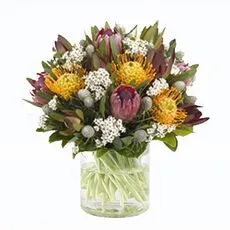
Our flagship. Hand-tied banksia, protea, leucadendron, and seasonal native foliage. The woody elements dry naturally for months. For someone hard to buy for, someone who finds roses predictable, or a sympathy delivery where longevity matters more than tradition. 296 verified reviews.
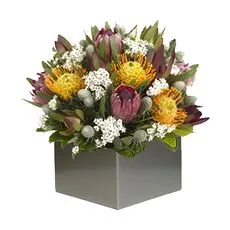
In a box or vessel, no vase needed. The recipient unwraps it and puts it straight on the table. Good for hospital deliveries where the arrangement stays upright and contained, or for someone you know does not keep vases around. 325 reviews.
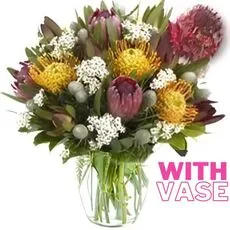
The bunch plus a glass vase included. Solves the "do they have a vase?" problem Anna heard on the phones constantly. 143 reviews.

Native Arrangement With Chocolates
The arrangement paired with chocolates. When the flowers need to feel like a complete gift, not an afterthought. Works well for birthdays, thank you, or any time you are sending to someone who will open it in front of others. 60 reviews.

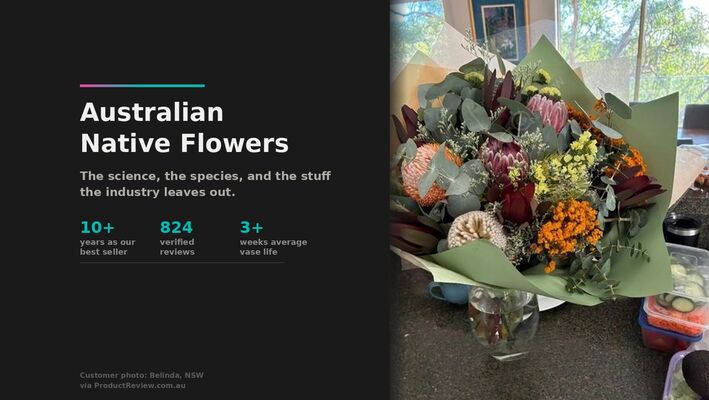
Photo shared by Belinda via ProductReview.com.au. Used with attribution.
CUSTOMER PHOTO, KITCHEN BENCH, NSW
"The flowers were beautiful & delivered on time. My friend was genuinely happy & loved the bouquet. My request to have native flowers & proteas was honoured. Thank you so much!"
Belinda, NSW | Australian Natives Bunch (Premium) | View on ProductReview.com.au
Send the Same BunchAnna, Qualified Florist
Look at that photo. You can see the banksia cone at the bottom left, cream and textured, already starting to dry. The two large protea heads (the deep pink focal flowers) are at full open, which means they were cut at the right stage and conditioned properly. Leucadendron foliage running through in that dark burgundy. Eucalyptus doing the structural fill, silver dollar variety by the look of the leaves. And there is a spray of orange, probably a native chrysanthemum or solidago, adding warmth across the middle. The wrapping is kraft and olive green, which tells me the florist dressed it to match the earthy palette rather than defaulting to cellophane. A partner florist who builds to this standard is doing exactly what we hope they do when a customer says "native flowers and proteas please." Belinda asked for something specific. The florist delivered it. The photo on a kitchen bench with an avocado in the background is worth more than any styled product shot we could take.
The Real Science Behind the Longevity
The short answer to "why do they hold up so well?" is ethylene insensitivity. Ethylene is the plant hormone that triggers senescence: petals drop, tissue wilts, the flower dies. Roses are highly sensitive to it. Carnations are devastated by it. Most cut flowers are, which is why commercial growers use anti-ethylene treatments during transport.
Australian natives evolved in an environment where ethylene sensitivity was not useful. Research on several native genera, including Grevillea and Calothamnus, found that vase life was not significantly shortened by ethylene exposure. The flowers ignored the chemical signal that kills roses. Waxflower is the significant exception: it is ethylene-sensitive and can lose every bloom in one go if exposed to ripening fruit. Commercial growers treat waxflower stems with anti-ethylene compounds before shipping.
The woody tissue does the rest. Dense, lignified cell walls act as both a water reservoir and a physical barrier against bacterial decay. The practical result: natives continue holding their shape and colour even after the vase dries out, transitioning to dried-flower status without anyone doing anything. A dried banksia cone is doing exactly what evolution built it to do. We just put it in a glass cylinder and call it a feature.
Anna on the second life
When the soft flowers in a native arrangement start to fade, do not throw the whole thing out. Pull the faded stems and leave the banksia cones, the leucadendron, the brunia. Those dry on their own. Some customers keep dried native pieces on a shelf for a year or more, and I have seen it with my own eyes in a customer's house in Casuarina. A year. No European cut flower does that, and I say that as someone who loves working with European flowers too (sort of).
Why Most Natives Have No Scent (and the Exceptions That Do)
One of the most common questions we get is some version of "these are beautiful but they do not really smell." There is a reason for that, and it is not a flaw. It is forty million years of evolution making a deliberate choice.
Most Australian native flowers evolved to attract birds, not insects. Honeyeaters, wattlebirds, lorikeets. Birds find flowers by sight, not by smell. Research from Monash University confirmed that bird-pollinated natives evolved colour signatures targeting bird tetrachromatic vision, shifting toward the reds and oranges that birds discriminate best. If your pollinator cannot smell, investing energy in fragrance is a waste. So banksias, waratahs, kangaroo paws, and grevilleas produce no detectable scent.
The exceptions are the insect-pollinated species. Brown Boronia produces beta-ionone at concentrations that make it one of the most commercially valuable fragrance plants on the planet. Waxflower leaves contain citronellal and limonene, giving them a clean lemon-myrtle scent when crushed. Sydney's Rose Boronia is pollinated by moths (which locate flowers by smell) and is intensely fragrant. Even banksia produces a faint earthy sweetness at night to attract small marsupials that pollinate in the dark. You would not notice it from a vase. But it is there.
The "Native" Label: What the Industry Does Not Always Tell You
This section matters if you care about what you are actually buying.
Are Proteas Australian?
Proteas, leucadendrons, and leucospermums are South African. They end up in "native" flower arrangements constantly because they belong to the same plant family, Proteaceae, as banksias and grevilleas. Both continents were once joined as Gondwana, so the plants share distant ancestry and look similar. But a South African protea provides zero ecological value to Australian wildlife. The birds and insects here did not co-evolve with it. The Australian Native Plants Society explicitly acknowledges the confusion. If you are ordering natives and want genuinely Australian species, ask your florist.
The second issue is more confronting. Australian native species, including kangaroo paw, eucalyptus, and wattle, are being commercially grown in Kenya, China, Ecuador, and Israel, then imported back into Australia. These flowers are fumigated and reportedly treated with glyphosate before entry. About half of all cut flowers sold in Australia are imported, rising above 90% during Valentine's Day and Mother's Day. There is currently no legal requirement to label cut flowers with their country of origin. Food must carry origin labels. Flowers do not.
Flower Industry Australia has been pushing the federal government for mandatory labelling for years. In the meantime, they have introduced green-and-gold "Australian Grown" bands for growers. The most useful thing you can do as a buyer is ask where the stems were grown.
Our partner florists source from Australian wholesale markets: Flemington in Sydney, Epping in Melbourne, Rocklea in Brisbane. The native stock that goes into a Lily's Florist arrangement was grown by Australian growers and conditioned by a partner florist who knows what to do with woody structural pieces.
65,000 Years of Knowledge Before Floristry Existed
Long before any of us put native flowers in a vase, Aboriginal and Torres Strait Islander communities held deep, detailed knowledge of these plants across more than 250 language groups. The oldest continuous relationship between people and plants on Earth, and it puts our few decades of commercial floristry into perspective.
The Noongar people of southwest Western Australia soaked banksia flower spikes in water to make sweet energy drinks for travel. Dried cones were used as slow-burning torches to carry fire between campsites. The Eora people around Sydney used waratah flower tonics to treat children's coughs. Kangaroo paw roots were eaten as a starch source and the nectar drunk for quick energy. Wattle seeds were ground into nutrient-rich flour for bread.
Rather than four European seasons, Aboriginal communities recognised between two and thirteen seasons depending on the region, marked by specific environmental indicators including which native flowers were blooming. The Bininj/Mungguy people of Kakadu recognise six. The Noongar of southwest WA traditionally count six, each tied to different flowering cycles across the bush. The Dharawal of coastal NSW count three. Flowering was calendar, pharmacy, and food supply.
What the Sales Data Says
Andrew, Co-Founder, Lily's Florist
I have tracked every product category since we built the software in 2009. The native range took over as our top seller around 2015 and has not dropped since. The reorder rate is higher than roses by a margin I did not expect. People buy natives once, they see how long they hold, and they order again. I do not need to guess at this. The numbers are in front of me every month.
The sympathy shift is the one I find most interesting. A decade ago, almost every sympathy order was white roses and lilies. Now a significant portion request natives, specifically for the longevity. When someone is grieving, a bunch that keeps going for three weeks sits on the table longer than the condolence cards. If you are stuck on what to write on the card, keep it short. "Thinking of you" or "With love from all of us" is enough. The card gets read twice and kept for months. The words matter more than you think and less than you fear.
How to Care for Native Cut Flowers (the Short Version)
The full guide lives in our Caring for Australian Native Flowers post. The essentials are quick. Crush or split the bottom of woody stems before putting them in water. Use a clean vase with room-temperature water. Change it every three to four days. Keep native arrangements out of direct sun and away from ripening fruit (the ethylene from bananas and apples will ruin waxflower). When the soft blooms fade, remove them and leave the woody stems and pods. They transition to a dried display without any effort.
Anna on placement
Natives handle heat better than European flowers but they are not invincible. A banksia in direct afternoon sun on a west-facing windowsill will dry out faster than one on a shaded kitchen counter. Dry aircon strips moisture from petals. Best spot in the house: a cool room with indirect light, away from vents. If the room is comfortable for you, it is comfortable for the flowers.
What Happens After You Order
You pick the product, add the card message, and pay. From there, the order routes to a partner florist near the recipient. The florist sources native stock from the wholesale market that morning (or the day before for early deliveries), builds the arrangement, and runs the delivery by hand. You will not see the arrangement before it arrives. That is the part that makes people nervous, and I understand why. You are trusting a stranger to represent your feelings to someone you care about.
If you want to check on an order after placing it, ring us on 1300 360 469 (7am to 6pm weekdays, 10am Saturdays) or email [email protected]. If the recipient does not text you a photo within a few hours, do not panic. New parents are asleep. Hospital patients are on medication. People forget. The photo comes when it comes. And if something goes wrong, if the flowers arrived damaged or late or not what you expected, call us the same day. We want to know while we can still fix it.
The thing I keep coming back to, after ten years of watching customers discover natives, is that these plants were never designed for a vase. They were designed to survive fire, drought, and soil that would starve anything else. A banksia cone drying on a shelf is just doing what banksia cones have done for millions of years. We put them in a glass cylinder and call it interior design. They call it Tuesday. And I will admit something here (because Andrew never would): when our accountant told us we were making a mistake buying a flower shop in 2006, he was probably right about a lot of things. But the native flowers were not one of them.
Order before 2pm weekdays or 10am Saturdays for same day delivery. $16.95 flat rate, anywhere in Australia.
Related Guides


The Kingscliff shop where it started. We still live around the corner. Most business decisions still happen at the dinner table, which drives the kids nuts.
Blog Categories