
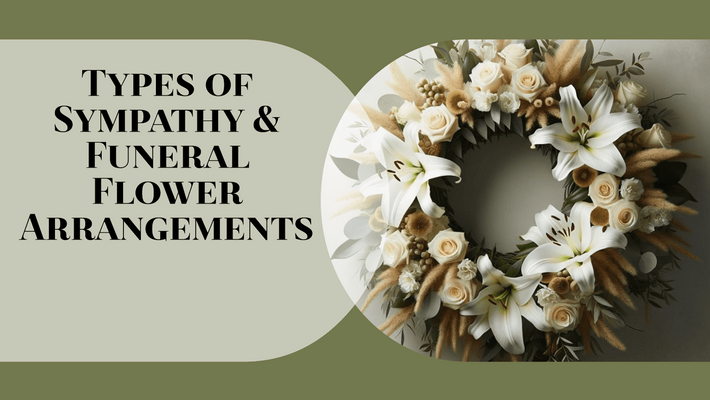
Flowers will not fix it. You already know that. They are not meant to fix it, and anyone who tells you the right bunch will help a grieving family feel better is selling you something. What flowers do is say the thing you cannot say from where you are standing, without you having to find the words, and without asking the family for anything back.
Tuesday arvo, 2008. Our shop in Kingscliff was not really a florist by then. We had bought one in 2006, painted over the signage, and turned it into an organic gift, food and baby product store called Down to Earth Organics, which sold a few flowers on the side that a work-from-home florist dropped off to us every morning. So the woman who came in that afternoon, maybe sixty-something, eyes all red, had walked into a baby shop to buy funeral flowers. Her husband had just died, he had been sick for ages. She stood in front of the cooler and stared. Ten minutes, easy. Didn't say anything. I was nervous, and I had no business advising anybody about anything, because I sold skincare and muslin wraps. Eventually I asked if she needed help and she said, "I don't even know what I'm supposed to send. We were married for 42 years and I don't know what flowers to send."
Still think about that. She was not asking for a product. She was asking someone to tell her what she was meant to do. I took tens of thousands of flower calls in the years after, right up until I stepped away when our second daughter Ivy was born, and I reckon one in five was a sympathy call. Almost every one opened the way she did. Not with a question about flowers. With an apology for not knowing.
So this page answers her, in the order you need it. Should you be sending flowers at all, because for some families the honest answer is no. Then the sort. The funeral and the family home are two completely different gestures and the industry sells them as one. Then Anna, our florist, picks four flowers and tells you why, from the bench, with numbers. She does not pick the lily. We are called Lily's Florist. She still does not pick it, and her reasons are the most useful part of this page.
Nothing here is going to make it easier. A page cannot do that. The most it can do is stop you standing in front of the cooler for ten minutes.
In this guide
Before You Pick a Flower
The most useful advice we found is also the most boring. Check whether flowers are wanted before you assume they are. The funeral notice usually says. If it does not, ask whoever is organising the service. "Does the family have any cultural or religious preferences for the flowers?"
Ask. It is not a clever technique and there is no better one.
In most Jewish traditions, flowers are not appropriate. Not at the funeral, not in the hearse, not at the graveside, not at the shiva house. Orthodox, Conservative and Reform, though families vary. The reasoning is about equality: death should not become a display of who could afford the bigger tribute. The Melbourne Chevra Kadisha says bringing flowers to the mourners' house is not practised in Jewish communities and may even be viewed as insensitive. Sydney's Emanuel Synagogue says the same (reference 7). Send food to the shiva house instead, or a donation in the person's name.
Anna redirected hundreds of those calls in three years on our phones, from people who had no idea and were grateful to be told. Muslim funerals were the ones she asked the most questions about, because the range of practice is enormous. Burial ideally inside 24 hours, simplicity and modesty the whole spirit of it. Flowers only if the family says so, and never to the mosque. Hindu families arrange their own garlands, and an all-white Western arrangement is specifically what to avoid. For both, a donation or food to the home afterwards is safer.
And one rule that runs across more traditions than any other: red is the most dangerous colour at a funeral. To Chinese, Vietnamese and Buddhist families red signals celebration, and red flowers at a Chinese funeral are read as mocking the bereaved. Keep red for Western Christian services, or a secular one where somebody has asked for it.
And if you ask and get a shrug, or there is nobody left to ask, ring us on 1300 360 469 and say which family it is for. Working out what is appropriate is the part we can take off you.
The full protocol across eleven traditions, with the sources, lives on our sympathy versus funeral flowers guide. One last point before you go anywhere near a flower. Aboriginal and Torres Strait Islander customs are not one thing. Hundreds of language groups, hundreds of protocols. Ask the family. It is the only safe universal there is.
The Funeral, or the House
One thing first. If this happened yesterday, if it was sudden, and you are reading a blog post at midnight because it is the only thing you can do, skip to Anna's four and take the first one. It is the right answer and you do not have to earn it. The rest of this is for people who have had time to think, and there is no shame in not being one today.
Two gestures, sold as one. The service flowers are gone by the evening. The house flowers are still there in week three, which is when everyone else has stopped coming. Both of them are you, standing in a room you could not get to. Almost everything sold as a sympathy flower is built for the first job.
For the service you want something structured that holds its shape for hours, so a wreath or a sheath, or a formal bunch from the funeral range. Timing is not flexible here. A birthday delivery that lands at 4pm instead of 2pm is still a birthday delivery. A funeral delivery that lands at 2:15pm for a 2pm service is somebody walking an arrangement through seated guests while a person is speaking. Read how to send flowers to a funeral for the cutoffs and the director coordination. And check the spelling on the card twice, because from what our florists have seen a parlour can have several families moving through in a week and every arrangement lands at the same door with a name on it.
The house is the underrated one. I delivered one of these to a place in Casuarina once, back when we lived up the road and I was still doing runs myself. The daughter answered, took the flowers, and started crying immediately. Not sad crying. Relieved crying. "Something beautiful," she said. "Finally something beautiful in this house."
She did not say a word about the flowers themselves, and Anna says that is the rule. In three years of people ringing back to report how a delivery went, not one ever mentioned a stem. All white and really elegant. The pinks were gorgeous. So much bigger than I expected. Colour and size, in that order, then they stopped. Worth knowing before you spend an hour choosing between two bunches that are the same colour.
Bunch or box
A bunch arrives wrapped in paper. Somebody has to find scissors, find a vase, cut the stems on an angle, fill it and arrange it. Pleasant work on a normal Saturday. In a house where the kettle has been going since Tuesday and there are four casseroles in a fridge that was already full, it does not happen. The bunch sits in its wrapping on the bench next to the sympathy cards, and by the time anyone gets to it, it has lost two days.
A box arrives finished. Foam, water, done, straight onto the table. For a service a bunch is fine, there are people there whose job is to deal with it. For a house, send the box. Nine dollars more, and it saves somebody a job they do not have in them.
The card is its own problem and I am not solving it here. Stuck on that bit? Go to what to write on a funeral flowers card. Short beats poetic. Come back when you are done.
White lilies would have been a lie.Siobhan Thomson, Co-Founder
Anna's Four, and the Problem With White
Anna is our florist. Trained in North Carolina, fifteen years on the bench before she came to us from a boutique florist at Salt in Kingscliff, and well over 10,000 inbound calls out of our Pottsville home office between April 2010 and June 2013. Her question is not "which flowers mean sympathy." That one has a lookup table and everybody has published it, ours included, down in the further reading.
Every page you read tells you to send white. They are right. White is the safest colour across Buddhist, Chinese, Vietnamese, Greek Orthodox, Italian Catholic and Western Christian funerals. White is also the hardest colour on earth to keep. There is no pigment to hide behind. Every bruise shows. So does every dry edge, and every hour the stem spent in a van. A red rose browning on day six looks like a red rose. A white rose doing the same looks like something died on the kitchen table, in a house where nobody has the energy to throw it out.
So my question is which whites survive being white, in an Australian lounge room, for the weeks after everyone goes home. Four gates: culturally safe, no scent, weeks of vase life at real room temperature rather than cool room temperature, and it holds its colour while it ages. Four stems pass. I made thousands of these. The colour was almost always right. The stems usually weren't.
And understand what the vase life is buying. Twenty days instead of seven is nineteen extra mornings where the family walks into that kitchen and the first thing they see is not a casserole dish. Pick the stem that buys the most of them.
The one that clears all four by the widest margin is the stem Australians think is cheap. Servo flowers. Mums for Mum. The white disbud chrysanthemum is the most under-respected flower in the trade and I understand why you would not believe me, because you have only ever seen the nine-dollar bunch at the checkout. A disbud at 22 degrees is still white on day twenty while the rose beside it browned on day seven. It is also correct in more cultures than any other stem: Chinese funerals, Buddhist services, Vietnamese families, Italian Catholics on the second of November. The flower of the dead, and I mean it as the compliment it is.
And there will be thirty or forty arrangements at that service, every one with a card on it and a name. Yours is one of them, and people read the cards. Nobody wants to admit that is part of the calculation. It is part of the calculation.
Here are the four. If it is before 2pm on a weekday as you read this, or before 10am on a Saturday, the florist still has time to build it and get it there today. After that you are looking at tomorrow, and for a service tomorrow can be too late. That is the only genuinely urgent part of this.
Three of the four sit within a dollar of each other, so the choice is about the room, not the budget. The natives cost more because protea and leucadendron cost more at market, not because they are the premium tier and not because they mean more. No one at the other end is pricing your flowers. What they will notice is whether the things were still alive in week two. Delivery is $16.95 flat anywhere we go.
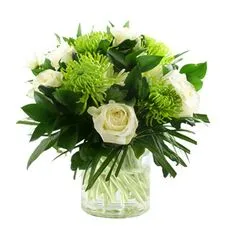
14 to 24 days in a normal lounge room. Ethylene-proof, no scent, safe on the hospital wards that turn half of everything else away. It also fails more gracefully than any other commercial stem: the foliage yellows before the bloom does, so the white stays white while the leaves go first.
$79.95Send this bunch
Going to a house? The same flowers boxed and ready are the Blissful Botanics Arrangement, $86.95. No vase required at the other end.
Our bestselling sympathy product, for years, by a distance, is white roses and green chrysanthemums. What everybody was already quietly buying was what our florist would have told them to buy. We had just never made the argument out loud. We had been ringing it up.
One warning, and it runs the opposite way. The same property that makes the chrysanthemum right for a funeral makes it a disaster anywhere else. Send them to a Chinese household for a birthday and the message is the opposite of the one you meant. The trap is written up properly here. Right for a funeral. Wrong for a Tuesday.
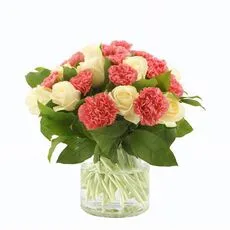
14 to 21 days, and they keep opening, so the bunch fills out in week two rather than thinning. The waxy petal that shrugs off air conditioning shrugs off handling too. The market, the bench, the van, the doorstep, none of it shows.
$80.95Send the carnations
Boxed version for a home delivery: the Rose & Carnation Arrangement, $89.95.
The condolence fruit basket kills the flowers, and I have never seen a florist put this in writing. Ripening fruit gives off ethylene gas. Carnations are about as ethylene-sensitive as a commercial stem gets, and in warmth they produce their own on top of it, so they poison themselves while the bananas finish the job. What it looks like is petal curling. The trade calls it sleepiness. A fruit bowl on a warm kitchen bench takes a carnation from three weeks to about a day, in 12 to 24 hours. Same room is enough. Different room is safe.
Now put that in a grieving house. The fruit basket is the second most common condolence gift after flowers. It is what you send a shiva house. It is what I steered Hindu and Muslim callers toward for years. It turns up in the same week as the flowers, from somebody else, and it goes on the kitchen bench, next to the flowers, because the bench is where the flat surface is. Three weeks becomes three days. Nobody understands why. The family assumes the flowers were poor, and the person who sent them never finds out. Move the vase to another room. Ten seconds, no cost. Chrysanthemums or natives, do not bother. They could not care less about ethylene.
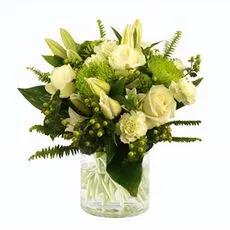
On the list because leaving it off would be dishonest, not because it wins on the numbers. It is what reverence looks like to most Australian families and it is what the person on the phone is picturing when they ask for something appropriate. Read Anna's caveat below first.
$80.95Send the whites
The boxed twin is the Gorgeous White Arrangement, $89.95, and at 273 reviews it is the better-proven of the two. For a house, send that one.
The white rose is the right flower and the wrong stem. Ten to fourteen days in a cool room. Seven to ten in a normal one. In a Brisbane lounge room in February with no air conditioning you are looking at three to six days, and it does not die quietly: the petal edges brown, the petals loosen and drop, and in a warm room the head folds over on the neck because an air bubble or a bacterial plug has blocked the plumbing in the stem. Meanwhile the chrysanthemum sitting beside it in the same vase is still white on day twenty.
So send it to the service. Two hours, and it will be perfect for all of them. Be careful sending it to the house. And brown spots on the outer petals in humid weather are not bruising and not the florist being careless. Botrytis. Grey mould. Pull those petals off and the bloom underneath is fine. If you want the look and you want it to last, ask for lisianthus in it. Ten to seventeen days, passes for a softer rose. The rest sits under sympathy roses and the white collection.
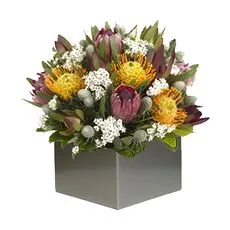
Leucadendron runs 14 to 28 days and can go months if the water stays clean. Protea gives 10 to 18. No scent, no pollen, immune to ethylene, and the palette is silver, cream, green and soft pink, which looks reverent without being white at all. It sidesteps the white problem rather than solving it, and it is the one that survives a regional van in February.
$136.30Send natives
Already a box, so this one needs nothing at the other end. More shapes under sympathy natives.
Two things happen with natives and both get blamed on the florist. The protea is a heavy drinker. It can pull an entire vase dry in a few days. Check the water. It is the only thing this arrangement asks of anyone, and it is the one job a grieving house forgets. And the leaves will go black. The flower head is pulling sugar out of its own leaves to stay alive, so the leaves blacken while the head stays perfect. Nothing has gone wrong. Keep it near light and it slows down.
For a family who buried someone on Country, natives are the point. Banksia, waratah, kangaroo paw, wattle. If the family has said flowers are welcome, this is where I would start.
The four, side by side
Days of vase life in an average Australian lounge room, around 22 degrees.
In a Queensland lounge room in February with no air conditioning, take roughly a third off every bar. The rose drops to three to six days. The natives still give you a fortnight. All four are safe on a hospital or hospice ward, which is not true of much else in a florist's cool room.
And every number above assumes the flowers were made this morning by a florist near the recipient. If they arrive in a box that has been in transit since Tuesday, take two or three days off before you start. The chart measures the flower plus how it got there. Those are not the same number.
Vase life ranges come from postharvest research compiled from three independent sources citing university extension and horticultural science work, cross-checked against Anna's bench experience (references 1 and 2). The figures for 28 to 32 degrees are partly extrapolated, because published research mostly tests flowers at 20 to 25. Treat the hot-room numbers as a working guide, not a guarantee.
One gap, while we are here. Anna recommends the carnation in white or a soft tone and we do not sell a white carnation bunch. Pink and white is what we carry. Want white specifically? Order the Florists Choice Sympathy Bunch and say so in the card message field. And people assume Florist's Choice means leftovers. It means whatever was best on the bench at five that morning, picked by the person who was standing at the market. The gap is a hole in our range and it is on us to fix.
Why Our Florist Does Not Pick the Lily
A surf lifesaver from Kingscliff died suddenly. Young bloke, everyone knew him. His mates ordered bright mixed bunches for the service. Yellows, oranges, reds. The funeral was full of colour and his mum told us later it was exactly right. He had lived in boardshorts and rashies, always in the sun, always smiling.
White lilies would have been a lie.
The soft version of the argument. Anna's is harder, it comes with two mechanisms, and the first of them is the best-evidenced claim on this page (reference 6).
Open any sympathy page in this country and the lily is first. The business I work for is called Lily's Florist. I still do not pick it, and it has nothing to do with vase life, because the lily lasts fine. Eight to fourteen days in a normal room. Longevity was never the objection.
The first objection is the smell. Smell is the only sense that runs straight into the parts of the brain that handle memory and emotion, with nothing in between, which is why a scent drops you into a moment from twenty years ago before you have consciously registered it. The binding is automatic. You do not get a vote. Send heavily fragranced Oriental lilies into a hospice room and there is a real chance you have permanently welded that exact smell to the worst day of somebody's life. They will smell it in a supermarket in 2031 and be back in that room.
The second objection is the one the hospitals actually write down, and it is not the smell at all. It is the pollen, and the problem is not your tablecloth. Lily pollen sits exposed on prominent stamens, which is why it goes airborne when a rose or a carnation's never would. It lands on a nurse's sleeve and it walks. Out of that room, down the corridor, into a room with somebody in it who never saw your flowers and is now having an allergic reaction to them. The wards I dealt with would not take them, and the big private groups were the strictest of the lot. The word on those policies was never fragrance. The word was allergen.
And be precise, because the rest of the trade is not. The problem is Oriental lilies. Asiatic lilies have no fragrance at all, it was bred out, and pollen-free Asiatic varieties exist if the florist knows to pick them. Calla lilies are unscented. Peace lilies and orchids are not Lilium at all, different genus entirely, no pollen problem and no fragrance problem. Every competitor page says "lilies" as though it is one thing. It is four.
Not a lily ban. A routing rule, and a better one than putting the lily first would have been.
| Where it is going | Verdict | Why |
|---|---|---|
| Hospice, hospital, palliative room | No | The room where the scent becomes the death, and the room where the pollen goes walking on somebody's uniform. In our experience the wards are strict about it, and the large private groups will not accept lilies at all. Send something built for a ward instead. |
| A small home, an elderly recipient | No | Enclosed space, headaches, nausea in somebody already running on no sleep. Roughly one in five Australians has a pollen allergy and you have no way of knowing which family member. |
| A church, a chapel, the service | Yes | The space absorbs it and the scale carries it. Ask for Asiatics if the chapel is small. |
| The family home, weeks after | Yes, this is the moment | Away from the death, the scent has a chance to become a comforting association rather than a clinical one. What the sympathy lily range is actually for. |
| They loved lilies | Always yes | The person outranks the protocol, every time. Take your pick. |
Anna's four are what she picks when she cannot see the room. The lily needs you to know the room.
Which leaves the fourth row of that table, and it is the row we would rather you acted on. Not today. In six weeks, when the house has gone quiet and the scent has nothing to bind itself to except a Tuesday afternoon and somebody remembering.
When White Would Be a Lie
Everything above assumes the family wants the register of a funeral. Sometimes they do not, and the last row of that table is the one that matters. The person outranks the protocol.
Our work-from-home florist made a bunch once for a woman whose best friend had died. She did not want pink and she did not want white. Her friend hated both, wore purple and green together every day of her life, had the whole house done in those shades. So that is what we made. When it turned up at Tweed Lawn Cemetery you could pick it out from the doorway, sitting in the middle of forty white arrangements. The family came looking for whoever sent "the purple one", because it was so obviously her.
Nobody remembers the fortieth white wreath. They remembered that one.
If you knew the person well enough to know they would have wanted colour, send colour. You do not need permission and you are not being disrespectful. Card messages we have taken read like "Nan would have hated boring flowers" and "Dad always said life was too short for white", and every one of those senders was right.
Anna still talks about a caller who told her the woman who died had grown sunflowers in her backyard every summer of her life, so they built the whole arrangement around sunflowers. Another wanted waratahs because her father had bushwalked every weekend for forty years. Those were the orders Anna asked the most questions about and liked the most, and she reckons they carry something a white bunch never will.
The only rule is that you have to actually know. Guessing? Ask the family. Cannot ask? Go back up to Anna's four. Bright is a stronger gesture when it is true and a worse one when it is a guess.
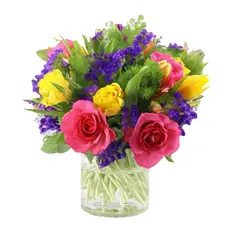
Florist's Choice means the colour comes from what was actually good that morning, not from a photo taken two years ago. Tell them who it is for in the card message and they will pitch the bunch to the person rather than the occasion.
$79.95Send colour
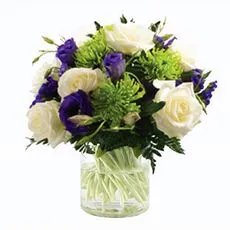
The closest we carry to the bunch that went to Tweed Lawn. It stands out without being loud, and purple sits comfortably in Greek Orthodox and Catholic settings where a bright mixed bunch would not.
$79.95Send the purple one
The other move in celebrations of life right now is away from the materials. No floral foam, natural twine instead of ribbon, biodegradable bases, seed paper cards. Anna has watched it come through the orders and reckons it is the best change the trade has made in a decade.
And the one we probably should not tell you about: some families are asking guests to bring a single stem from their own garden instead of ordering anything. Forty people, forty stems, nobody spends a cent, the whole thing assembled at the door. We sell flowers for a living and I still think that is the most beautiful version of this I have heard. Sounds like your family? Do that instead. We will survive.
One caution, and it is why this section sits after the gate rather than before it. Bright is a Western move. Red signals celebration to a Chinese, Vietnamese or Buddhist family, and a celebration of life is not a licence to skip Part One. Check first. Then send whatever is true.
Why Words Fail and a Flower Doesn't
The bereavement literature is consistent on what lands worst after a death, and it is most of what any of us say. "At least they're not suffering." "They're in a better place." Religious explanations offered to someone whose beliefs you do not know. Comparisons. Advice. Anything implying a timeline. All of it rates among the most unhelpful things said to grieving people and it rates there regardless of how kindly it was meant. The full research is on our sympathy versus funeral flowers guide, with the citations. Here is the part that matters when you are choosing something.
A flower makes no claim about where anyone went. It offers no comparison, no advice, no timeline. It says nothing propositional, which is exactly why it is safe. The support that actually helps just validates. "I'm so sorry." "I'm here." A flower is the non-verbal version of that, and it asks the family for nothing back, not even a reply.
I heard the proof of this on the phones for years without recognising it. People would get to the card message field and freeze, and a lot of them said some version of the same sentence: "I didn't know what to write so I just sent the flowers." They thought they were admitting a failure. They had actually worked it out on their own.
The study we are supposed to quote at you
Every florist cites the same research. Rutgers, 2005 (reference 3). Women given flowers rather than fruit or candles showed elevated mood, measured through involuntary smiles, and it held for days. A follow-up put single flowers in a lift and found people handed one stood closer to strangers and started conversations with people they had never met. For someone bereaved, and therefore socially withdrawn, something that lowers the guard even slightly is not nothing.
It is also widely understood to have been paid for by the flower industry.
So there it is. The study that proves flowers work was funded by people who sell flowers, we are people who sell flowers, and we are citing it at you. Read it with that in mind. The lift result still surprised the researchers who ran it and I find that part hard to explain away. But you should know who paid.
One last honest note. Line up everything the literature says helps and flowers are not at the top. Someone turning up and sitting there is. Flowers sit high among the things you can send and below the person in the room, which means they work best alongside showing up, or as the substitute when showing up is not possible.
Flowers do not cover what has happened to that family. They mark that you tried to.
Flowers are not a replacement for showing up. They are what you send when you cannot.Siobhan Thomson, Co-Founder
Week Six, and the Losses Nobody Sends Flowers For
The industry points everything at the funeral week. Send within one to three days, before the service, so the family can use them at the visitation. Fine advice, aimed at a moment that is already saturated. The funeral home is full of flowers, the house is full of people, and the phone has not stopped since Tuesday.
The etiquette authorities are clear there is no formal deadline (reference 5). And the bereavement research is blunt about what the fear actually is: not that people will forget the person who died, but that people will forget them. The fear gets worse after the crowd disperses, not before. So thinking of you flowers on a quiet Tuesday in week six do more work than the biggest wreath at the service did, because no one else will have sent anything that week.
And if six weeks went past because you had no idea what to say six weeks ago, that is most people. The gap is not evidence of anything. Six weeks late is a different delivery altogether, to a house that has emptied out since the funeral. If the person who died loved lilies, this is their moment, for every reason Anna gave you in Part Four.
The other date worth putting in your phone is the anniversary. Everyone remembers the first one. Almost nobody remembers the fourth, except the person living in that house, who has been counting down to it since about March. We have customers who have been sending the same order on the same day since before our eldest started school.
One exception. Vietnamese families often hold the wake at home for three to five days, and flowers arriving after the funeral can land wrong rather than late. Before or during, not after. Vietnamese family? This section does not apply to you.
The losses with no funeral to send to
Disenfranchised grief (reference 4). Loss the world does not treat as legitimate, so none of the social machinery fires. The ex-partner. The estranged parent. The pet that everyone treats as a small thing. The loss somebody never announced and is quietly carrying at their desk.
No funeral means no notice, which means no script, which means no flowers and no acknowledgment at all. The entire apparatus of "send flowers to the funeral" excludes exactly the people getting the least. If you know somebody in that position and you have been wondering if it would be weird to send something, it would not be weird. It would probably be the only thing they get. Send it to the house. There is no service to send it to.
Still cannot decide?
Then stop deciding. The Florists Choice Sympathy Bunch is $74.50, 325 reviews. Tell the florist about the person in the card message field instead of picking stems off a screen. A florist near the recipient reads it before they build it and they have made a lot more of these than you have. Were they bright? Say so. Going to a house rather than a service? Say that too, and ask for a box.
And if somebody at work asked you to organise this for the team, that is a different job to the one this page has been describing. A task, not a bereavement, and there is nothing wrong with that. Florist's Choice, the team name on the card, four minutes, done. No one is judging you for not agonising over it. Worried about the money, the under $60 range is well made and no one at the other end is auditing what you spent.
The Hardest Version of It
Serena left this on ProductReview a fortnight ago. She opens on the fear itself, which almost nobody does out loud.
It's difficult to order interstate, not knowing the Florist etc. However Lily's Florist delivered a 'spectular' sheath of roses and lilies for the coffin of my dear friend last Friday so big thank you.
Serena, five stars, July 2026. Read it on ProductReview. The flowers went to Brighton, down on the water in Adelaide. Serena was not in Adelaide.
See the sheathsOne thing you should know about where that review lives. ProductReview is the platform where our rating is worst. We sit at 4.0 there against 4.3 on Feefo, and for years it was a good deal lower than that. We are putting a five star from our worst platform on this page on purpose. Praise from the place that has been hardest on us counts for more than praise from the place that already likes us.
I wrote back to Serena, and what I said to her is what I would say to you. Ordering interstate for something like this is the hardest version of it. You cannot walk in, you cannot look anyone in the eye, and you are handing the one thing that has to be right to a florist you will never meet.
And then look at what she actually got. A sheath of roses and lilies, on a coffin, at a service. Go back up to Anna's table and find the row for a chapel. Yes, it says. The space absorbs the scent and the scale carries it.
Serena has never met Anna. She has never read a word of this page. She ordered a lily sheath for a farewell in a room she was not standing in, and it was the right call, and the two of them will never know they agreed.
What happens after you press order
Andrew, Siobhan's partner and the one who built the network Most of these orders cross a border. Someone in Melbourne has lost a friend in Cairns, or there is a church in Hobart that needs flowers by 10am and you are sitting in Perth. What happens after you press order is less impressive than people imagine. It lands with us, we match it to a partner florist in or close to the delivery area, and they build it that morning from what they bought at market that week. No warehouse. It has not been in a box since Tuesday. And the florist is not whoever quoted lowest that morning, which is the bit people assume and never ask. Most of ours have been with us ten years or more. They are on the list because of what they sent last time, and they come off it the same way. I cannot tell you the exact arrangement they will make, because they are working with what is good this week rather than what was photographed two years ago. Cutoffs are 2pm weekdays and 10am Saturdays, no Sunday, and we hold them, because the alternative is worse. Wilted flowers I can fix. The order that never turns up at all for a funeral cannot be fixed, not the next day, not ever, and there is no version of that phone call I want to have again. If something looks wrong, ring 1300 360 469 while there is still a florist standing at a bench who can do something about it.
One more, because it was the call we got most and I have never seen anyone else mention it. You will probably not hear anything back. On a birthday the recipient photographs the flowers inside the hour and it is on your phone before you have finished your coffee. A family in the week after a funeral does not do that. They are not going to text you a photo and a heart. The silence is not a verdict on what you sent. Those flowers did their work in that room whether anyone has managed to tell you about it or not.
Further Reading
This page is the triage. If you have got past it and need the next layer, these are the ones worth your time.
If you have read enough and you want to send something safe, this is the whole range, sorted by where it is going and who it is for.
Browse by occasion
Lily's Florist delivers Australia-wide through a network of 800+ partner florists.
22,800+ verified reviews on our reviews page, which we cannot edit or delete.
Same-day delivery when you order before 2pm weekdays or 10am Saturdays. Delivery $16.95 flat.
Questions? Ring 1300 360 469, 7am to 6pm weekdays, 10am Saturdays.
What We Read
Every number on this page came from somewhere. Where a claim is contested, or where the people who funded the research had something to gain, we have said so in the text rather than burying it down here.
The woman who did not know what to send for her husband? We ended up making her a mixed arrangement in his favourite colours, blue and yellow. Not traditional, but right for him.
She came back a week later to thank us and tell us it helped.
About the Authors
Siobhan wrote this one. Anna picked the four flowers and argued us out of the lily. Andrew handled the part about what happens after you press order. Read our full story.

The Kingscliff shop. In 2008 it was full of organic baby products and the cooler she stood in front of was inside this door, on the left.

Andrew, Ivy, Siobhan and Asha. Hobart, June 2024.