
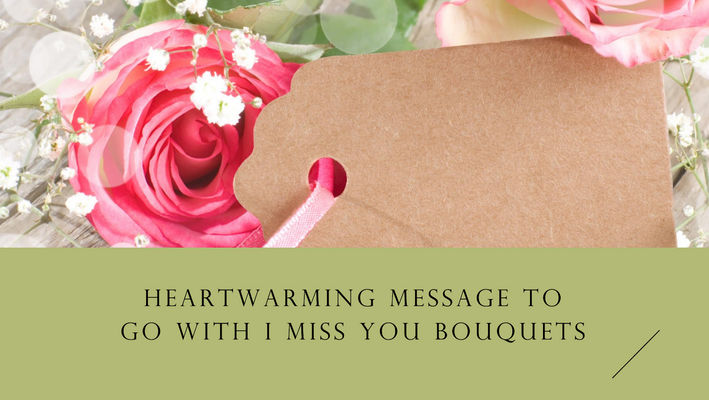
Somewhere right now, someone has the order page open on their phone, the bouquet picked, the delivery address typed, and the cursor blinking in the card message field. They have been there for fifteen minutes. The flowers are easy. The words are not. They keep starting and deleting because the message they want to send keeps coming out wrong. Either too dramatic for a three-day work trip, or somehow not enough for six months of distance, or strangely formal for a sister, or strangely familiar for a friend they have not seen in a year.
The fear underneath is the same fear every miss-you sender has, and almost no one says out loud: that the card will read as desperate, as needy, as out of proportion to the relationship. The recipient will read it once, look at the flowers, and feel slightly weird about it. Or worse, the gesture will land in the wrong tone register and the sender will not be there to fix it.
I am Siobhan. Andrew and I have been running Lily's Florist since 2009, and the truth is the brand was built by people who moved away from their families. We left Sydney for Kingscliff at the end of 2006. My Dad Bill stayed up the coast in Taree. Andrew's family stayed in Sydney's inner west. The first phone calls Andrew made to build the network in 2008 were calls to florists in cities we no longer lived in. The whole business was built across the distance the two of us had created. Twenty years later, that is still most of what we do.
This guide is the version of the page we wanted to find when we first started taking the calls. By the end of it, you will know which of the eight kinds of "I miss you" you are sending, what to write on the card, what to skip, and which of our flowers does the work for the relationship you are sending to. Anna, our florist, is here too. She took ten thousand of these calls from our Pottsville office between 2010 and 2013, and the question she heard most often was the one you are probably stuck on right now.
In this guide
Why "I miss you" is harder to write than other cards
A birthday card has a hook. So does an anniversary, a get well, a sympathy. The occasion does half the writing for you. "Happy birthday" works. "Thinking of you" works. "Congratulations" works. The reader knows what kind of message they are reading before they open the envelope, which means the words just have to confirm what the flowers already said.
"I miss you" does not work like that. There is no neutral default. The same three words read as romantic from a partner, sweet from a parent, slightly worrying from a colleague, intrusive from someone you used to date, and possibly accusing from an estranged sibling. Flowers cannot calibrate the tone. The card has to. And the calibration depends on the relationship in a way no other card message does.
The other reason these cards are harder is that "I miss you" sits next to a lot of other feelings the sender does not necessarily want on the card. Guilt about not visiting. Worry about an aging parent. Loneliness the sender does not really want to admit to. Sometimes a fight that has not been resolved. The good miss-you message handles one of those and leaves the rest in the room with the sender. The bad ones try to handle them all at once and end up reading like a confession.
Most of the calls about miss-you orders started the same way. The caller would describe who they were sending to, then they would pause, then they would ask if it was weird. They were not asking about the flowers. They were asking permission to send. The question came up hundreds of times on the phones at Pottsville and the answer was always the same one. If you are stalled on the message because you are worried about how the gesture lands, the gesture is going to land fine. The fact that you care about the wording is the proof that the recipient knows you care. Flowers are doing the heavy lifting on the emotion. The card just needs to sound like you. Two sentences in your real voice, signed the way you sign a text. That is the whole rule.
So that is the floor. If you write something that sounds like you, signed the way you sign a text, in two sentences or less, you have already cleared the bar that everyone else is worrying about. The rest of this guide is about getting the message right for the specific relationship and the specific kind of absence. Underneath, the flowers are doing more work than you think.
The card sits on the bench for a week. Whatever you write, write it as if you are going to read it back to that person sitting next to you. If you would not say it out loud, do not write it down.Anna, Qualified Florist, 15+ Years
A note from the place we moved away to
We left Sydney at the end of 2006, and the funny thing about building a flower delivery business out of the place you just moved to is that you spend a lot of years sending flowers backwards. Most of the early orders we took were people in Sydney and Brisbane and Melbourne sending up the coast or down to Tassie or out to Perth, and we were sitting in our front room in Kingscliff packing things off to cities we had family in. So we knew the order shape from the inside before we knew it as a business. My Dad Bill is in Taree (he taught at the TAFE there for decades and is still in the Taree & District Vintage & Classic Motorcycle Club, which I mention because it is the kind of detail he would want me to mention). Andrew's grandmother was in Manly. Most of our friends stayed put.
The thing nobody told us when we moved was that the absence works in both directions. You miss them. They miss you. And after a while you realise you are not going to fix it with a phone call because the phone call ends and you are still here and they are still there. So you send something. The flowers are not really about the flowers. They are about the small fact that you sat down, picked something out, paid for it, and asked a person you do not know to drive it across town and put it on the doorstep. The whole sequence is the message. The card is the bit that says it in your own voice.
When Andrew started ringing florists in 2008 to build the partner network, the first one who said yes was a woman in Murwillumbah, just up the highway from us. The second was a shop in Newcastle. The third was in Hobart on a cold June day, before we had even agreed on a brand name. He was nervous on every call (still is, when he has to ring a new partner). The whole network was built on people we did not know agreeing to drive someone else's flowers across someone else's town. It still is. Eight hundred and something florists later, that is exactly what happens when you place an order with us. Someone you do not know rings or drives flowers to someone you do, in the place you are not. Most days that is the whole job description.
The eight kinds of "I miss you"
Almost every guide on the internet treats "I miss you" as one occasion. From the calls Anna took, it is at least eight, and the right card for each one is different enough that mixing them up is the most common mistake people make. A heavy declaration of longing reads as appropriate from a partner six months into a deployment and slightly alarming from a friend who saw you in May. A casual one-line tease lands beautifully between siblings and falls flat from a parent. So before the messages, the sort.
Find the one that matches what you are actually sending. The card-message library further down is organised the same way, which means once you pick your archetype here you can scroll straight to the words that work for it. If you are between two of them (a partner who feels like a friend, a parent who feels like both), the closer one is usually right. Trust the first instinct.
1. Partner, short separation
Three days, a work trip, a weekend with matesHe has been gone three days and you are already on the order page. It is a small absence and that is the bit that is hard to write into a card. The danger here is over-romanticising a short trip. "Each day without you feels like a year" reads as theatrical when the trip is four days. What works: one specific reference, light, ending in your normal sign-off. The bed feeling cold. Dog still waiting at the door. The Tuesday plan you had together. One sentence.
2. Partner, long separation
Deployment, FIFO rotation, overseas posting, LDRSix months in. Or three. Or just the half of a half. The card has to bear actual weight without collapsing into desperation. The recipient is missing you too and they do not need a poem reminding them of it. What works: a specific shared memory, a specific anticipation, an honest acknowledgment of the in-between. Counting down without making the count the whole message. Anna heard these calls weekly for three years and the senders almost always asked the same thing. Could she keep the card simple. The answer was yes. Always yes.
3. Adult child to elderly parent
Mum or Dad in another state, often aloneShe is in another state and you are scrolling through florists at 11pm on a Tuesday. The trap here is making the parent feel that they are being mourned in advance. "Always remember how much you mean to me" is the message you write at a funeral, not for a parent who is alive and well. What works: one specific memory or shared reference, a line that places the parent in the present, a practical sign-off about the next visit. Tender without heavy. The parent reads it twice and feels seen, not foreshadowed. If the parent has dementia, the flowers might mean more to you than to them. Send them anyway. The staff will read the card to them. You will hear about it.
4. Parent to adult child
Uni, first job interstate, gap year, first houseHe is at university with three housemates and the card will be read in front of all of them. The parent who writes a long emotional message to a 19-year-old creates a delivery moment the 19-year-old finds slightly excruciating. What works: one warm line, one specific reference (the dog still on his bed, the Saturday cricket, the photo from last weekend), a casual sign-off. Mum xx. Dad. M. The card does not need to do the heavy emotional work. The fact you sent flowers does that already.
5. Friend to friend
Different cities, different life stages, time has passedIt has been a while. The flowers say what calling after six months cannot. The biggest mistake here is apologising for the silence in the card. "Sorry it has been so long" makes the silence the subject of the message, which is the wrong direction. What works: a reference to the last time you saw them (where, what you ate, the joke that got out of hand), a casual signoff, an open door for a reply. Wine on the calendar for the 14th. Show up. Coffee soon. Disgraceful gap, all on me, fix it next month. If they take a few days to reply, that is normal. The flowers did the work whether the text comes back fast or not.
6. Sibling to sibling
Brother, sister, the longest relationship in your lifeYou have spent thirty years roasting each other and now you are trying to write a tender Hallmark line. It will not sound like you and your sibling will hear the gap immediately. What works: a reference only the two of you would catch, the normal register slightly softened, your real signoff. The flowers from the neighbour's garden in 1998. Dad still wrong about the boat. The recipe Mum used to send. If you sign things "your idiot brother" do not switch to "love, James." Your sister knows what you sound like.
7. Estrangement or post-fight reach-out
A year of silence, the first message after a fightThe hardest card to write on this list. The recipient may be hostile, hurt, indifferent, or relieved, and you do not know which until they reply. Maybe they will not reply at all. The card has to open a door without forcing the recipient through it. Apologising in 200 characters is worse than no apology. Demanding a response is worse than asking nothing. What works: one short line that opens the door, an offer with no obligation, your real name (not just an initial). Often a single sentence is the right answer. The flowers do the rest.
8. Migrant or expat
Sending home, or receiving from homeThe distance here is not three states. It is an ocean, a generation, sometimes a country your family left a long time ago. Two languages, one card field of 250 characters. The flowers are a proxy for an entire missed life and the message often needs to work in both the recipient's first language and your working English. The trap is English idioms that do not translate ("hold the fort", "thinking of you tons"). What works: a bilingual card if the relationship calls for it, a specific reference to home (a place name, a family event, a meal), restraint above all. Long messages translate badly. A short one in two languages translates beautifully.
Tone calibration: what fits which relationship
A reference table for the moment you have picked your archetype but you are not sure where the message should land. Read the row for your relationship, glance at the avoid column, then move to what works. Length is the third column because most cards run too long and the recipient feels the strain. Two sentences is usually the sweet spot.
| Relationship | What to avoid | What works | Length |
|---|---|---|---|
| New partner (3-6 months) | Heavy "forever" language | Specific moment from last week, soft tease | 1 sentence |
| Established partner, short trip | Long emotional arcs | Light, specific to the absence, normal sign-off | 1-2 sentences |
| Established partner, long separation | Hyperbole, performative grief | Specific date, shared anticipation, quiet honesty | 2-3 sentences |
| Spouse, ten years plus | Anything you would not say in person | Plain, with the inside joke or shared reference | 1-2 sentences |
| Adult child to parent | Goodbye-sounding lines, smothering apologies | Specific memory, present-tense placement, near-future plan | 2-3 sentences |
| Parent to adult child | Length, lectures, surveillance lines | One warm line, one specific reference, casual signoff | 1-2 sentences |
| Friend, close and recent | Apologising for silence, big declarations | Specific shared moment, easy invitation | 1-2 sentences |
| Friend, long quiet | Heavy tone, pressure to respond | Light reach-out, no obligation framing | 1 sentence |
| Sibling | Hallmark register, formal signoff | Your real voice, the family in-joke, normal signoff | 1-2 sentences |
| Estranged | Apology in the card, demand for response | One open-door line, real name | 1 sentence |
| Migrant or expat | English idioms, long messages | Bilingual, place-specific, restrained | 1-2 sentences |
If you can write a message that hits the "what works" column for your row, it will land. The recipient will read it and feel the relationship, not the effort. That is the whole job. If you stretch toward the next row up in tone weight, the message reads as more than the situation. If you stretch toward the row below, it reads as less. Your row is your row.
Card messages by relationship
Pick your archetype from the section above and the message library below. Use any of these as written. Edit them to match a specific reference. Or use them as a starting point and rewrite in your own voice. The point is not the literal words. The point is the calibration. Each one of these has been built to fit the relationship and the absence without overshooting either.
Partner, short separation
"House is quiet. Dog is sulking. Three more sleeps. x"
"You take the good coffee with you and I find out who I really am. Two more days, then redeem yourself. xx"
"Watching the rugby on the couch. Normally you would be telling me to stop yelling. Miss the yelling. Love you."
"Bed is too big. Come home. x"
Partner, long separation
"Day forty-seven. Counting down. Bought the tickets for that thing in November you said you wanted to do. Love you."
"Watched our show without you. Lasted seven minutes. Will wait until you are home. Miss you."
"I keep finding your hair on my jumpers. Three months in and you are still here in pieces. x"
"Half way. Same coffee. Same bench. Different morning. Love you to the end of this rotation."
"If we make it through this one, every other separation will feel small. Three weeks, then home."
Adult child to parent
"Found the recipe for your sausage rolls. Still cannot get the pastry right. Coming up next month. Bring more. Love you."
"Watched the cricket and thought of you swearing at the TV. Three weeks until I am there. xx"
"Asha asked about your roses again. Send a photo. Love you, Mum."
"Thinking of you on a Thursday morning, in your kitchen, in your dressing gown, with the radio on. Be home before you know it. Love."
"Dad. Quick note. Your Saturday morning silence is missed. Will ring tonight. Love."
Parent to adult child
"Heard you smashed the assignment. Proud of you. Eat a vegetable this week. Mum xx"
"Dog still sleeps on your bed. Door is open whenever. Love, Dad."
"Saw the photo from Saturday. You look happy. Two weeks until the visit. M xx"
"Remember to drink water. The flowers do not love you as much as we do. Mum and Dad."
Friend to friend
"Walked past that pub we ate at in May. Should do it again. Miss you. x"
"Saw a kid in the supermarket pulling the same face we used to in Year 9. Thought of you. Hope work is being kind."
"Three months. Disgraceful. Coffee soon. Love."
"Wine on the calendar for the 14th. Show up. xx"
Sibling to sibling
"Picked these because they look like the ones you stole from the neighbour's garden in 1998. Idiot. Miss you. K."
"Dad still won't admit you were right about the boat. Coming up at Easter. M."
"If the flowers die in three days, that is your watering, not the florist. Love you. C."
"Same flowers Mum used to send. You'll get the joke. xx"
Estrangement or post-fight reach-out
"Thinking of you. No expectations. Door is open whenever. Sarah."
"It has been a year. I miss you. Whenever you are ready. Love, James."
"I would like to talk. No pressure. Send back a one-word reply if you want to, or do not. Dad."
A note on the estrangement card. Anna remembers a small number of these calls and the pattern was the same every time. The caller would be quieter on the phone, more careful with their words. Her advice was always to keep the card short. The recipient will read it ten times. Every word is going to be weighed. Make sure no word in there can be read as accusing or as demanding, then send a separate, longer letter through the post if there is more to say. The flowers and the enclosure card are the opening. The letter is the conversation.
Migrant or expat
"For Mama. Thinking of you in the kitchen. Love from Sydney. Marisa."
"Happy Lunar New Year, Yeye. We will be home for Qingming. Love, Andy and family."
"Eid Mubarak, Tata. Missing your dolma. Coming home in October, inshallah. Love."
Six mistakes to avoid
Most miss-you cards do not fail because the writer ran out of words. They fail because the writer reached for one of these six patterns and did not catch it. Each one is fixable with a short rewrite. Each one was something Anna heard regularly in the calls.
The hyperbole mistake
Writing "I cannot live without you" or "every day without you is empty" for a separation that does not match the language. Three-day work trip, ten-year marriage. The message reads as theatrical because the absence is not theatrical. The recipient feels it. Save the heavy register for separations that genuinely warrant it. A quiet line lands harder than a loud one when the relationship is real.
The apology hijack
Inserting an apology into a miss-you card. "Sorry I have not called more, I have been so busy, I should have visited, I know I have been distant." The card becomes a guilt confession, and the recipient reads the flowers as a guilt offering rather than a love gesture. If you genuinely need to apologise, send the flowers and a separate handwritten letter with the apology in it. The card is the opener. The letter is the conversation.
The demand for response
"Please call me." "Hope I hear from you soon." "Looking forward to your reply." Putting an action on the recipient turns the gift into an invoice. It is especially bad in estrangement contexts, where the recipient is already weighing whether to respond at all and the demand makes that weighing worse. The flowers should arrive without a debt attached. Whatever the recipient chooses to do next is their call.
The quote without connection
Pasting an Audrey Niffenegger or Hans Nouwens line, or song lyric, without any personal sentence around it. The quote does the talking, the sender is silent, and the recipient reads it and thinks "this could have been written by anyone." Quotes work as a garnish around your own words. They do not work as the whole message. If you love the quote, write a sentence of your own first, then close with it.
The wrong voice
Using a register that is not yours. Your wife knows what your texts sound like. Your daughter knows what your voicemails sound like. If the card sounds different from those, if it suddenly sounds like a poet wrote it, the recipient hears the gap immediately. The sentiment lands less hard, not more. The plain version of you is the version that already has the relationship's trust. Use that version.
The length mistake
Filling the entire 250 characters because the field allows it. The most powerful miss-you cards are short. White space on a small enclosure card is part of the design. A paragraph fills the card and the words start running into each other visually before the recipient has finished reading the first one. Two sentences with breathing room outperforms a paragraph every time.
The cards I saw work were never the long ones. People would read the short ones twice, the long ones once. There is something about the small enclosure card that makes a paragraph look strained. Two sentences is usually the sweet spot. One sentence is fine. Three is generally one too many. Two hundred and fifty characters is less than two text messages. Whatever you put on the bottom of every text, the way you sign yourself off in real life, put that on the card. Not "yours forever." Not "with all my love." Whatever you actually use. The recipient knows your voice. Match it.
When to send
When the flowers arrive changes how they land more than people think. A miss-you bouquet that arrives Monday morning lands into a workload and gets parked. The same arrangement on a Wednesday lands into a quieter moment and the recipient sits with it. Friday afternoon at home is the worst window because the flowers wait for Saturday before they get a proper look. Tuesday and Wednesday are the strongest landing days, and Thursday is excellent if the recipient lives alone, because the flowers carry them into the weekend.
Stage of the absence is the other lever. The first three days of a trip are too early. The recipient is still in the swing of being away, and a bouquet arriving on day two reads as needy rather than considered. Day five to ten is the strongest window. The novelty has worn off, the homesickness or longing is real, and the flowers land into a soft moment. For long separations, the halfway point is emotionally loaded and the gesture does its largest work there. Save heavier messages for that midpoint and keep the final week light and excited.
The day-of-week summary
Tuesday or Wednesday: the strongest landing days, midweek and quiet enough to be felt. Thursday: strong if the recipient lives alone. Monday: buried under the week ahead, gesture muted. Friday afternoon home delivery: the flowers wait for Saturday. Saturday before 10am: excellent for home delivery if the recipient is genuinely there. The exception to all of this: the unannounced delivery is almost always more powerful than the telegraphed one. Do not text "flowers are coming today." Let them arrive.
A note from Andrew, co-founder Here is what happens when the order comes in. Same day, before 2pm weekdays or 10am Saturdays, the system routes it to a partner florist near the recipient. They build it. They drive it. Most metro deliveries land between 10am and 3pm. You will get a notification when it lands. We have eight hundred florists across Australia, most of them strangers when I first rang them in 2008 to ask if they wanted the work. The first one who said yes was a woman in Murwillumbah. Twenty years on, she still gets our orders for her area. If the timing is sensitive, ring us on 1300 360 469 and we will confirm the run before you place it. That is the whole system.
The estrangement archetype is the one exception to the surprise rule. If the relationship has been silent for a long time, an unannounced delivery can feel ambush-y. A simple text the day before, "I am sending you something, no need to do anything with it", takes the surprise out and gives the recipient time to prepare. After a long silence, send when you are ready. Their timing comes second. Avoid major events on their end if you know about them, but otherwise the readiness is yours, not theirs.
When you cannot be there, the flowers should not finish in three days. The cost-per-day argument matters more here than on almost any other order.Anna on Longevity
Four flowers for the four kinds of distance
Each of these matches a cluster of the eight archetypes above. They are not the only options. They are the ones Anna would steer the call toward if you described who you were sending to and what you were trying to say. Each card carries her rationale, the archetype it fits, and a price you can read on the page itself when you click through.

Roses And Carnations Bunch With Vase
$222.95, vase includedAnna's lead miss-you product. Pink roses across the spectrum from blush through to hot pink, with hot pink carnations doing the structural work the customer never sees. Roses fade around day five or six. The carnations are still holding shape and colour at day twelve. For an order where the sender cannot follow up the gesture with a phone call or a visit, that longevity does the work the visit cannot. The vase inclusion removes the one logistical friction point on the recipient's end. They open the box and the flowers are already presented.
View product →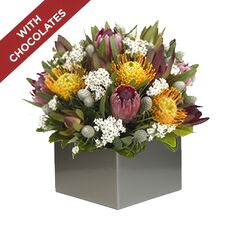
Native Arrangement With Chocolates
$166.50, chocolates includedThe longest-lasting product on the page. A Pink Mink Protea anchors it, a yellow Leucospermum sits at the apex, Leucadendrons add burgundy depth, and the silver Brunia clusters bridge to the metallic vessel. Three weeks fresh, then months as a dried arrangement on a shelf. The recipient effectively gets two displays from one purchase. For miss-you orders to a friend who needs to know you are still thinking, or a sibling who would find roses too soft, this is the one. The chocolates push it from arrangement to gift.
View product →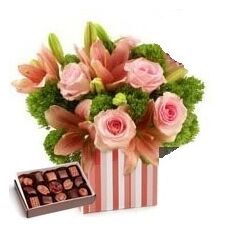
Blush Pinks Arrangement With Chocolates
$158.95, chocolates includedFoam box arrangement, no vase needed at the recipient's end. Pink roses, Asiatic lilies, lisianthus tucked between, Green Trick chrysanthemums anchoring the dome. The Asiatic buds open as the roses fade. The Green Trick holds for twelve to fourteen days. A built-in second wave so the arrangement is not over by day six. The format is the argument. With foam, the recipient does not need to be home to receive it cleanly. Water holds through hours on a doorstep, no vase to find, no stems to trim, no arranging on a kitchen bench. For an elderly parent or a daughter at university or anyone whose schedule the sender does not know, the format does the heavy lifting.
View product →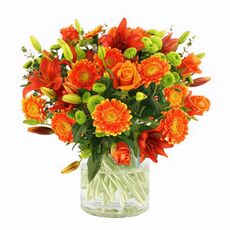
Mixed Orange Bunch
$174.95Sending flowers to a man can feel awkward, and orange takes the awkwardness out. Everyone reaches for pink for women or red for romance and then they get stuck when the recipient is a male sibling, a friend, a brother-in-law, anyone the sender cares about who is not on the romantic-feminine end of the spectrum. Orange roses, orange gerberas, orange Asiatic lilies, green chrysanthemum buttons that hold for two weeks. It reads as warmth without flirtation. Orange roses also hold their colour longer under indoor light than reds. They actually deepen as they open.
View product →If none of those four match what you are picturing, the catch-net is Florists Choice. Write the relationship and the tone in the order notes ("for my sister, gentle and not romantic", "for my dad, nothing too pink") and the florist builds to fit. The Florists Choice option exists for exactly this kind of order, where the sender knows the relationship better than the catalogue does. If you would rather talk it through with a person, ring us on 1300 360 469 between 7am and 6pm weekdays, 10am on Saturdays. Most miss-you calls get sorted in under five minutes once we know who you are sending to.
When you cannot be there
Most of what we do is reach across distance for people who cannot be there. The miss-you order is the version of that where the sender knows it the most clearly. They know they are not where the recipient is, that the flowers cannot fix it, that the card has to do work the flowers cannot. And they sit there for fifteen minutes trying to write the right two sentences.
The thing I would say (and Anna would say it too, in fewer words) is that the message landing is mostly already done before you write a word. You picked the relationship. The flowers came next. Then the day, then the address. You did all of that because you wanted them to know you were thinking of them, and the recipient knows you well enough to feel that on the doorstep before they read anything. The card is the small bit at the end. Two sentences. In your voice. Signed the way you sign a text. Job done.
Once you have sent it, you will wait. The waiting is the hard bit. Most recipients photograph the flowers within an hour or two. Some take a day. Estranged ones might not say anything for a week, or ever, and the gesture still landed. The flowers arrived. The card was read. You will hear when they have a moment to find the words back.
Flowers cannot fix a six-month silence. They can open a door the silence has closed. Anyway.
Further reading
Two adjacent guides if you want to keep going.
When you cannot be there, the flowers go in your place. Same-day delivery anywhere in Australia when you order before 2pm weekdays or 10am Saturdays. If you are still stuck on the words, our free card-message tool will draft you something based on the recipient and the relationship.
Browse all flowers
Lily's Florist delivers Australia-wide through a network of 800+ partner florists.
23,362+ verified reviews on our reviews page.
Same-day delivery when you order before 2pm weekdays or 10am Saturdays.
Questions? Ring 1300 360 469
About the authors
This guide was written by Siobhan Thomson with expert input from Anna and Andrew. Read our full story.

Andrew, Ivy, Siobhan and Asha. Hobart, June 2024.