
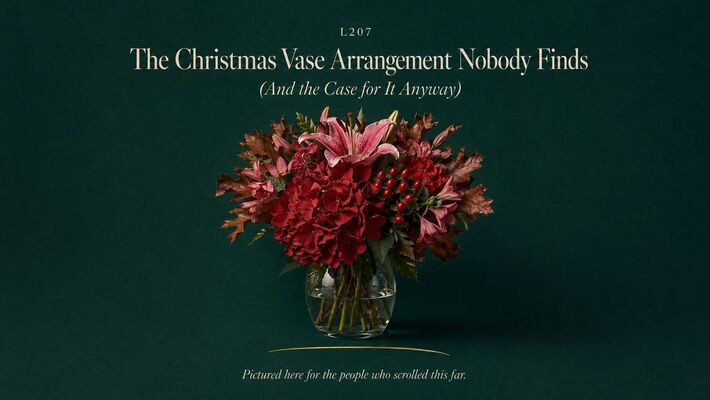
Christmas flower orders on our website follow a pattern. Someone searches for Christmas flowers. The first product they see is the Christmas Bunch at $99.95. Red, white, green, lilies, the works. Into the cart, finished by lunchtime.
There is a second Christmas product on the site that they almost never see. Same flowers, same palette, same partner florist building it. Twelve dollars more. Comes in a vase. We have been selling it since 2009. Two reviews on the page, five-star apiece, both from over a decade ago. It was our 176th most popular product in 2025.
This blog post is about that second product. The Christmas Special With Vase. SKU L207, if you needed to look it up, which you probably did not. The piece runs through why nobody finds it, why the people who would actually need it have trouble getting to it, and the one specific reason it might be the smarter gift if your situation lines up with what we are about to describe.
We are also going to be honest about the parts where we have done this to ourselves. There is no graceful way to introduce a product almost no one buys, so we will not try. And yes, we know it is April. The product itself is out of season for most of the year. So is this post, give or take.
The Product Almost Nobody Finds
Start with the search journey. Someone types "Christmas flowers" into Google or into our site search. They land on the category page. The Christmas Bunch is what they see first. It is twelve dollars cheaper, the photograph reads well, and the Christmas Bunch is what people picture when they hear "Christmas flowers." The vase version sits one scroll further down and there is no signal on the category page that it solves a different problem. We could have engineered that better. We did not.
Naming is the next problem. We called the hand-tied product the Christmas Bunch and the vase product the Christmas Special With Vase. The first name reads as a product. The second reads as a product with extra fittings. By the time someone is comparing the two, the brain has filed L207 as "the bunch but with a vase, which costs more, and I have a vase, so why would I." The buyer leaves the page in their head before the value of the vase has been explained.
The third issue is the calendar. L207 only exists for about six weeks a year. The preserved oak leaves, the red hydrangea heads, and the hypericum berry stems are all wholesale-market items that show up in late October and disappear by mid-January. The product literally cannot be built in March. Twelve weeks of selling against fifty-two weeks of sitting on the website is a hard equation. We knew that going in. We built it anyway.
Christmas stock at the market is its own world. For about six weeks each year, late October to mid-January, the wholesalers bring in things you cannot get the rest of the year. Preserved oak leaves, particular berry stems, conifer branches, frosted decoratives. The florist who orders early gets the best material. Whoever waits until December the twentieth is scrambling for what is left in the bins. A version of L207 built on December the third from the first market shipment and the same product built on December the twenty-second from the back of the cool room are not the same arrangement. Both are honest builds. The first one is the photograph.
After that comes the review count. Two reviews in twelve years, both five-star, neither newer than 2014. A new customer landing on the page sees a small number and either distrusts it or assumes the product is being phased out. The truth is more boring. L207 sells in low volume to a self-selecting audience that tends not to leave reviews afterwards. We have not figured out how to fix this without manufacturing the reviews, which we will not do.
Price perception kills another tranche of customers. Twelve dollars more for a vase is a question, not an answer. The customer ordering Christmas flowers owns at least one vase already, and they assume the recipient does too. The vase reads as a tax. There is one specific kind of recipient where that calculus flips entirely, and the rest of this post is about them, but the customer needs to have understood the flip before they decide. They almost never do.
The last factor is the sister product. The Christmas Bunch is genuinely good. We are not pulling our punches on this. If your gift is going to a recipient who owns a vase and will be home to take delivery, the Christmas Bunch is the right product. L207 is not better than its sibling in some abstract sense. It is better for a specific situation. Most of the customer base correctly does not need it.
Six factors converge to push the product to the bottom of the rankings. None of them is the product's fault. All of them are ours.
Two versions of the same Christmas arrangement is a problem most customers won't realise they're navigating.Anna, Qualified Florist, 15+ Years
Same Flowers, Different Job
Both products use the same four ingredients. There is a red hydrangea head at the centre, dense with dozens of small florets packed tight. Pink oriental lilies rise above it, with one or two blooms open and the rest as buds that will crack open over the following week. The frame is preserved oak leaves in dried autumn brown. Red hypericum berry clusters fill the gaps.
The hand-tied arrives in cellophane and the recipient does the rest. Find a vase. Maybe rummage at the back of the cupboard if the obvious one is in the dishwasher. Cut the stems back. Strip the lower foliage. Twenty minutes of small jobs if they enjoy it, two minutes of fuss if they do not. The vase format skips the lot. Glass vase, in water, ready to sit on a flat surface the moment the box opens.
The flowers do the same job. The format does a different one.
| Christmas Bunch (hand-tied) | Christmas Special With Vase (L207) | |
|---|---|---|
| Flowers | Same red hydrangea, pink oriental lily, preserved oak, hypericum | Same red hydrangea, pink oriental lily, preserved oak, hypericum |
| Format | Hand-tied bouquet in cellophane with a ribbon | Arranged in a clear glass vase, already in water |
| Recipient effort | Find a vase, trim stems, strip foliage, arrange | Place on a flat surface |
| Best for | Recipient who has a vase and will be home | Hydrangea protection, no-vase situations |
| Price | From $99.95 (Standard) | $112.00 single size |
| Sizes | Standard, Deluxe, Premium | One size, vase included |
Red hydrangea does not arrive at the wholesale market by the stem. It comes in bunches of three to five heads. For this product the florist pulls the head with the most uniform colour and the tightest dome. Whatever is left over goes into cheaper arrangements. The discard rate is higher than for any other ingredient in this build. Part of the per-stem cost is what does not get used.
Pink oriental lilies have a rule. Once a bloom opens, the anthers shed bright orange pollen that stains tablecloths, countertops, and shirt sleeves. Almost permanent on cotton. A careful florist removes the anthers before delivery. If yours arrive with anthers still attached, pinch them off the moment the bloom opens. There is a quieter benefit. The lily reads the absence of pollen as "I have not been pollinated yet" and keeps the bloom open longer, waiting. You add three or four days of vase life by removing the anthers before they shed.
The decorative elements outlast the flowers in either format. Preserved oak holds for years. Two to three weeks for hypericum berries if they stay dry. Lily buds open in sequence over seven to fourteen days. Hydrangea is the variable. Kept properly hydrated it gives seven to ten days, and how the hydrangea does is the lever everything else hangs off.
The Forty-Minute Window
There is one floristry fact that justifies the entire existence of L207 as a separate product, and it is about hydrangea. Over to Anna.
Most people think the choice between a hand-tied bunch and a vase arrangement is convenience. For hydrangea it is not. Hydrangea has the highest surface-area-to-volume ratio of any commercial cut flower I have ever worked with. The head is enormous and the petals are tissue-thin. That means transpirational loss is enormous. Every degree above twenty-one Celsius raises the rate by about 6.8 percent. On a normal December afternoon in most of Australia we are at twenty-eight degrees, sometimes thirty-two, often with low humidity. A wrapped hydrangea sitting on a doorstep starts losing turgor inside the first hour. Forty minutes is the working number I gave callers when they asked.
After forty minutes the cellular pressure drops below the threshold to keep the head domed and you can watch it slump. Not a metaphor. The petals at the outer edge go translucent first, then the dome flattens, and by the time the recipient finds the parcel the flower is already past saving in any meaningful way. You can get partial recovery if you cut the stem and submerge the head in cool water for an hour, but the arrangement does not look like the photograph again.
The thirty-eight-degree summer afternoons were the worst for these calls. I would tell the caller a hydrangea was not going to make it through that day. A few sent it anyway. The complaint came in by the next morning.
In a glass vase with the water at the right depth, the stem has been drinking the entire time. The collapse never starts. The extra twelve dollars on this product is not for the vase. It is for the forty minutes between the doorbell and the water level, which is the window where hydrangea fails.
Hydrangea is classified across multiple commercial floristry references as the most temperature-sensitive cut flower in the global trade. Vase life ranges by temperature: seven to fourteen days at fifteen degrees Celsius, four to ten days at twenty-two degrees, one to five days at twenty-eight degrees. Floristry research consensus: every degree above twenty-one Celsius raises transpirational loss by roughly 6.8 percent. At twenty-eight degrees with low humidity, lab observations record full bloom collapse within hours.
A red hydrangea head costs the florist between $6 and $12 wholesale, depending on whether the order goes through early in the December run or late. That is one stem. If a customer pays $112 for an arrangement and the centrepiece collapses on the doorstep before the recipient gets to it, they have paid roughly ten percent of the order for an unrecoverable stem. The vase format protects the most expensive single ingredient in the build. The twelve dollars buys insurance on a stem you have already paid for.
What Anna is describing is the difference between a flower that arrives at peak and a flower that arrives already finished. For most stems on a hot Australian afternoon, the gap between the two is measured in hours. For hydrangea, the gap is closer to half an hour. The vase is buying that difference.
In a glass vase with the water at the right depth, the stem has been drinking the entire time. The collapse never starts.Anna, Qualified Florist, 15+ Years
For Recipients Who Probably Don't Have a Vase
The single five-star review on the L207 product page from December 2014, order reference 51582, ordered by Michael for his daughter-in-law in the days right before Christmas, has one line in it that explains the entire product. He wrote: "She has just moved house so the vase was particularly appreciated." The whole use case sits in that sentence. We have stared at it for years.
She had just moved house. The kitchen boxes were almost certainly still taped up, and the vase that probably lived on the windowsill of the previous place was now somewhere between the move and the unpack, possibly in the box marked fragile and possibly in a box not labelled at all. She had Christmas coming, in-laws sending flowers, and no obvious place to put them. The vase version walked through the door already solved. Nothing to find. The water was already in. The flowers were already arranged. Place it down somewhere and keep unpacking.
Michael was not a special case. He was an early version of a recipient profile we have seen, in different shapes, every year since. Adult children sending to parents who have downsized into something smaller. Office Christmas gifts going to an interim address while a colleague is between houses. Friends sending to friends in hospital, or a hotel, or a share house, or any of the other situations where the recipient does not have a vase ready to use.
Eight situations show up most often. If you are sending to a recipient in one of these, the vase format is not a $12 upgrade. It is the difference between a gift that works and a gift that creates a small problem the recipient now has to solve.
The new house
Boxes still taped up in the kitchen. The vase that lived on the windowsill of the last place is somewhere between the move and the unpack, and it could be Saturday before they find it. With the vase version, that whole search is skipped.
The Christmas Day host
Flowers go to someone hosting Christmas lunch for fifteen people. Every vase they own is already on the dining table holding centrepieces. The kitchen is in service from breakfast onwards. A vase arrangement walks in already finished and goes straight onto the sideboard.
Aged care rooms
Rooms in residential aged care are small, and the bedside table is mostly a glass of water and a tissue box. Shared bathrooms or kitchenettes most of the time, no real way to fuss with stems and water at a sink. A finished vase arrangement is the only format that works in the space.
Hotels, Airbnbs, and serviced apartments
Christmas in temporary accommodation. Vases in a rental are decorative items, not functional ones, and the obvious containers behind the bench are minibar glasses. A wrapped bunch sits in the kitchen unwrapped for the duration of the stay.
Share houses and student rentals
Kitchenware in a share house is one mug per person and one shared frypan. Vases are uncommon. The vase version arrives ready to display, and when the recipient moves out they have a vase to take with them.
After a separation
The vase often went with the other person. So did the spares. Christmas after a split is hard enough without the gift triggering an inventory check. The vase arrangement avoids the question entirely.
Illness, surgery, or grief
Energy is the missing ingredient. The recipient may have ten vases in a cupboard and not the bandwidth to find one. A vase arrangement removes a task that should not be on this week's list.
Older recipients with arthritis
Gripping a knife to trim stems while standing at a sink is a barrier we underestimate. So is bending under a sink for a vase nobody has touched in eighteen months. The vase format hands over the gift fully assembled.
The Michael review is the only marker on the product page that the use case exists, and it has been doing all the heavy lifting since 2014. Michael is not at fault. Neither is the customer for missing it. The journey is the problem.
Two things this product is not the right gift for. Cats in the home, because oriental lilies are toxic to cats and even pollen contact can cause kidney failure. Hospital recipients need something else. Most Australian wards restrict lilies due to airborne pollen and the risk to other patients. If your recipient is in either situation, browse our Christmas hampers for lily-free options instead.
The Honest Verdict
If your gift is going to a recipient who owns a vase and will be home to take delivery, the Christmas Bunch is the right product. It is twelve dollars cheaper, the partner florist builds it that morning from the same flowers, and it does what a Christmas hand-tied is supposed to do. It is also in position one on the category page for a reason. We did that on purpose.
If your gift is for one of the eight situations above, or any situation where you are not sure whether the recipient has the time, the energy, or the spare cupboard space to find a vase, the Christmas Special With Vase is the right product. The twelve dollars is not for the vase. It is for the forty minutes between the doorbell and the water level, which is the window where hydrangea fails. It is also for the quiet absence of having to wonder whether they had a vase to put it in.
Andrew We thought about renaming it. "Christmas Hydrangea Vase" is more descriptive, more searchable, and would help with everything this post is trying to fix. The catch is the two reviews from 2014. Renaming the product breaks its review history, the existing inbound links, and the sixteen years of SEO equity the URL has carried since 2009. So the product stays Christmas Special With Vase, the SKU stays L207, and we accept that the post is doing the work the product name should be doing. Yes, we know.
Andrew, on what we are fixing for Christmas 2026 L207 was our 176th most popular product in 2025. The Christmas Bunch was 146th. Christmas at our place is a seasonal niche, not a blockbuster category, so neither product is climbing into the top 50 of an 800-product catalogue. But there is a piece of data that matters more. Our most popular Christmas product last year was the Bright Mixed Bunch With Vase. Vase included. The vase format is not the problem. We have just not given L207 the runway it should have had on the category page or anywhere else. That is on us, not on the product. For Christmas 2026 we are giving L207 better positioning on the category page, clearer signalling about who it is for, and a real attempt at finding the audience for it. We will report back in January.
This post is unusually long for what it is selling. We are aware. The brief on this post was short: tell the truth about a product hardly anyone finds, explain why, and make the case for the situations where the vase format is the better gift. We have done all three. The honest version of the rest is shorter again. Most customers who land on this post will not need the product. The customers who do need it are the reason it still exists.
This is a blog post about a product that lives at the back of the catalogue. We wrote it because the people who would benefit from it have a hard time getting to it. If you have read this far and the product fits your situation, you have just solved your own problem. We do not have a better way to put that.
Further Reading
Two more posts on Christmas if you want to keep going.
Same-day delivery when you order before 2pm. Twelve dollars more than its more popular sibling. Vase included.
View The Christmas Special With Vase
Lily's Florist delivers Australia-wide through a network of 800+ partner florists.
23,000+ verified reviews on our reviews page.
Same-day delivery when you order before 2pm weekdays or 10am Saturdays.
Questions? Ring 1300 360 469
About the Authors
Andrew wrote this post with input from Anna and Siobhan. The hydrangea forty-minute number is Anna's. The Michael review is Siobhan's territory. Andrew owns the honesty about the product naming. Read our full story.

Andrew, Ivy, Siobhan and Asha. Hobart, June 2024.