
Flowers With The Best Fragrance
The Science of Why Some Flowers Fill a Room and Others Barely Register
There is a moment, maybe ten minutes after the florist has left and the front door has closed, when the fragrance arrives. Not all at once. Slowly. A warmth in the hallway. A sweetness that was not there before. If you have ever had Oriental lilies on the kitchen bench, you know this moment, and if you have not, there is genuinely nothing I can compare it to except maybe walking past a jasmine hedge at dusk (which, growing up in Taree, happened most summer evenings on the walk back from Old Bar).
Andrew and I have been sending flowers through our partner florists for seventeen years now. In that time the single question our call centre has fielded more than any other, apart from "will it get there today," is about scent. Will these smell nice? Will she be able to smell them? Can you send something fragrant?
The honest answer is complicated. One stem of Oriental lily can scent an entire house. A dozen commercial roses barely register. A flower your grandmother swore smelled like heaven might smell like absolutely nothing to you, because of your genetics (we will get to that). And the bedroom showpiece becomes a hospital room problem the moment you put it in a shared ward.
We asked Anna, our qualified florist, to help us pull the science apart. She said yes, then talked for two hours.
Anna
Qualified florist, 15+ years on the bench, 10,000+ customer calls processed from our Pottsville officeI trained in North Carolina and worked as a florist for over fifteen years before Siobhan and Andrew brought me on to help build Lily's Florist. Most of what I know about fragrance I learned from standing at the bench at 5am, conditioning stems that had come off the truck from Flemington or Rocklea, and noticing which ones changed the air in the room. You condition fifty bunches of roses and they barely register. You crack open one box of Oriental lily stems and the entire workshop smells like a cathedral.
When I took calls from customers between 2010 and 2013, fragrance came up constantly, but usually in one of two ways. People either wanted the flowers to smell as good as they looked. Or they needed flowers for someone in hospital and were worried about overwhelming the room. Both are valid concerns, and both have real answers grounded in what the flower actually produces at the molecular level, not marketing copy.
The research Siobhan and I pulled together here goes deep. I will be honest: the molecular biology section nearly broke me. I am a florist, not a biochemist. I had to read four research papers before I understood why white flowers are more fragrant than coloured ones, and I am still not entirely sure I have got it right. But every claim I make connects back to something I have seen on the bench or heard on the phone, and the science just explains why.
Every Flower at a Glance: Fragrance, Mood, and Best Placement
If you are here for one specific flower, this table has your answer. The detail lives in the sections below.
| Flower | Fragrance | Dominant Effect | Best Placement |
|---|---|---|---|
| Oriental Lily | Very high | Bold, sweet, fills a room | Large living areas, private rooms |
| Stock (Matthiola) | High | Spicy, clove-like, persistent | Hallways, open-plan kitchens |
| Freesia | High | Citrusy, fresh, spring-like | Bedrooms, daytime offices |
| Hyacinth | Very high | Green, sweet, penetrating | Cool rooms, spring displays |
| Rose (garden) | Moderate-high | Romantic, calming, complex | Bedrooms, living rooms |
| Rose (commercial) | Minimal | Near-scentless | Anywhere (no fragrance risk) |
| Lavender | Moderate | Calming, anxiety-reducing | Bedrooms, recovery spaces |
| Carnation | Low-moderate | Spicy, clove-like, subtle | Anywhere, including hospitals |
| Asiatic Lily | None | Deliberately bred scentless | Hospitals, shared wards, offices |
| Gerbera | None | No scent | Anywhere |
| Chrysanthemum | Faint | Negligible | Anywhere |
| Tulip | Faint | Negligible | Anywhere |
Why the Most Fragrant Flowers Are Almost Always White
There is a pattern that anyone who has worked in a flower shop notices eventually, even if they cannot explain it. The most powerfully scented cut flowers are nearly all white or pale: jasmine, gardenia, tuberose, Oriental lily, freesia, lily of the valley. The deeply coloured flowers, the saturated reds and purples and oranges, tend to have less fragrance or none at all.
This is not coincidence. The metabolic pathways that produce flower pigments and the pathways that produce fragrance compounds compete for the same chemical building blocks inside the plant. Anthocyanins (the molecules responsible for red, purple, and blue) and volatile organic compounds (the molecules your nose detects) both draw from the shikimic acid pathway. A flower investing heavily in colour has fewer resources to invest in scent. White flowers, freed from pigment production, pour everything into scent production instead.
Jasmine alone contains over 100 distinct aromatic chemicals. Its primary compound, benzyl acetate, makes up between 15 and 67 per cent of the fragrance depending on the species. Linalool provides brightness. And then there is indole, a molecule that smells aggressively unpleasant in isolation but at the ratio the flower produces it (roughly 200:1 benzyl acetate to indole), it transforms into something rich and hypnotic. Perfumers call this the molecule that makes white flowers "breathe and shimmer."
Gardenia's scent is so chemically complex that no perfumer has ever managed to replicate it synthetically. Tuberose, known in perfumery as "the carnal flower," is so voluptuously scented that in India young women were historically warned not to breathe it after dark. The extraction economics tell you everything about how much these white flowers invest in scent: tuberose needs 3,600 kilograms of flowers for half a kilogram of absolute. Jasmine needs roughly 15,000 blossoms to yield 1.5 grams of oil. Neroli, distilled from bitter orange blossom, needs a full tonne of flowers for a single kilogram. These are staggering numbers. The living flower does what a perfume factory cannot do cheaply.
Anna on Oriental Lilies
Oriental lilies are the most powerfully fragrant stem in any florist's cooler. One arrangement can change the entire ground floor of a house. The fragrance builds, too. Day one, when most buds are still closed, you catch hints. By day five, with three or four blooms open at once, the scent peaks. No other flower has that slow crescendo. A rose smells the same from the first hour to the last petal drop. Orientals build toward something.
The trade-off is that the intensity is not for everyone. In a hospital shared ward, an Oriental is antisocial. The person in the next bed did not choose that fragrance. Asiatic lilies give you the visual without the scent if the setting demands restraint.
The most underrated fragrant flower in commercial floristry is stock. Matthiola. Spicy-sweet, clove-like, persistent from day one to day ten. Excellent vase life. Available through the cooler months, which is half the year in most of Australia. Nobody outside the industry talks about it, and that is exactly why it ends up in your florist's choice arrangement as the stem you did not expect and cannot stop smelling. If a customer told me they wanted the room to smell like a florist shop, I would reach for stock before anything else.
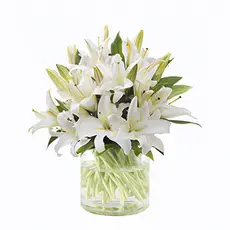
White lily stems at staggered opening stages, so the fragrance builds across ten to fourteen days as each bud opens in sequence. Starts from $80.75. Five to six stems at Premium carry fifteen to twenty-five individual blooms over the arrangement's life. One of our highest-reviewed products with 67 verified reviews.
Day 1
Hints
First buds still closed. Catch the scent if you lean in.
Day 3
Building
Two blooms open. The hallway picks it up.
Day 5
Peak
Three or four blooms open. Fills the room.
Day 10+
Gently fading
Last buds opening as first blooms finish. Scent softens.
Two practical warnings before you order
The fragrance is extraordinary. The pollen is a menace. The anthers carry rust-orange pollen that permanently stains fabric, carpet, skin, and white surfaces on contact. A good florist removes the anthers before the arrangement goes out, but buds that open on day three or four in the recipient's home will expose fresh anthers. The fix is simple: pinch them off before the pollen disperses. If pollen lands on fabric, do not wipe it. Lift it off with sticky tape. Rubbing drives the pigment into the fibre and sets the stain permanently.
And if the recipient has cats, skip lilies entirely. All lily species are highly toxic to cats. Roses, gerberas, and chrysanthemums are safe alternatives with zero toxicity risk. (Our pet safety guide covers this in detail.)
An honest note about gardenias and jasmine
Every "most fragrant flowers" list on the internet includes gardenias and jasmine near the top. They deserve to be there. The scent is extraordinary. But neither is a realistic option for a delivered bouquet, and pretending otherwise is misleading.
Gardenias brown within hours of being handled. The petals bruise if you look at them sideways. They are a garden shrub, not a cut flower. No commercial florist stocks them for delivery because they would not survive the supply chain from market to van to doorstep.
Jasmine is a vine. Beautiful on a fence at dusk. Useless in a vase. The stems are too thin, too fragile, and the blooms collapse once cut. You can buy jasmine essential oil. You cannot buy a jasmine bouquet from any working florist in Australia.
I include them here because you should know what they are and why they smell the way they do. But if you are ordering flowers for someone and fragrance matters, the realistic options are Oriental lilies, stock, freesia, hyacinth, and garden-grade roses when they are in season.
The Rose Fragrance Paradox: 400 Scent Molecules and Most Roses Smell Like Nothing
Rose oil contains over 400 distinct scent molecules. Four hundred. More than almost any other flower on the planet. And yet most of the roses you receive in a delivered bunch will have almost no perceptible fragrance.
The explanation sits at the intersection of chemistry and economics. Rose scent is not linear. The most abundant compound in rose oil, citronellol (20 to 34 per cent of the total), has a high odour threshold. Your nose needs a lot of it before it registers. Meanwhile, a compound called beta-damascenone makes up just 0.14 per cent of the oil, but has an odour threshold measured in parts per trillion. It punches absurdly above its weight. The "rosiness" you associate with a garden rose comes disproportionately from trace compounds, not from the bulk of the oil.
Modern commercial roses, the Colombian and Kenyan varieties that dominate the global wholesale market, have been bred for stem length, petal count, vase life, and disease resistance. Fragrance was never the priority. When breeders selected for a 70-centimetre stem that lasted twelve days in a vase, they inadvertently selected against the gene expression that produces those trace scent compounds. The genes are still there. They are just suppressed.
Garden varieties and heritage cultivars, the David Austins and the old Damask roses, still carry the full fragrance profile. But they cost more at the market, produce shorter stems, and last fewer days in a vase. Andrew calls this the fundamental rose trade-off: scent or longevity, not both. If scent is what you are after, mention it when you order from our roses range and the florist will reach for whatever garden-grade stock came through that morning.
Anna, Qualified Florist
I took a call once from a woman in Perth who was furious. She had ordered a dozen red roses for her wedding anniversary and they had zero scent. She thought the florist had sent old stock. They had not. The stems were fresh, well-conditioned, gorgeous to look at. They were also standard commercial hybrid teas, bred to travel 10,000 kilometres from Bogota to Flemington without losing a petal. Fragrance was never part of the specification.
If someone phones and says they want roses that smell like a garden, I steer them toward a florist's choice with specific instructions, or I tell them honestly: it depends on what the florist has that morning. Garden-grade roses come through the market seasonally. They are not a guaranteed item.
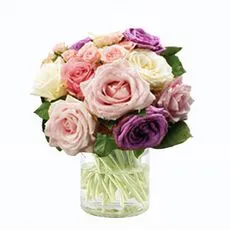
A mixed-rose palette with soft pink, cream, cerise accents, and what Anna identifies as double lisianthus providing the purple register. The garden styling evokes cottage roses, though the stems are commercial grade. The lisianthus will outlast the roses by three to four days, giving the arrangement a quiet second act.
Why the Same Flower Smells Completely Different to You and Your Partner
This is the part that surprised me most in the research and, honestly, made me feel better about years of arguments with Andrew about whether the shop smelled like anything at 7am.
Humans carry approximately 400 functional olfactory receptor genes. But which ones are active varies enormously between individuals. A single genetic variation in the OR5A1 receptor gene determines whether you perceive beta-ionone, the violet-floral compound found in roses and violets, as a pleasant floral scent or as a sour, vinegary tang. People with two copies of the A variant are roughly 100 times less sensitive to the compound. One gene. The difference between finding roses intoxicating and finding them faintly unpleasant.
Phenylethyl alcohol, the primary "rosy" compound, has its own receptor variation. Some people cannot detect it at all. Roses, to them, are genuinely odourless. This is not a preference. It is not them being difficult. It is a neurological gap as real as colour blindness, and it is more common than most people realise.
One gene. The difference between finding roses intoxicating and finding them faintly unpleasant.Siobhan Thomson
Scientists call these gaps "specific anosmias," and they affect a surprising number of fragrance-relevant compounds. Linalool (the calming compound in lavender, jasmine, and freesia) has wide sensitivity variation across the population. Geosmin, the earthy smell of rain on soil, is invisible to a measurable percentage of people. Even androstenone, a musky compound that some noses read as woody and pleasant and others read as acrid sweat, factors into the complex way we experience floral blends.
A cross-cultural study testing populations from Tanzania, Bolivia, New Guinea, Poland, and Malaysia found that while molecular identity drives most pleasantness judgments, personal experience accounts for 54 per cent of individual scent preference. Culture contributed only 6 to 7 per cent. The implication is stark: your relationship with a fragrance was built mostly by your life, partly by your genes, and barely at all by your geography.
Anna on customer calls
I had callers tell me they "could not really smell roses." Not often, but enough that I stopped assuming they were exaggerating. Science backs them up. If your receptor for phenylethyl alcohol is underperforming, a rose practically registers as almost scentless. The flower is producing the same molecules. Your nose is just not equipped to detect them. Knowing this changes how I make recommendations. If someone says they want fragrant flowers and roses have never done it for them, I skip roses entirely and go straight to Oriental lilies or freesia. Different chemistry, different receptors.
When Fragrance Becomes the Problem: Hospitals, Small Rooms, and Olfactory Fatigue
Everything above is about fragrance as a gift. But there are settings where fragrance is a liability, and getting this wrong turns a thoughtful gesture into something uncomfortable for the person receiving it.
Shared hospital wards
A strongly scented flower in a private room is a beautiful thing. In a shared ward with three other patients, it is an imposition. The person in the next bed might be nauseous from medication, recovering from surgery, or simply not in a position to escape a scent that fills the entire room. Orientals and stock are the worst offenders. From what our florists have seen, most major hospitals in Australia prefer unscented arrangements in shared wards, though policies vary and are not always enforced.
The safe picks for hospital deliveries where you do not know the room type: Asiatic lilies (the lily look without any scent), gerberas, chrysanthemums, or a hospital-friendly arrangement where the florist makes the call based on what is available that morning.
Olfactory fatigue (or: why you stop smelling your own flowers)
If you have placed gardenias on the kitchen bench and thought the scent was fading by the second day, you experienced what neuroscientists call olfactory adaptation. Your flowers did not lose their fragrance. Your brain deprioritised the signal. When odorant molecules continuously bind to the same olfactory receptors, intracellular calcium triggers a negative feedback loop that reduces receptor sensitivity. Your brain stops noticing what is constant and redirects attention to anything new or changing.
Recovery is fast. Leave the room for fifteen minutes and return. The scent hits you all over again. This is why a guest walks into your kitchen and says "it smells incredible in here" while you had forgotten the flowers were there.
Complex, layered fragrances resist adaptation longer than simple ones because they present new molecular facets over time. Lilies, with their evolving scent profile as each bud opens across the week, maintain their presence in the room longer than a flower with a flat, unchanging scent.
The fruit bowl next to the vase
Ripening fruit produces ethylene gas, a colourless, odourless compound that triggers aging in cut flowers at concentrations as low as 100 parts per billion. A fruit bowl with bananas, apples, or avocados on the same kitchen bench as your flowers can devastate carnations, delphiniums, and waxflower within twelve to twenty-four hours. Carnation petals curl inward. Waxflower drops every bloom at once, as if someone shook the stem over a bin.
Anna on ethylene
The fruit bowl kills more flowers than the heat does, and nobody thinks about it. Bananas are the worst offenders. Same bench is enough. Same room is borderline. Different room is safe. Chrysanthemums could not care less about ethylene. They are the cockroach of the flower world. But carnations, waxflower, freesia, and both types of lily will age days faster if the fruit bowl is within arm's reach. Move the vase or move the fruit. One or the other.
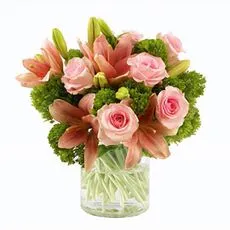
The zero-fragrance alternative. Pink Asiatic lilies (deliberately bred scentless), blush roses, and Green Trick dianthus. Anna rates this for hospital rooms, aged care, offices, and any setting where scent is a risk. The Asiatics give you the lily shape and multi-bud opening sequence without any of the perfume. Green Trick dianthus lasts two weeks.
When Flowers Smell Their Best: Temperature, Time of Day, and Humidity
Floral fragrance is not constant. It follows a biological clock calibrated over millions of years to match the activity patterns of pollinators. Jasmine ramps up scent production in the evening because its primary pollinators are nocturnal moths. Day-blooming orchids peak in daylight because their pollinators are diurnal insects. The plant is running an advertising campaign, and it only pays for airtime when the audience is tuned in.
For cut flowers on a kitchen bench, this translates into practical knowledge. The lilies will smell strongest in the evening, especially in a warm room, because warmth accelerates the release of volatile compounds from the petal surface. Cooler rooms slow evaporation, which means the scent lingers longer and travels further instead of dissipating quickly. Humidity helps too. Moisture in the air keeps scent molecules airborne.
A bunch of those lilies in a cool, slightly humid living room at 7pm on a winter evening in Melbourne or Hobart is experiencing near-perfect fragrance conditions. The same bunch in a hot, dry, air-conditioned office at 2pm will release its compounds faster but they will dissipate before they reach the other side of the room.
Anna on climate and vase life
Temperature compresses every timeline. A rose that gives a Melbourne customer seven days will give a Darwin customer three, sometimes four. The same principle applies to fragrance. Warm air strips volatile compounds from petals faster. The flower smells stronger for a shorter window, then the scent fades because the molecules are used up. Cool conditions slow the release. The fragrance lasts days longer, and the vase life extends with it. A Hobart living room in June is the best-case scenario for fragrant flowers in Australia. Everything else is a compromise with the thermostat.
The lavender exception
Most fragrance research compares clinical settings. Lavender has been studied more than any other fragrant flower, and the evidence is substantial. A meta-analysis of 37 randomised controlled trials involving over 4,000 participants found that inhaled lavender significantly reduced anxiety. In one controlled study with open-heart surgery patients, roughly 70 per cent of the variance in cortisol levels was attributable to the lavender intervention alone. The active compound, linalool, works on the same GABA receptor system targeted by pharmaceutical anxiolytics. This is not aromatherapy marketing. It is pharmacology. The nasal-brain pathway allows inhaled compounds to reach the central nervous system without passing through the bloodstream, meaning effects can begin within seconds of inhalation. Anna kept dried lavender on the bench for years and thought it was just habit. The linalool was doing real work on her cortisol at 6am while she stripped thorns. She did not know that until we pulled this research together.
Rose fragrance shows similar mechanisms through different pathways. A 2025 EEG study found that exposure to rose scent during stress recovery reduced total mood disturbance by 29 to 37 per cent compared to baseline and improved brain network connectivity. A rose compound called beta-damascenone, one of those trace molecules that drives most of the perceived "rosiness," was identified in 2023 as a novel immunomodulator, capable of inhibiting inflammatory cytokines. The science is young but the direction is consistent: fragrant flowers produce measurable physiological effects that go beyond simply smelling pleasant.
Andrew Thomson, Co-founder
We ship into every climate zone in Australia. Hobart at 15 degrees. Darwin at 34. When someone in Cairns orders Orientals, the fragrance window is two, maybe three days before the heat burns through the volatile compounds. Same product ordered to Launceston gets a week of scent. Same flower, same price. What we can control is making sure the florist in or near the delivery address conditions those stems properly before they go out. A well-hydrated lily on a cool bench holds its fragrance longer than one that spent two hours on a hot delivery van. That bit is on us.
The Memory Connection: Why Floral Fragrance Stays With People for Decades
You know that moment when someone walks past wearing the same perfume your mother wore? The way it stops you cold, mid-step, and you are not in a shopping centre anymore, you are sitting on the floor of her bedroom watching her get ready for a night out? That is not nostalgia. It is architecture. Your nose is wired to your brain differently from every other sense.
When you see or hear something, the signal passes through a structure called the thalamus, which filters information before it reaches the cortex. When you smell something, the signal skips the thalamus entirely and goes straight to the amygdala and hippocampus, the regions that process emotional memory. No gatekeeper. No filtering. The emotion arrives before the conscious thought. Neuroscientists call it the Proust Phenomenon, after Proust's description of a tea-soaked madeleine unlocking a childhood memory in 1913, and the science since then has confirmed what he observed: scent-triggered memories are consistently older, more emotionally intense, and more involuntary than memories triggered by sight or sound.
For flowers, this means something that extends well past the vase life. When someone receives a fragrant arrangement during a meaningful moment, the scent becomes encoded in a memory structure that is remarkably resistant to decay. The research suggests odour-evoked memories may even bypass damaged pathways in Alzheimer's patients, reaching older and more resilient storage routes. (Women, incidentally, outperform men on every measure of scent detection. A meta-analysis of over 8,000 participants confirmed it. I could have told them that. Andrew walks past the cooler at Flemington and notices nothing. I walk past and know what came in that morning.)
The vase life is seven to fourteen days. The memory, if the science is right, can last a lifetime.Siobhan Thomson
I think about this when customers ask whether the extra cost of lily flowers or garden-grade roses is worth it. Not sentimentality. Neuroscience.
Choosing Fragrant Flowers: A Decision, Not a Default
If the research here teaches one thing, it is that fragrance in flowers is not a binary. It is a spectrum that depends on the flower species, the recipient's genetics, the room temperature, the time of day, and whether other people share the space. Choosing flowers for fragrance means knowing what the setting demands and picking flowers that match.
For maximum fragrance in a home, Oriental lilies are unmatched. For subtle, layered scent in a bedroom, a bunch with garden-grade roses and freesia (when seasonally available) will produce something gentle and evolving. For hospitals, shared offices, aged care rooms, or any setting where scent sensitivity matters, get well flowers built from Asiatic lilies, gerberas, and chrysanthemums deliver colour and longevity with zero fragrance risk. If fragrance is the priority and colour is secondary, start with white flowers. The science says they invest the most in scent.
The recipient's age matters more than most people expect. Research shows younger recipients gravitate toward bold, sweet, fruity-floral scents. By their thirties and forties, preferences shift toward complexity and nuance. Older recipients tend to prefer lasting, gentle fragrance over dramatic intensity. A twenty-five-year-old might love the full force of Orientals in a small apartment. Her seventy-year-old grandmother in aged care might find them overpowering. Same flower, different nose, different room, different result.
Quick pick: fragrance by occasion
Home
Oriental Lilies
Room-filling scent that builds across the week
Hospital
Asiatic Lilies
The lily look, zero scent, ward-safe
Sympathy
White Lilies
Fragrance and formality in one stem
Thinking of You
Freesia + Roses
Gentle, layered, memory-making
Birthday
Mixed with Stock
Bold, spicy-sweet, lasts two weeks
Not Sure
Florist's Choice
Mention fragrance. They will know.
If you are not sure, that is exactly what the florist is for. When you order, mention that fragrance matters. Our team notes it on the order and the partner florist reaches for the stems with the strongest scent development that morning. Delivery is $16.95 flat, same day if you order by 2pm weekdays or 10am Saturday (we subsidise the rate because the actual freight cost is higher). Bunches start from $42.95 if budget matters, and flowers under $60 still carry the same same-day promise. No Sunday delivery because the markets close Saturday afternoon and Monday stock is fresher than anything that sat in a cool room over the weekend.
Ring us on 1300 360 469 and tell us the room. We will tell the florist.
Related Guides


The Kingscliff shop where it started. No boardroom, no marketing team. Just a shop on the main street and a phone that would not stop ringing.
Blog Categories
Recent posts
- Sending Sympathy Flowers to Australia From the UK
- Which Lily to Send Oriental, Asiatic or LA, and Why the Buds Arrive Green
- Post-surgery flowers and the six jobs a bouquet hands over
- What One Gerbera Tells You About Your Flower Delivery
- Sending Flowers to Canberra Hospital: What Happens When They Arrive
- Flower Tattoos: The Symbolism and Artistry in Popular Flower Ink
Can't decide?Ring us, we pick the flowers with you.
Call Us NowGive us a call and one of our friendly Australian team will pick the right flowers with you. It takes two minutes.
1300 360 4697am-6pm weekdays. Australians answer the phone.