
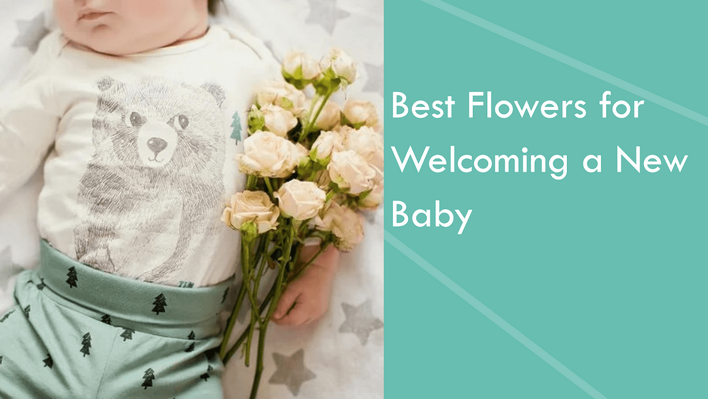
When I was pregnant with Asha, back in 2010, I received four bunches of flowers in two weeks. Three of them died before she was born. One lasted, this little stubborn cluster of pink carnations from a friend in Taree who rang our Kingscliff shop and ordered over the phone because she did not trust the internet. That bunch sat on the bedside table at John Flynn Hospital the morning Asha arrived, and I stared at it for twenty minutes while the midwife did her checks, because it was the only still thing in the room.
I was on the receiving end that day. Most of you reading this are on the sending end, which is harder. A new baby is one of the genuinely happy reasons to send flowers, and you wish you could deliver them in person instead of trusting a stranger with your emotions and a credit card number.
I stopped counting new baby orders somewhere around year three. The system tracks them now, across 800+ partner florists, in every state, to hospitals I could not point to on a map and homes I will never visit. And the one thing I know for certain, from seventeen years of doing this, is that most people get the flowers right and the timing wrong. Or they get the stems right and the format wrong. Or they spend forty-five minutes choosing the perfect arrangement and send it to a ward that does not accept flowers at all.
Anna trained in North Carolina, worked the bench at Salt here in Kingscliff, then spent three years on the phones at our Pottsville home office taking ten thousand calls from people sending flowers to new babies in every hospital and every suburb in Australia. She has two boys of her own. I mean, between us, four kids and a decade and a half of flower orders, we have made every mistake in this guide and learned the fix for each one.
This is not a list of pretty flowers with a buy button at the bottom. If you read this and still send lilies to a maternity ward, we tried.
In this guide
How hospital flower delivery actually works
Sending flowers to a hospital when you cannot be there yourself is an act of faith in strangers. Here is how the chain works so you know exactly who is handling them. Your flowers go to the main reception desk or patient services. Not the ward. Not the room. A staff member checks the patient name and ward number against the system. If the patient is admitted and the ward accepts flowers, a ward clerk collects them and takes them up. Nursing staff or volunteers bring them to the bedside. The gap between the florist leaving and the flowers reaching the new mum can be thirty minutes on a quiet Tuesday. On a Friday afternoon when every office in the city has sent congratulations, three hours.
The florist does not walk through the hospital. They never see the room. They hand the arrangement to a person behind a desk and leave. Everything after that is out of their hands and out of yours. On a 35-degree day, the van interior between the cool room and the hospital reception can hit 50 degrees in twenty minutes. The florist runs the delivery first thing, before the heat peaks.
You need the mother's full name (her name, not the baby's) and you need the ward number. Hospitals will not tell an unknown caller which room a patient is in. If you are ordering flowers and you do not have the ward number yet, call the hospital switchboard, give the mother's name, and they will tell you which ward. Without that number, the flowers sit at reception with a name on the card and nobody comes to collect them. Our full hospital flowers guide covers ward-by-ward restrictions in more detail.
The question came up hundreds of times on the phones. "Can you deliver to the hospital?" Yes. "Will the florist take them to the room?" No. The delivery chain is reception to ward clerk to bedside, and the florist controls only the first step. The other thing people miss: maternity wards usually accept flowers. NICU does not. Special care nursery does not. If the baby is in intensive care, the flowers go to the mother's ward or they do not go at all. The underdeveloped respiratory and immune systems in NICU mean nothing organic goes near those babies. I had a caller once, her daughter's baby was in special care at Royal Brisbane, and she wanted to send the biggest arrangement in the range to the NICU. I had to explain why that was the one ward in the hospital where flowers could not go. She sent them to her daughter's room in general maternity instead. Right decision.
The lily ban nobody mentions
Every Epworth hospital campus in Victoria bans lilies by name. Not a suggestion. A ban. The exposed pollen on lily stamens is easily airborne, lands on staff clothing, transfers between rooms. Stargazer lilies carry an intense fragrance that triggers headaches and respiratory symptoms in enclosed spaces. Epworth's policy covers all lily varieties, all wards, no exceptions.
Most new baby flower guides online recommend lilies. They photograph well, they smell beautiful, they open dramatically over a week. What those guides do not mention is that the pollen stains fabric permanently, the fragrance fills a shared maternity ward like perfume in a lift, and more hospitals are restricting them every year.
Peace lilies and orchids are not lilies. People assume they are. Peace lilies are Spathiphyllum, orchids are Orchidaceae. Neither has the exposed pollen or the fragrance issue. Both are fine in hospitals. The ban targets Lilium species: Asiatic, Oriental, Stargazer, and their hybrids. Pollen-free Asiatic varieties do exist (sterile anthers, no scent) and are suitable for hospitals if the florist knows to select them. Most do not.
I stopped recommending lilies for hospital deliveries years ago. Hard to say, because they are the best stem I have ever worked with on the bench. The buds open over a week, the colours deepen as they mature, and one stem fills a vase the way three roses cannot. But the pollen issue is real. It lands on the bedsheets, on the baby blanket, on the nurse's scrubs. A single Oriental lily can perfume a room within an hour, and in a shared maternity ward with three other mothers who are nauseous and exhausted and trying to sleep, that perfume is not a gift. It is a problem. If the flowers are going to a home, lilies are gorgeous. Remove the anthers before they open (twist them off with a tissue, do not pull because the pollen smears) and the staining risk disappears. For hospital? Send roses. Send gerberas. Keep the lilies for the homecoming.
The day-two rule
Day one in hospital is chaos. The birth, the recovery, the first feed, midwives in and out, family arriving, the baby being weighed and tagged and tested. Flowers delivered on day one sit at reception for hours. They arrive bedside when the mother is asleep, or in a procedure, or surrounded by seven visitors who are more interested in the baby than the arrangement on the windowsill.
Day two is different. The visitors thin out. The room settles. Reality begins to land. Day-two flowers arrive into a quieter space where they can be noticed and appreciated. The mother picks up the card, reads the names, and for the first time since labour has a quiet moment to feel something that is not medical.
If you are ordering to a hospital, day two is the send date. Not day one. Speak to the people closest to the parents, find out when she was admitted, and order for the next morning. If she is heading home quickly, redirect to the house instead. Ring 1300 360 469 and we can change the delivery address before the arrangement is built.
Order before 2pm weekdays or 10am Saturdays. The cutoff is not arbitrary. The florist needs the afternoon to source the stems, build the arrangement, and run the delivery before the day ends. We do not deliver on Sundays. Flower markets close Saturday afternoon and Friday stock loses a third of its vase life sitting through a weekend. If the baby arrives on a Saturday night, order first thing Monday morning.
Why box beats bunch for hospitals
A box arrangement sits in pre-soaked floral foam inside a gift box, stems inserted at angles, the whole thing self-contained. No vase, no unwrapping, no trimming, no finding a container. It goes on the bedside table and stays there looking finished without anyone doing anything to it.
A hand-tied bunch needs a vase. Hospital rooms do not have spare vases. The nurse is not going to stop mid-shift to find one. The bunch leans in its water wrap on the windowsill, slowly dehydrating, leaning sideways, dripping onto whatever paperwork is underneath.
For hospital delivery, the format matters more than the flowers. A box of carnations and gerberas that holds steady on a bedside table outperforms a hand-tied bunch of premium roses that has nowhere to stand.

Box format. Pink gerberas, carnations, spray roses, green chrysanthemums in foam. The gerberas give you four to five days. The carnations give you fourteen. Fills a bedside table without crowding the water jug. Zero effort from the recipient.
A box arrangement is the only format I would send to a hospital. The ward does not have spare vases. The box sits on the table and the new mum does not have to do a single thing.Anna, Qualified Florist, 15+ Years
Anna's picks: the stems that last in a new baby household
If you are not a florist, every arrangement looks the same in the thumbnail. Pink things, green things, a ribbon. The difference between a bunch that lasts three days and one that lasts a fortnight is invisible in the photo. Anna breaks it down stem by stem.
New parents are not doing flower maintenance. Nobody is trimming stems at 3am between feeds. The flowers need to survive a week of benign neglect in a warm room where the curtains stay closed and the air conditioning runs on a loop. These are the stems Anna recommends for that job, and the reason behind each one.
Roses
Rosa (mild varieties)Self-pollinating, pollen stays contained. Accepted in every ward that takes flowers, no pollen questions, no fragrance complaints. The benchmark new baby stem because they photograph well for the group chat and they carry emotional weight that gerberas cannot. Seven to ten days in moderate conditions. In a cool Hobart room, push that to twelve.
Gerberas
Gerbera jamesoniiLow allergen, no significant fragrance, bright open face that reads cheerful from across the room. The problem: hollow stems droop without support. In a foam box arrangement the stem is held upright by the block. In a hand-tied bunch, the neck bends within days. Pick the format to match the stem.
Carnations
Dianthus caryophyllusFourteen days minimum. Anna calls them the insurance policy of every baby arrangement. When the roses have dropped their petals and the gerberas have softened, the carnations are still going. They cop unfair criticism from people who think they look cheap. A skilled florist knows they are one of the most reliable commercial stems in existence.
Chrysanthemums
Chrysanthemum (disbud)Ethylene-insensitive, minimal fragrance, fourteen to twenty-four day vase life depending on the room. The stem most florists use when they need something that will still look presentable next week. Green disbuds pull double duty: they read as foliage from a distance but they are a working flower providing colour contrast and longevity.
Lisianthus
Eustoma grandiflorumThe florist's quiet weapon. Rose-like petals, tissue-paper texture, virtually no scent, ten to seventeen days in a cool room. Costs less than standard roses and customers cannot tell the difference in a mixed arrangement. Seven to ten different colours available depending on the season. In a pastel baby bunch, customers think they are looking at roses. The florist knows better and the margin knows better.
Australian Natives
Protea, Banksia, ChamelauciumWaxy cuticles, low airborne pollen, built for survival. Waxflower in particular holds two weeks without dropping petals, which matters when the arrangement sits next to a bassinet. Protea and banksia signal "premium" without the fragility of imported stems. Australian-grown, so no international freight delay and no cold chain break between grower and florist. Browse the full native flowers range.
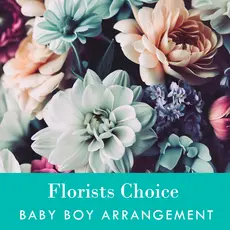
Florists Choice Baby Boy Arrangement
The florist picks what came in strongest at market that morning and builds to a "baby boy, soft palette" brief. Seasonal stems the website photo cannot promise but the cool room delivers. The latitude is the point. Trust the florist to cook.
What NOT to send
Every florist knows these. Most gift guides skip them. If you are sending flowers to a house with a newborn, a hospital ward with an immunocompromised patient next door, or a room where a three-day-old baby sleeps, this is the list that matters more than which colour to pick.
Toxic stems: the ones that cannot go near a baby
Oleander contains cardiac glycosides in every part of the plant. Leaves, stems, flowers, sap. Fatal if ingested. It grows wild across northern Australia and people occasionally bring cuttings indoors without knowing what they are handling. Lily of the valley contains convallatoxin, which disrupts heart rhythm. Foxglove contains digitoxin. All three are rare in commercial floristry, but they appear in cottage-garden-style arrangements and DIY bunches from time to time. A professional florist will never include them. A neighbour picking stems from her garden might not know.
High-risk for hospital wards
Oriental and Asiatic lilies for the pollen and fragrance reasons above. Baby's breath (gypsophila) is a heavy pollen producer, a respiratory irritant, and it sheds tiny white petals that land on every surface within arm's reach. In a maternity ward, those petals can reach the bassinet. Sunflowers from non-sterile varieties shed organic dust from the disc florets. Stock (matthiola) and freesias carry intense fragrance that fills a shared ward within the hour. Potted plants with soil are banned in most hospital clinical areas because soil harbours Pseudomonas and Aspergillus, both dangerous for immunocompromised patients.
Gypsophila is the default filler in every cheap baby arrangement because it is inexpensive and it photographs like a cloud. The problem is the shedding. Those tiny petals dry and drop within days, and they land on whatever is below the arrangement. In a hospital room, that is a bedside table next to a bassinet. In a home, that is a kitchen bench where bottles are being sterilised. Waxflower does the same visual job and drops nothing. It costs more per stem but the florist needs fewer stems to fill the same space, so the price difference is negligible. If I was building a new baby arrangement, gyp does not go near it.
The cat rule
If the household has a cat, no lilies. Not reduced lilies. No lilies at all. Lily pollen is fatal to cats, even in small amounts ingested from grooming pollen off their fur. The cat walks past the arrangement, brushes against a stem, licks the pollen from its coat. The toxin attacks the kidneys. This is not a precaution. It is a clinical fact confirmed by every veterinary toxicology reference in existence. If you are sending flowers to a home and you do not know whether they have a cat, avoid lilies. The florist cannot check for you.
Climate matters: what survives where mum lives
Lily's delivers to every climate zone in Australia. A blog post that says "send roses" without mentioning that roses compress to three days on a Darwin doorstep in January is irresponsible advice. The stems that work in Hobart are not the stems that work in Cairns. The difference is not subtle. It is the difference between flowers that last a fortnight and flowers that collapse before the first feed.
| Stem | Cool (15-18C) Hobart, Melb winter | Moderate (20-24C) Sydney, Perth spring | Warm (28-32C) Darwin, Brisbane summer |
|---|---|---|---|
| Rose | 10-14 days | 7-10 days | 3-6 days |
| Gerbera | 10-18 days | 5-12 days | 3-7 days |
| Carnation | 18-24 days | 14-21 days | 7-14 days |
| Chrysanthemum | 18-30 days | 14-24 days | 10-14 days |
| Lisianthus | 14-22 days | 10-17 days | 6-10 days |
| Orchid (Cymbidium) | 21-28 days | 14-21 days | 8-14 days |
A caller once asked me to send hydrangeas to a friend in Darwin in January. I steered her to chrysanthemums instead. The hydrangeas would have been limp before the baby had its first bath. Chrysanthemums gave her a fortnight of colour on the bedside table. Not a preference. Physics. A hydrangea bloom is 85% water. In 34-degree heat with 80% humidity, the bloom sweats faster than it drinks and the whole head collapses within hours. A chrysanthemum's waxy petals slow that moisture loss to a fraction of the same rate. A gerbera arrangement delivered in Perth was probably grown in the same city. In Darwin, those stems were flown in from Brisbane overnight. Both arrive fresh, but the Perth gerbera starts with an extra day of vase life it never spent on a plane. The florist knows this and builds accordingly. If mum lives somewhere warm, chrysanthemums and carnations are the smart picks. Not because they are glamorous. Because they are still alive at the end of the week.
The gender-neutral question
Not every buyer wants pink or blue. The parents might not have revealed the gender. They might not know. Others are simply over the pastel binary and would rather receive flowers that belong in a living room, not a nursery catalogue. Yellows, whites, greens, warm neutrals. A florist given creative freedom with a "celebration, no gender preference" brief builds some of the strongest arrangements in the range because they are not constrained by a two-colour palette.

No colour specification, no gender brief. The florist picks what came in strongest at market that morning, not what did not sell during the week. The freedom to choose is a freshness advantage. A yellow gerbera arrangement with white roses is not a compromise. It is one of the best-looking combinations in the range.
When baby comes home: the whole-family gift
Hospital flowers are for the mother. Home flowers are for the household. New parents are almost always home, but they step out for check-ups, they fall asleep at 1pm with the curtains drawn, they cannot hear the doorbell over the white noise machine. If the florist arrives and nobody answers, they follow safe-spot protocol: sheltered from sun, shaded, out of public view, with a card left in the letterbox. And the household, by the third day, includes a three-year-old who has been told a hundred times that the new baby is exciting and is starting to feel that nobody is excited about her anymore.
My friend Lisa from the mothers' group in Kingscliff told me something I never forgot. She said the best gift she received when her second baby came was a bunch of flowers, a box of chocolates, and a small toy for her older daughter. Not because any one of those items was remarkable. Because the person who sent it had thought about all three people in the room. The mother. The father who had eaten nothing but toast for two days. And the toddler who needed something that was hers.
The chocolate question comes up constantly on the phones. Andrew will tell you the data shows that chocolate add-ons increase order value by a margin he finds personally satisfying (his words, not mine). What I will tell you is that a new mother who has not slept and has been surviving on hospital sandwiches will be more grateful for a box of good chocolate than for an extra three roses in the bunch. Flowers are for looking at. Chocolate is for 2am on the couch while the baby finally sleeps.
Andrew The chocolate add-on costs less than one premium stem. Turns flowers into a gift. The margin is not the point.
On the phones, Anna could predict the buyer within the first sentence. Grandparents call first. They have the due date saved and the card message half-written. Friends call later, usually the day after the birth text goes out. Work colleagues email at lunch. The order that surprises nobody: grandmother, baby girl, something with a teddy.

Florist's Choice Baby Girl Bunch With Chocolates
The florist builds a pastel bunch from whatever is strongest on the bench that day. Chocolates travel alongside. The combination covers both people: flowers for the mother to look at, chocolate for the mother to eat at 2am. That is the whole equation.
Why neonatal noses matter more than you think
There is a published clinical trial showing that mild Rosa damascena (Damask Rose) aromatherapy reduced apnea attacks and improved oxygen saturation in preterm infants. Not folk medicine. Measured respiratory improvement in a NICU from a controlled scent exposure.
Newborn olfactory systems are acute. More acute than adult systems. Mild floral scent, particularly rose, has demonstrated clinical benefit for infant breathing regulation. Intense fragrance (Oriental lilies, stock, freesias, hyacinths) can overstimulate the same sensory pathway. Lavender, through the compound linalool, promotes longer sleep duration in infants via GABA receptor interaction. Save the Stargazers for the housewarming.
I recommended low-scent stems for maternity wards because strong perfume in a small room bothered mothers and nurses. I did not know there was a clinical study backing it up. Now there is research confirming it. A newborn's nose has been processing nothing but amniotic fluid for nine months. Dumping the fragrance of six Oriental lilies into the room is like turning on stadium lights in a dark nursery. Roses give a trace of scent. Gerberas give none. Carnations give a mild spice that most people cannot detect from a metre away. The sweet spot for a new baby room is barely there.
The ethylene warning: keep flowers away from the fruit bowl
Every new parent has a fruit basket on the kitchen bench. Visitors bring them. Ripening bananas and avocados emit ethylene gas. Ethylene triggers senescence in cut flowers. Carnations, which otherwise last fourteen days, detect ethylene and accelerate their aging dramatically. The same arrangement, same room temperature, same water, will last five fewer days next to a fruit bowl than it would on a table by the window.
If you are receiving new baby flowers and you want them to last: different surface from the fruit. Ideally different room. Anna used to tell callers the same thing: put the arrangement on the table by the window, not on the bench next to the fruit. One instruction, three extra days. The bench by the kettle is where most people put them. Reasonable choice, as long as the fruit basket is on the dining table and not beside the toaster two feet away.
When it really matters
Some new baby orders carry a different weight. The IVF baby after four rounds. A first grandchild seven years in the making. A pregnancy that followed a loss nobody mentions at the table. These orders are not about cheerful stems and a cute card. They are about acknowledging something enormous with a gesture that feels proportional.
When Ivy was born, Asha was two and a half. The arrangements that arrived for Ivy were lovely. But the one that made me cry, properly cry, was from Siobhan at my old mothers' group (different Siobhan, confusing I know) and it came with a note that said "You did it again." Three words. No card template. No "congratulations on your new addition." Just someone who had watched me be terrified for nine months saying the only thing that needed saying. What would she have written with more space on the card? No idea. Three words was the right number.
The card message on a milestone baby is doing work that no arrangement can do by itself. If you are stuck on what to write, keep it under fifteen words and make it specific. Not "Wishing you all the best with your new bundle of joy." Something that proves you know the story. "Seven years and she's here." "Welcome to the world, the most wanted baby in Brisbane."
A caller told me she had waited seven years for her daughter to have a baby. Seven years of IVF. She did not want a bunch. She wanted something that matched what she felt. We built the largest arrangement in the range, added the teddy, the chocolates, the balloon. Her card message took ten minutes to compose and I stayed on the line while she worked through it. Those orders are rare and they are unforgettable.

New Baby Girl Arrangement + Teddy
Flowers for the mother. Teddy for the baby. The arrangement lasts a fortnight with the carnations anchoring it. The teddy is still in the toy basket eighteen months from now. One purchase, two emotional timelines. The flowers are the first impression. The bear is the keepsake.
The honest bit: what can go wrong
The photo on the product page shows what the florist builds from ideal stock on a good day at market. The arrangement that arrives uses what is freshest that morning. If the website shows pale pink roses and the market had hot pink spray roses instead, the florist uses the hot pink. The arrangement will look different from the photo. It will also contain stems the florist chose because they were the strongest in the bucket, not the oldest.
I know this bothers people. It bothered me for years. I wanted every arrangement to match the website photograph exactly, and I spent more time than I should have trying to make that happen across 800 florists in different cities buying from different markets on different days. It cannot be done. We tried. The photos on the website are what the florist builds on a good day at market. Most days are good days. Florist's Choice products are built on that exact principle, and they carry 4.5 stars from over 500 reviews, which tells you the system works more often than it fails.
I took those calls. The arrangement was fine. Good stems, well made. But the customer had the photo saved on their phone and they were comparing pixel by pixel. The pink was a different shade. The roses were a different variety. The greenery sat at a different angle. When I asked if the recipient liked the flowers, the answer was almost always yes. The mismatch was in the photo comparison, not in the quality. A new mum in a hospital bed is not comparing the arrangement to a website. She is reading the card.
If something genuinely goes wrong, if the arrangement arrives damaged, or if the hospital could not accept the delivery and nobody told you, ring us. 1300 360 469, 7am to 6pm weekdays, 10am Saturdays. Or email [email protected] if you need to change the delivery address or timing after ordering. That is a person, not a recording. The call takes two minutes. You do not need to be in the same city.
After you order
The florist builds the arrangement that morning from whatever came in fresh at market. The driver runs the delivery. For hospitals, the chain is reception to ward clerk to bedside and it takes anywhere from thirty minutes to three hours. For homes, the florist knocks. If nobody answers, safe-spot protocol.
Then you wait. This is the part nobody prepares you for. The thank-you photo usually comes within a few hours. If it takes longer, the new mum is asleep, or feeding, or being visited by everyone she has ever met. Silence is not rejection. Give it a day. New parents read the cards out loud to each other, usually at 2am, sometimes through tears. Your card does not need to be poetry. It needs to be from you.
Nobody remembers which stems were in the bunch six months later. They remember the colour, who sent it, and what the card said. The card outlasts the flowers by years.
Keeping new baby flowers alive (the 60-second version)
For box arrangements in foam
Top up the foam with water every two days. A small cup, slow pour into the centre of the box until the foam stops absorbing. Most people forget this step. It adds three or four days to the arrangement. In a hospital room with the heating running, the foam dries faster than you expect. A turkey baster or a children's medicine syringe works better than a cup if you want precision.
For hand-tied bunches in a vase
Change the water every two days. Trim 1cm from the bottom of the stems on an angle each time. Pull out any stem that looks tired before it rots in the water and takes the healthy stems down with it. Keep the arrangement out of direct sun (UV fades anthocyanin pigments in reds and pinks within 48 hours) and away from fruit bowls (ethylene accelerates aging in every stem, especially carnations).
A plant for the nursery (once they are home and settled)
Cut flowers for the hospital. A potted plant for the nursery at home, once things calm down. A snake plant (Sansevieria) uses a process called CAM metabolism that produces oxygen at night rather than during the day. Non-toxic, zero maintenance, survives months without water. Not flowers. A gift that is still in the nursery when the baby starts walking. Spider plants work too: air-purifying, non-toxic, safe around babies and pets. Potted plants with soil cannot go to hospital. Soil harbours bacteria and fungal spores that are dangerous in clinical environments. Plants are a homecoming gift, not a hospital gift.
Ready to send?
The new baby flowers range starts from $74.50 for a Florist's Choice bunch and runs through to $111 for the full arrangement with teddy. Same-day delivery when you order before 2pm weekdays or 10am Saturdays. The $16.95 delivery fee is flat and subsidised. The actual cost varies by distance and we absorb the difference. Every product on the site carries the stem detail and vase life data Anna would have told you on the phone, and you can always ring 1300 360 469 and talk to a person who can walk you through it.
Send flowers to the new parents today. The florist makes it fresh, the driver delivers it by hand, and somebody in a hospital room or a chaotic living room reads a card and knows they were remembered.
Browse New Baby FlowersFurther reading

Lily's Florist delivers Australia-wide through a network of 800+ partner florists.
23,000+ verified reviews on our reviews page.
Same-day delivery when you order before 2pm weekdays or 10am Saturdays.
Questions? Ring 1300 360 469
About the Authors
This guide was written by Siobhan Thomson with expert floristry content from Anna, drawing on a combined 30+ years of experience sending flowers to new parents across Australia. Read our full story.

Andrew, Ivy, Siobhan and Asha. Hobart, June 2024.