
Andrew and I are both born in August. Three days apart, the same year, a detail that used to feel coincidental and now, twenty years on from the day we bought the Kingscliff shop, feels less like coincidence and more like a quiet fact of our partnership. When people ask what flowers are in season in an Australian August, they usually mean it as a wedding question. My standard reply is proteas, and if the bride follows up I steer her toward what actually grows in the month she is asking about.
Most of the guides online disagree with me about what belongs in an August bouquet. I know because brides quote them back to me on the phone. Last August a bride in Geelong asked if we could build her a sunflower-and-dahlia bouquet for the second week of the month. She was reading a US wedding blog on her lunch break. I spent twenty minutes explaining why the flowers she wanted were a March stem for us, and we ended up with a ranunculus-and-protea build that she loved more than the photograph she had sent. Our August is cool, short-lit, and off-peak. The flower list is different. The prices are different. The venues are different. The whole feel of the month is different.
This post is a rebuild of one we published in 2023. Three years on, I wanted to say what the old version did not. Peonies are not what you think they are in an Australian August (Anna is going to be the one to explain that). Gladioli, technically the birth flower for anyone born in this month, barely exist as a cut stem at this time of year. The things that do work, the stems that actually thrive in a cool ceremony room with the heaters humming and the windows closed, are the ones nobody seems to write about. So that is where we will start.
You are here because someone you love is getting married in August, or you are. Either way, this is the guide I would want you to read.
Most August wedding guides were written for summer. Ours was written for the quiet end of the Australian year, which is where we actually live.Siobhan Thomson, Co-Founder
What August Actually Means for an Australian Wedding
August in Australia is the last full winter month. Sydney mornings sit around 8°C and the days climb to 18°C on the kinder afternoons. Melbourne is colder and damper. Hobart is properly cold, occasionally snow on Mt Wellington. Canberra is the coldest capital, most mornings there still carry frost at 6am on a wedding morning. Brisbane and Perth sit in the mid-winter mildness. Darwin and Cairns stay warm, which is why the Northern Hemisphere flower list is more relevant to a Cairns August wedding than it is to a Melbourne one.
A frosty Canberra morning means the florist times the van heater to run on the way back from the Flemington loading dock. Ranunculus holds cold without punishment and lasts for days, but if the cold snap hits the loading dock before the stems are hydrated, the petals arrive at the delivery address looking like they have been slapped. The good florists run a pre-hydration bucket in a fifteen-degree room for an hour before the build. The rushed ones do not. You can pick the difference in the opening photographs.
What this all means practically: off-peak vendor pricing, short daylight, and indoor ceremonies. Sunset in Melbourne in mid-August sits around 5:35pm. In Sydney around 5:40pm. Photography schedules compress. Receptions run longer than ceremonies. The venues that suit August weddings in Australia are the ones with heaters and internal spaces. Walled gardens in Sydney's eastern suburbs. Homesteads in the Southern Highlands. Converted warehouses in Collingwood and Richmond. Chapels with stained glass and old cast-iron radiators that clank softly under the vows.
The economic angle is genuine and worth knowing. In the wedding team's diary, a Saturday in August is rarely more than half-booked. A Saturday in late November is capped by Wednesday lunchtime. The consequence for a couple is that August florists can still consult, swap stems mid-brief, and redraft palette boards a month out. November florists mostly cannot. Everyone is building for three weddings that weekend. For a couple who does not need to marry in summer, August is the quiet month in the industry, and it is quiet at every single link in the supply chain.
But the flowers. The flowers are where August gets interesting.
The Availability Reality
Every August, someone rings us asking about peonies. Someone else asks about dahlias. Someone asks if they can build a "wildflower" bouquet with sunflowers. The phone calls are well-meaning and they are all asking the same question, which is: can I have my Pinterest board in August?
The truthful answer is that Pinterest boards are seasonally agnostic and Australian winter is not. Most of the stems that dominate the bridal aesthetic on saved-image platforms are Northern Hemisphere summer flowers photographed in July and August at their peak. When the same couple types "August wedding bouquet Australia" they are looking at photographs that cannot be recreated here, in this hemisphere, in this month, at any reasonable price.
Here is the availability picture as it actually sits on the bench in an Australian August.
The thing nobody tells brides about a winter wedding is that the flowers last longer. Not a little longer. A lot longer. A rose that gives a Brisbane bride in February seven days gives a Melbourne bride in August eleven. Tulips at 15 to 18 degrees run ten to fourteen days in the vase. In a summer kitchen at 24 degrees they run four to eight. Lisianthus in cool conditions hits fourteen to twenty-two days. Leucadendron, which is a native stem you probably already know from supermarket bunches, can run forty-two days in a cool room. Forty-two days. That is six weeks. You could marry with a leucadendron bouquet on the first Saturday in August and still have foliage standing in a jar at the wedding-night honeymoon apartment by mid-September.
Cool temperatures slow respiration. The flower is still doing the same biological work it was doing in February, it is just doing it in slow motion. For a ceremony, that means the bouquet built on Thursday is still fresh on Saturday. For the reception centrepieces built the same morning, nothing on the table wilts before the speeches. For the florist, it is the one part of winter weddings that is genuinely easier.
The catch is what happens at the venue. A heated reception room with ducted aircon running all night is not cool and calm. It is warm and dry and full of draft. Hydrangeas wilt within hours in an aircon draft. Sweet peas can drop from seven days to forty-eight hours. If the reception is in a venue with serious climate control, tell your florist, and steer away from the fragile stems even though the calendar says they are in season. What is in season outside is not always what survives inside.
Tulips are one of the few commercial cut flowers that keep moving after they have been cut. The stem is phototropic, meaning it grows toward light, so a tulip in a vase by the window will lean over during the day and straighten up overnight. They are also thermonastic, meaning the petals open wider as the room warms and close as it cools. If you hold an August tulip ceremony bouquet outside in cool morning air for photographs and then walk into a heated ceremony space, the petals will visibly open on you mid-aisle. Brides find this either delightful or alarming depending on temperament. Either way, no other wedding flower does this.
The Peony Question, Honestly
Every August wedding post in Australia tiptoes around peonies. Most just don't mention them. The unvarnished version of the peony question needs Anna, so this section is hers.
A peony sold in Australia in August has one of three stories, and as a bride, you deserve to know which one you are paying for.
The first story is a Netherlands import. Peonies come in from Dutch growers on air freight. At the Sydney wholesale market you will see them arrive in August at twelve to eighteen dollars per stem at wholesale cost. That is before the florist's markup. For a bouquet of twelve to fifteen peonies, you are looking at a stem cost of around two hundred and fifty dollars before labour, vase, delivery, anything else. The flowers will be beautiful. They will also be expensive.
The second story is what the Americans call zombie peonies. These are peonies cut from Australian or Tasmanian farms in November, when our local season ends, and held in a CoolBot cool room at one degree celsius for nine months. They come out looking good. They open. Vase life is generally shorter than a stem cut that week because the peony has been sitting dormant for most of a year. You might not be able to tell the difference at the ceremony. They are legitimate commercial stock and plenty of florists use them. Some florists are upfront about what they are. Some are not. If you ask your florist directly whether the peonies are fresh Dutch import or held-stock Australian, you will get a better answer than if you don't ask.
The third story is no peonies. Australian peony season is late October to early December, full stop. If your wedding is in late November, you can have them at their peak from Victorian and Tasmanian farms. In August, domestic peonies do not exist.
Most brides who came into the shop saying they wanted peonies left with ranunculus and tulips. They got the same romantic density, they got the same layered petal look, and they paid a third of the price. A tight, fully-doubled ranunculus in cream or blush is, visually, within shouting distance of a peony for ninety percent of people looking at the bouquet. The difference matters to the bride and to the florist. It does not usually matter to the guests or to the photographs.
If the Peony Is the One Thing You Want
Ring us. Seriously. Tell the wedding team you want peonies in August and we will be honest about what the florist can source and what it will cost. Some weeks the supply is clean and the pricing is workable. Some weeks it isn't. We would rather tell you in July what your bouquet will cost than deliver something on the morning of the wedding that isn't what you were picturing.
If the peony budget matters more than the peony itself, the Florist's Choice path is the straightforward route. You give the florist a spend cap and a colour story. They build from what is freshest in your delivery area the week of the wedding. In August that tends to mean ranunculus and tulips doing the romantic work, with roses and lisianthus building the body. The result looks like what you pictured. Without the import premium.
August Birth Flowers: Gladiolus and Poppy
Every month has a birth flower. For August it is the gladiolus as the primary, with the poppy as the secondary. Between them they carry a thousand years of symbolic weight, almost none of which matches their Australian commercial availability.
The gladiolus name comes from the Latin gladius, meaning sword, after the shape of the leaves. Roman gladiators wore them around their necks before combat and were showered with them after a win. Asha asked me once why my birth flower was named after a weapon. I did not have a good answer for an eight-year-old. In Victorian floriography the gladiolus came to mean strength of character, integrity, and moral conviction, which, for the record, I am willing to claim on behalf of August babies. The poppy, depending on the colour, meant remembrance (red), consolation (white), wealth (yellow), or imagination and dreaming (generally). Egyptian mythology links poppies to Osiris and rebirth.
Both flowers carry meanings that suit a wedding. Both are native to the Northern Hemisphere's growing cycle. Neither is easily available in Australia during August as a commercial cut stem.
Andrew and I both have August birthdays and we have talked about this almost every year. My birth flower is technically the gladiolus. Andrew's is the same. Neither of us has ever been given a gladiolus for a birthday, for the simple reason that it is not reliably in season in the month it is supposed to represent down here.
Years ago we settled on proteas for our own birthday flowers (mine a king protea, his a pincushion, a small disagreement about which was the better stem that we have never resolved). Proteas carry the same stand-up-straight energy as gladioli. They are architectural. They do not apologise for being large and a little strange-looking. They last forever in a vase. And they are at their peak in Australian August, grown in Western Australia and in Victoria, shipped nationally through the market system, and available in every capital city at a price that makes sense.
If you are an August bride who loves the idea of the gladiolus but cannot have one, consider the protea as the substitute. Same symbolic weight, different stem shape, infinitely more reliable in the month you are marrying. For the poppy, anemones and ranunculus carry similar delicacy and colour work. Icelandic poppies sometimes appear at markets in August in small quantities, grown in Victoria and Tasmania, but they are a garden flower with a short vase life and they are rarely the bouquet stem itself. They work beautifully as a table-centrepiece accent where a three-day life is enough.
The personal layer is just this. A wedding in the month you were born is already a layered occasion. Your birth flower does not have to appear literally. It can appear symbolically, or through a cousin stem that shares its character. That is what florists do for a living.
The wedding team gets one or two calls every August from brides asking whether we can source gladioli for the ceremony. The last one was from a bride in Newcastle the week after Siobhan's birthday. Two mornings of phone calls across the wholesale network turned up ten stems at a premium that made her pause, and when we told her the delivered price with the import margin she quietly pulled the request. She went with proteas and white ranunculus. The photos we saw afterwards were extraordinary. The gladiolus was the wrong flower for the month, not the wrong flower for her.
Five Bouquet Directions for an Australian August
The five directions below are not the only ways to build an August wedding bouquet. They are the ones that have come up most consistently on the wedding phone line over the years. Each one maps to a colour story, a venue type, and a conversion route if you want to browse what the actual product range looks like.
The bouquet itself is almost always custom. A bridal bouquet is not something you pick off the website from a static photograph. Our wedding flower team builds bespoke from your colour story and venue brief. But the ready-made product ranges below tell you what the partner florists in the network can reliably source in August, and they double as the bridesmaid, thank-you, and bridal-shower spend without the custom consult.
The Winter White Bouquet
Classic, cool-toned, venue-agnostic. This is the direction for couples marrying in traditional chapels, sandstone churches, or minimalist modern spaces where white pops against any backdrop. The winter sun at three in the afternoon drops to a low angle that turns white flowers almost gold in photographs. Bouquets that look washed out at midday look like jewellery at the four-o'clock ceremony window.
For the bouquet itself, we build custom to your brief. For bridesmaid posies, reception centrepieces, or the mother-of-the-bride thank-you delivery, the Gorgeous Whites range shows the palette the partner florists work in.
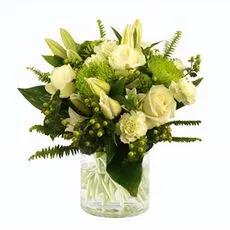
White Avalanche roses, green trick dianthus, white lisianthus, asparagus fern. Clear glass cylinder. Works as bridesmaid thank-you, mother-of-the-bride morning delivery, bridal shower centrepiece.
The Australian Bush Bouquet
Bold, architectural, unmistakably Australian. This is the direction for couples marrying outdoors in a bush setting, in the Hunter Valley or the Margaret River or the Northern Rivers, or for anyone who wants the bouquet to feel rooted to the country rather than imported from somewhere else. Natives hold up under winter light where the soft imports wash out, and they outlast every other stem category by a margin.
Lily's Florist was born in Kingscliff in 2006, which sits in the heart of Australia's native flower growing country. The Tweed Valley farms and the Northern Rivers slow-flower growers have been our neighbours from the start. Natives generally run cheaper per stem at wholesale than Northern-Hemisphere premium imports, which is why an August native bouquet can land at roughly half the delivered price of an equivalent-scale peony direction. Our native range is one of the oldest categories in the business.
The Pre-Spring Garden Bouquet
Soft, romantic, garden-style, mixed colour. This is the direction for couples marrying in homesteads, walled gardens, or warm-climate outdoor venues in NSW or southeast Queensland where blossom branches are emerging from late August. Cherry blossom branches open first in the Northern Rivers and the Hawkesbury, a week or two before the Southern Highlands catches up. A late-August Byron Bay wedding can have them. A late-August Bowral wedding usually cannot. Reads hand-picked, not delivered.
For the bridesmaids, for pre-wedding thank-yous, for the bridal shower flowers going to the host's place the morning-of, the Pastel Roses and Blissful Botanics ranges carry the garden-style palette.
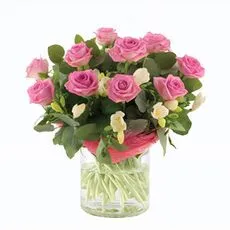
Ten to twelve roses across three pink tones (mid-pink, soft pink, coral-pink) with cream freesias tucked into the mid-level for fragrance. Hand-tied, delivered in water.
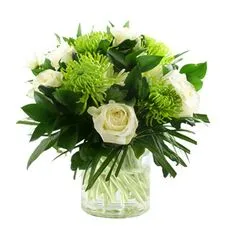
White Avalanche roses, green spider chrysanthemums, white lisianthus, aspidistra collar. A green-and-white palette with the chrysanthemum doing the textural work.
The Fragrance-Led Bouquet
For ceremonies in small chapels, intimate spaces, heated reception rooms with closed windows. The scent works with the venue rather than dissipating in open air. A chapel under forty guests is the sweet spot for fragrance-led. Above sixty, the scent dissipates faster than it builds, and the effort of choosing the fragrant stems is lost on the back row. Not a direction for photography-heavy outdoor weddings where the fragrance is wasted on wind.
For a reception-table Oriental lily feature, or for a hospital delivery to a wedding guest who can't attend, the Oriental Lilies Bunch is the scent-heavy stem at its most classic.
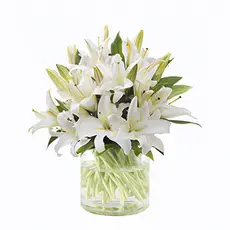
Five to six stems of white Oriental lilies, likely Casablanca or Siberia, in a clear glass cylinder with Italian ruscus foliage. Multiple buds per stem, staggered opening.
The Architectural Winter Bouquet
Bold, long-lasting, a statement piece that survives the entire wedding weekend and keeps going. This is the direction for modern venues, dark-palette aesthetics, and couples who want the bouquet to carry its own weight rather than whisper.
Our native flower range carries the proteas and banksias year-round. The dried pod element makes this the direction that extends into keepsake territory. Cymbidium is the longest-lasting wedding stem in the business. I have had couples put one in a bud vase on the honeymoon bedside table and send us a photo three weeks later, the bloom still going. Some of the natives will still be sitting on a mantelpiece a year after the wedding.
All five directions are starting points. A bridal bouquet is a conversation, not a catalogue selection. Our wedding team builds custom from your brief, your venue, your colour story, and the stems that are genuinely at their best the week of the ceremony.
Talk to Our Wedding TeamA peony in Australia in August has one of three stories. You deserve to know which one you are paying for.Anna, Qualified Florist, 15+ Years
Beyond the Bridal Bouquet
Every wedding has ten to fifteen flower-adjacent sends that are not the bridal bouquet. Most brides are so focused on the main bouquet and the centrepieces that the rest of the list goes out by text message on the Wednesday before the wedding. Half of these sends are the difference between a wedding that feels considered and a wedding that feels rushed.
Here is the full list of what a typical August wedding in Australia actually orders, and what the best product for each send looks like in practice.
Median composition across the wedding team's August order logs. The actual range runs three to eight bridesmaids, four to twelve centrepieces, one to four mother bouquets.
| Send | Why It Matters | Our Range |
|---|---|---|
| Mother of the bride thank-you | Delivered the morning of the wedding to her house. She will not have time to cut stems at 7am. Send a vase arrangement, not wrapped. | Thank-you flowers |
| Mother of the groom thank-you | Same logic, same format, delivered same morning. Match the palette to the bouquet if you want the photos to feel coherent. | Thank-you flowers |
| Bridesmaid thank-you (night before) | Delivered to the rehearsal dinner or the bridesmaid's accommodation. Sets the tone for the morning. Not a big send, a thoughtful one. | Pastel Roses, Blissful Botanics |
| Bridal shower flowers | Delivered to the host's place the morning of the shower. Bridesmaid organising usually pays. The flowers welcome the guests into the space. | Celebration flowers, Pretty Pinks |
| Hen's night flowers | Small-scale. Often just for the bride herself at the restaurant or the venue. Send a statement bunch. | Celebration flowers |
| Engagement flowers (pre-wedding) | If the engagement is August and the wedding is August the next year, the one-year loop is built in. Most couples don't do this. The ones who do remember the gesture. | Love and romance |
| Welcome bouquet (interstate guests) | Flown in for the wedding, staying at a hotel or an Airbnb. A small bunch on arrival says the couple is thinking about them. | Just-because flowers |
| Grandmother who cannot attend | Aged care or hospital. Box arrangement with familiar stems (roses, carnations, gerberas), not a complex bouquet. The recipient does not need to do any work. | Thinking-of-you |
| Post-wedding thank-you (host / venue) | Delivered the week after. A small gesture that closes the loop with whoever opened their home or managed the space. | Thank-you flowers |
If you are sending your mum a vase arrangement on the morning of your wedding, set the delivery for between 8am and 10am. She will be running around. She might be at the hairdresser's. She might be in a towel. Give the florist the phone number and tell them she might not answer the door on the first knock. The note on the card matters more than the flowers, honestly. Something short. She will read it and cry once and then put it on the kitchen bench and not have time to look at it again until the next morning.
You do not need to write something long. "Thank you for all of it" is enough. So is "I love you, see you at the chapel." The flowers do the rest.
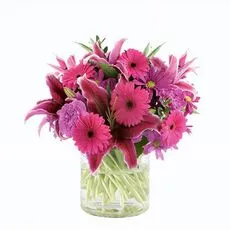
Hot pink gerberas dominating, with pink Asiatic lilies, pink roses, and stock for height and fragrance. Vase-included so the host does not need to find one.
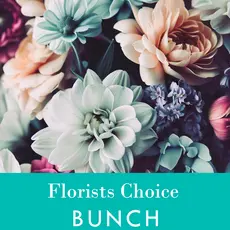
The partner florist builds from what is freshest the week of delivery. 551 reviews at 4.5 stars. The safest bet when you do not know the recipient's colour preference.
Weddings Where We Actually Live
Andrew and I live in Kingscliff, on the NSW side of the Tweed border, in the house we moved into the same year we bought the shop. From the road behind our place you can walk to Salt Beach in under ten minutes. The wedding team's home base is here. The partner florist network fans out from here. And a good share of the bouquets we build in August end up at one of the handful of wedding venues within a twenty-minute drive of our front door.
The Tweed is not Sydney and not Melbourne. In August the overnight lows sit around nine, the afternoon highs reach around twenty-one, and frost is almost unheard of. The climate here does things for a winter wedding that a Melbourne couple cannot get no matter what they spend. If you are marrying in the region, or if you are a Brisbane or Gold Coast couple crossing the border for the weekend, this section is for you specifically. Anna spent a number of years as a florist at Pollen at Salt in Casuarina before she moved across to the Lily's call centre in Pottsville, and she is the right voice for this.
Weddings were most of what I built at Pollen at Salt. The Tweed in August is the easiest month of the wedding calendar for a florist because the climate does the work for you. No frost, no humidity collapse, cool enough that the stems hold at twice the vase life they would get in a Brisbane summer. A ranunculus bouquet built on Friday afternoon for a Saturday ceremony is still holding its shape when the couple leaves for the honeymoon on Sunday morning.
Farm and Co at Cudgen is the outdoor venue most people picture when they think of a Tweed wedding. Open paddock, bush-rimmed, sub-tropical light on the bride. Native-led bouquets sit perfectly against that backdrop. Waratah for the feature, banksia, kangaroo paw, leucadendron, waxflower. The Tweed Valley flower farms are up the road from the venue, which means the stems in those bouquets were cut that morning more often than not. You cannot match that freshness on a Sydney wedding pulling from Flemington on Thursday.
Osteria at Casuarina is a different story. Enclosed, Italianate, stone and bougainvillea through the courtyard. A different palette sits better there. Ranunculus, garden roses, stock for fragrance, Italian ruscus through the foliage. Scent-forward works at Osteria because the dining space is partially covered and the fragrance has something to settle against. In an open paddock the same stems would lose half their perfume to the breeze.
Banora Point and Tweed Heads weddings tend to be smaller. Family homes, hinterland chapels, reception centres up on the hill. The order profile is different. More mother-of-the-bride arrangements delivered the morning of the ceremony, more bridal shower bouquets going to houses the week before, fewer enormous centrepiece builds. The partner florists who handle these runs know which driveways can fit a florist's van on a Saturday morning and which cannot. That knowledge is worth more than any brief the bride sends through.
If your wedding is in the Tweed, on the southern Gold Coast, or anywhere across the Northern Rivers, say so when you ring the wedding team. We actually live here. We know these venues. A lot of the partner florists on the corridor between Kingscliff and Cabarita have been with the network for more than a decade. The conversation moves faster when the person picking up the phone can picture the ceremony space you are describing.
Scent, Winter Venues, and the Warning About Lily Pollen
Winter weddings are enclosed. The scent carries further indoors than outdoors, which means fragrance-heavy stems work harder in an August ceremony space than they would in open summer air. This is one of the unremarked advantages of a cool-season wedding.
The stems that earn their place in a winter ceremony space are stock, freesia, hyacinth, daphne, and Oriental lily. Each delivers a different scent profile and each has its own risk.
An Oriental lily in an August ceremony space, with the heaters running and the windows closed, will fill that room. One stem scents the whole ceremony. If the venue is small, choose one or two feature lilies, not a whole bouquet. Too many and the scent becomes the dominant sensory experience of the day, which is not what anyone wants the guests remembering.
If someone in the bridal party has allergies, skip lilies entirely and use stock instead. Stock gives you the spice-clove scent without the pollen. And the pollen matters. Oriental lily pollen stains fabric permanently. A white dress, a groomsman's shirt, the aisle runner. If you are going to have lilies near the bridal party, the florist needs to remove the anthers before the arrangement leaves the bench. It adds a minute per stem. It saves the complaint that otherwise comes from a bride whose photos show an orange pollen line down the front of her gown.
Stock carries the winter scent best for ceremony venues with larger footprints. One stem is not enough to register in a hundred-guest chapel. Six to ten stems through the altar arrangements will fill the space by ceremony time. Freesia is more subtle, sweeter, more citrusy. It works well in small reception spaces where a heavier scent would overwhelm. Daphne is rarer, the most fragrant of the five, with a reputation for scenting an entire house from a single sprig. Short stem and short vase life. Keep it close to the bridal party, not in centrepieces on distant tables.
One quiet truth about scent. The sense of smell creates the strongest long-term memory association of any of the senses. The perfume you wore on the day, the candle burning in the back of the chapel, the stock in the bouquet. The bride will remember how the ceremony space smelled five years later when she cannot remember what any of the speakers said. Choose the scent deliberately. It is doing more work than you think.
Scent bypasses the brain's usual memory-filtering routes and lands directly in the structures that handle emotional memory. Which is why scent-triggered memories arrive with more emotional weight than memories triggered by sight or sound, and why the stock in your grandmother's kitchen still smells like Christmas forty years later. The same mechanism is at work in a ceremony space. Choose the scent deliberately.
A Short Note on Cultural Tradition
If your wedding draws from a specific cultural or religious tradition, some of the stems mentioned above may carry different associations in your context than they do in Western Australian wedding convention.
Chrysanthemums, which the Blissful Botanics Bunch uses as a textural element, are wedding flowers in some cultures and funeral flowers in others. In Italian, Chinese, French, Austrian, Belgian, and Polish traditions, chrysanthemums are strongly associated with mourning and grief. They should not appear in a bridal bouquet, a centrepiece, or any ceremony arrangement for a wedding drawing from these backgrounds.
White is the dominant wedding colour in Western tradition but in Chinese tradition it reads as a mourning colour. Red is the Chinese wedding colour. A Chinese-Australian wedding often inverts the Western assumption about palette. Hindu weddings typically use marigold garlands (which are not a mainstream Australian cut flower commercial supply, though they can be sourced through the partner network with notice). Jewish weddings welcome flowers, chuppah arrangements are common, no restrictions on stem type.
When you speak to our wedding team, tell us about your tradition. The partner florists across the 800-strong network have worked with multicultural weddings for years and the consultation starts with what your tradition calls for, not what the Western default assumes.
What Can Go Wrong (and What the Florist Does About It)
Every wedding flower piece on the internet ends with a version of "it will all be perfect." The truth is that sometimes things go sideways, and the wedding post that acknowledges this is worth more than the one that doesn't. Two uncomfortable moments before the close.
Cold chain failure is rarer in August than in summer but it still happens. Here is what it looks like. A courier van sits in a supermarket loading dock for forty minutes doing an unrelated drop. The flowers in the van warm up. They get put back into the cold delivery run afterwards and the stems experience a temperature shock. The shock does not always show on arrival. It shows twenty-four to forty-eight hours later when the flowers look tired earlier than they should.
For a wedding, that means the bouquet that was perfect on Thursday may start looking less than perfect by the Saturday ceremony photographs. Good florists compensate for this by building and delivering closer to the ceremony rather than further from it. Ask your florist when they plan to build the bouquet and when they plan to deliver it. The closer to the ceremony, the less there is between the flowers and the moment.
The second thing. A wedding bouquet photographed on a website three years ago in natural sunlight on a white table is not the same bouquet that arrives in Hobart on a Saturday morning in August. Substitution is real. Stems vary by season and by market availability that specific week. A bride who sends the florist three reference images and a short description of the vibe will get a closer match to her mental picture than a bride who orders the product photo exactly.
The florist who will tell you honestly what they can and cannot get in August is the one you want to work with. The one who says "no problem, we can do exactly this" on a twelve-peony bouquet in the second week of August is either lying or is about to spend two hundred and fifty dollars on imported stems without telling you that is what you are paying for. Ask the question. Pay the honest florist.
The conversation with our wedding team starts with what you actually want and what is genuinely possible in August. We will be honest about both.
Start the ConversationOr ring us directly on 1300 360 469
7am to 6pm weekdays, 10am Saturdays.
The Close
If Andrew and I were getting married this August, in the country we are actually in, here is what we would do.
Protea as the feature. A king protea at the centre of the bridal bouquet, not a peony substitute but the flower itself, in recognition that August is our month and the protea is the stem that actually belongs to it. Ranunculus around the king in layered cream and blush. Stock for the ceremony scent. Leucadendron and eucalyptus for the foliage that will still be standing in a jar on the kitchen bench in October. Some native wax if the week's supply is clean. No peonies. No gladioli. No apology for the flowers we are not using.
For the bridesmaids, pastel roses and freesia. My mum gets a white-and-green vase arrangement delivered at 9am in Taree. Andrew's mother gets the same, so the palette matches in the morning-of photographs. The bridal shower the weekend before takes a pink-tonal bunch on the host's bench. For the grandmother who cannot travel, a small arrangement with familiar stems delivered to her door the morning of the ceremony with a note that says she was there. On the morning after, the cymbidium orchid is probably the only stem still going, and that is fine.
August in Australia is cool, clear, quiet, and short on peonies. It is also the month that two co-founders of a flower business were both born in, three days apart. If you are marrying this month, you have picked one of the more beautiful ones on the calendar, whatever the Northern Hemisphere guides tell you. The flowers that belong to August in Australia are the ones that want to be here. Let those do the work.
Our wedding flower team has been building August bouquets for Australian brides for nearly twenty years. Talk to us about yours.
Speak to Our Wedding TeamOr ring us directly on 1300 360 469
7am to 6pm weekdays, 10am Saturdays.

Lily's Florist delivers Australia-wide through a network of 800+ partner florists.
23,362+ verified reviews on our reviews page.
Same-day delivery when you order before 2pm weekdays or 10am Saturdays.
Questions? Ring 1300 360 469
About the Authors
This post was written by Siobhan Thomson, co-founder of Lily's Florist, with the expert sections carried by Anna, the network's qualified florist, and a short operational note from Andrew Thomson, the other August birthday in the house. Read our full story.

Andrew, Ivy, Siobhan and Asha. Hobart, June 2024.