
Someone has died and you have a funeral flower order to place. Probably from somewhere that is not where the service is being held. Probably with not much time. Possibly with half the information you need and nobody you want to ring to get the rest. Such is the job on your desk right now, and the stakes are that you only get one go at it.
I have been answering phones and running the partner florist side of Lily's Florist since 2009. The single most common call we take is not from someone choosing between a wreath and a sheaf. It is from someone who does not know which funeral home the service is at, does not know whether to send to the chapel or the house, and has 90 minutes before they have to be back in a meeting. This guide is written for that person.
The expert voice through the rest of this post is Anna, our qualified florist. She took somewhere between ten and fifteen thousand inbound calls out of her Pottsville home office between April 2010 and June 2013, a lot of them sympathy orders. She knows what goes wrong and why. Siobhan will chime in near the end. If you want to skip the reading and just ring us, the number is 1300 360 469 and a person answers.
In this guide
Where do the flowers actually go?
Before anything else, sort this. The flowers go to one of three places: the funeral home or chapel where the service is held, the family's home, or both. Those are three different orders. Different formats, different delivery windows, different arrival instructions on the card.
Service flowers go to the funeral director. Structural, designed to be seen from twenty feet away, usually on a stand. Home flowers go to the kitchen bench or the hallway table. Built to be lived with for a week while the family gets through the days after. Most senders pick one. Close family and close friends often send both: a wreath or sheaf at the service, then a smaller arrangement to the house a day or two later.
If you are a colleague, a cousin at a distance, or a workplace collecting on behalf of a team, pick one and do it well. If you are closer than that, the week-later arrangement to the home (covered in Section 8) is the one most people forget, and it is usually the one that lands hardest.
The call I hated most was the one where someone had already ordered a big vase arrangement and sent it to the chapel. A vase arrangement at a chapel ends up on the floor because there is nowhere to put it. No stand, no table allocated for it, the funeral director has already set the room. A wreath sent to the house has the opposite problem. Twelve stems on a polystyrene ring do not fit on a kitchen bench. Format follows destination, not the other way around.
If in doubt, pick the funeral home. The funeral director is set up to receive and display flowers. You can always follow up with something to the home a week later when things have quieted down.
Service flowers for the chapel, or comfort flowers for the family at home. Two categories, two different gestures.
View service flowersWhen do they need to arrive?
Service flowers should arrive at the funeral home or chapel at least two hours before the service starts. The funeral director needs time to place them. They are coordinating a full room: casket, photo boards, chairs, audio-visual, and between six and thirty floral tributes that have all arrived across a four-hour window. A late delivery that turns up 15 minutes before the family arrives creates a problem nobody needs that morning.
For home deliveries, any time in the first week works. The day of the service itself is often a bad time because the family is out, or people are coming and going, and a delivery gets lost. Two or three days after is when a home arrangement lands best, when the visitors have stopped and the family is alone with the quiet.
The hard operational rules at our end
Same-day cutoff is 2pm weekdays and 10am Saturdays. Order by that and same-day is live. After it, the order rolls to the next delivery day. No Sundays. The reason is a market supply issue, not a policy one.
The flower markets close Saturday afternoon. Florists buy their weekend stock Thursday or Friday morning. By Sunday the stems have been out of the grower's cool room for two to four days, and the florist has no way to top up. Most partner florists in our network do not open Sunday. I got the Sunday call probably once a week for three years on the phones. Almost always a Greek Orthodox family or a Catholic Sunday funeral. The workaround is to deliver Saturday and have the funeral director hold the arrangement in their cool room overnight. Most funeral directors will do this without being asked. If the service is Sunday, order by 9am Saturday at the latest and we will get it there.
One more rule worth stating plainly: if the service is today and it is already 1pm, ring. Do not place an online order at 1.55pm and hope. A phone call goes straight to a florist who can tell you in 30 seconds whether it is possible.
Late delivery on a birthday is disappointing. Late delivery on a funeral is unrecoverable. You cannot catch up, you cannot make it right the next day, the moment is gone. In 15 years I watched every kind of delivery problem eventually get fixed except the funeral ones. The service is over, the family is at the wake, the flowers sat in a van 45 minutes late and now they are back at the shop. Nobody wins. Two hours before the service is the minimum. Three is better.
Same-day delivery to any suburb on our map until 2pm weekdays, 10am Saturdays. If it is late in the day, ring us first.
Browse all sympathy flowersOr call 1300 360 469. A person will answer.
Late delivery on a birthday is disappointing. Late delivery on a funeral is unrecoverable.Anna, Qualified Florist, 15+ Years
What format to send
The answer depends on where the flowers are going. Four main formats: wreath, sheaf, vase or box arrangement, and hand-tied bunch. Each has a specific job.
Wreaths, sheaves and standing sprays (for the service)
Wreaths are circular, usually on a polystyrene foam ring, delivered on an easel or stand. The circle symbolises eternity. They read as intentional at twenty feet, which is what you want at the front of a chapel. Sheaves are long, flat bundles designed to lie on the casket or be carried. Standing sprays sit on an easel like a wreath but are not circular, usually a teardrop or arched shape.
Wreaths at Lily's start from $145.95. Price goes up depending on size, stem variety, and whether you want a ribbon banner with a personal message. These are not home products. They go on a stand the funeral director provides.
There is an unwritten order to funeral tributes. Casket sprays come from the immediate family. They sit on top of the coffin and they are personal: favourite flowers of the deceased, specific colours, sometimes a photo tucked into the greenery. A casket spray from anyone other than the immediate family reads as presumptuous. Standing wreaths and standing sprays come from extended family, close friends, workplaces, clubs, sporting teams. Sheaves come from anyone. If you are not sure where you sit in the circle, a sheaf or a standing wreath is the safe pick.
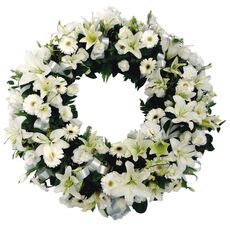
White Funeral Wreath
The safe answer when you do not know the family's preferences. White lilies, roses, and chrysanthemums on a foam ring, built to hold through the whole service. 36 reviews.
Order this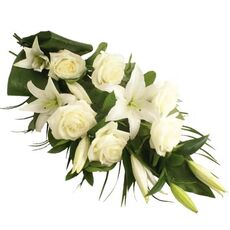
White Lily & Rose Sheath
Flat sheaf that lies on the casket. The tight lily buds open three to four days after the service, so the family gets a second wave of bloom at home. 44 reviews.
Order thisStructural tributes for the service. Wreaths on stands, sheaves, standing sprays, crosses.
Browse wreaths and sheavesArrangements and bunches (for the home)
For the family's home, a vase arrangement or a boxed arrangement is almost always the right format. Both arrive with the water already in them. The family puts it on the bench and it is done. In warm climates (Brisbane, Cairns, Darwin, Perth summer), the boxed format holds up better because the foam reservoir keeps the stems hydrated through the middle of the day.
A hand-tied bunch sent to a house where the family has just come home from a funeral is the wrong call. Wrapped in cellophane, sitting in a wet pack. Someone has to find scissors. Find a vase. Cut the stems at an angle. Fill the vase. Arrange the stems. Ten minutes of work, and the last thing the family needs is a ten-minute job. The Florists Choice Sympathy Arrangement is the one I recommended most often for home delivery after a service, because the florist can read the card message and build to the tone. Formal white for a work colleague. Softer pastels where the relationship was warm.
Florist's Choice is not the florist picking leftovers. It is the florist reading the card message and building to it. A card that says "With deepest sympathy from the team at [company]" gets a formal white-and-green build. A card that says "For Nan, we will miss you every day" gets a softer palette with pinks and creams because the relationship is personal. The product has 290 reviews at 4.5 stars across our network, which is high for something that has no fixed photo. The florist is the product. That is why it works.
Oriental lilies are the longest-lasting sympathy flower in an average indoor environment. Ten to fourteen days if the foam is topped up every second day. They come in staged bloom: some open at day one, some half-open, some still in bud. The arrangement looks different on day three than day one, and different again on day seven. Two weeks of evolving flowers from a single delivery. Our Oriental Lily Arrangement is the all-white version. One hard rule: the anthers must come off before delivery. Orange pollen on a white arrangement stains everything it touches, and it does not wash out of fabric. A thoughtful florist snips them at the cool room. If yours arrives with anthers still attached, snip them off yourself before they drop.
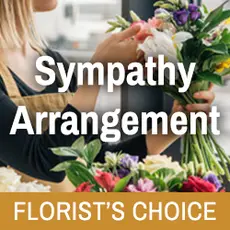
Florists Choice Sympathy Arrangement
The florist reads your card and builds to the tone. Formal white for a colleague, softer pastels where the relationship was warm. 290 reviews, 4.5 stars.
Order this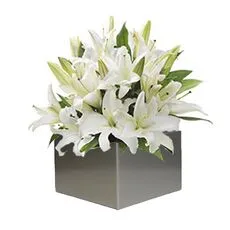
Oriental Lily Arrangement
Ten to fourteen days of evolving flowers. The buds open in stages, so the arrangement looks different on day seven than day one. Anthers removed before delivery.
Order this
Gorgeous White Arrangement
White roses and lilies with green chrysanthemums in a mirrored cube. The palette safest across almost every tradition. 257 reviews.
Order this
Florists Choice Sympathy Bunch
Hand-tied bouquet. Works at the chapel and then in a vase at the family home after. The dual-purpose choice when you are sending one gesture.
Order thisHome arrangements for the family. Vase and boxed formats, no work on arrival.
View home comfort flowersWhat you need before you place the order
The calls that go quickest are the ones where the sender has the information in front of them before they ring. The calls that drag are the ones where we are waiting on hold while the caller searches for the funeral home phone number.
For a funeral-home delivery
Seven items:
1. Full name of the deceased, as it appears in the death notice. Legal name, not a nickname. The funeral director may have twenty arrangements arriving across the morning and the name on the card is how they match yours to the right service.
2. Name and address of the funeral home or funeral director. Usually in the death notice. Failing that, a Google search of the funeral director's name plus the town will bring it up in under a minute. If there are multiple chapels at the same funeral home, name the chapel.
3. Service date and start time.
4. Funeral or memorial service. Funeral means the body is present. Memorial usually does not. Memorial services rarely have casket sprays, so a standing wreath or arrangement is more appropriate.
5. Cultural or religious tradition, if known. Section 6 covers the traditions where this matters most.
6. The card message. 250 characters maximum on our system. Section 5 covers what to write.
7. Your name as it should appear on the card. "From the Henderson family" reads differently from "From Susan and Geoff Henderson and the kids." Decide before you order.
The callers who had all seven in front of them got off the phone in four minutes. The ones who had none of it, trying to piece together the funeral details while a colleague messaged them fragments, sometimes took half an hour. Not their fault. They had just found out that morning and were doing a task they had never done before under time pressure. Read the death notice three times before you ring. It has most of what you need.
For a home delivery
Shorter list. Full address, recipient name (usually the closest family member, often the spouse or eldest child), card message, your name. If you do not have the address, ring a mutual friend before you order. Do not guess. Flowers to the wrong house are one of the hardest mistakes to recover from because the recipient family never gets them.
What to write on the card
The card is the part of the order that outlasts the flowers. Recipients throw out the flowers after a week or two. They put the card in a drawer, on the fridge, or in the back of a book, and sometimes it is still there five years later. The flowers are the gesture. The card is the memory.
Three principles. Keep it short, three sentences is plenty, two is often better. Do not try to find a silver lining ("At least he is no longer in pain" can land wrong even when well-intended). Avoid unsolicited religious references unless you know the family shares your faith.
Examples by relationship
Close friend or family: "There are no right words. Thinking of you and your family. With love, [name]." Or: "For [name], who was one of the best of us. We are so sorry."
Distant family or acquaintance: "With deepest sympathy from [your name(s)]." Or: "Our thoughts are with you and your family at this time."
Workplace or team: "With sincere condolences from the team at [company name]."
When you do not know the family well: "I am so sorry for your loss. From [name]." This is enough.
For a deeper guide, see our full post on what to write on a funeral flower card, which covers language by relationship and messages that accidentally hurt.
For Aboriginal and Torres Strait Islander families, there is a custom worth knowing. In some communities, particularly in the Northern Territory, it is not appropriate to write the deceased's name on a card or say it aloud for a period after the death. Practice varies. Not every family observes it. If the caller told me the family was Aboriginal, I asked whether they had any specific requests. If unsure, I steered toward a card that referred to the family rather than the deceased. "Thinking of the family at this difficult time. From the [name] family." That language works in every community.
White is safe across almost every tradition. Red is dangerous at almost every funeral.The three universal rules
Cultural and religious customs
The most common mistake in funeral flower orders is the sender defaulting to what they would want rather than what the family's tradition expects. Australia is multicultural and funeral customs vary enormously. What is appropriate at a secular Anglo service can be inappropriate or offensive at a Hindu, Jewish, or Muslim one. What follows is the short version. Read the section relevant to the family and, if still unsure, ring us.
Three universal rules cover most of it. White is safe across almost every tradition (the exception is Hindu, where outside flowers are not expected at all). Red is dangerous at almost every funeral, because red signifies happiness or celebration in Chinese, Vietnamese, Korean, and broader East Asian traditions. When in doubt about conventions, ask the family or ring the florist.
Jewish funerals
In most Jewish traditions, flowers are not appropriate. Not at the funeral, not at the graveside, and not at the shiva house during the seven days of mourning that follow. The right gesture is a food platter or fruit basket to the shiva house, ideally kosher, or if unsure, stick to fruit and nuts. A charitable donation in the deceased's name is also appropriate.
I redirected hundreds of these calls over three years. The caller wanted to send flowers to a shiva house and did not realise it could cause offence. Not awkwardness, offence. I explained the custom, told them a fruit basket or a food hamper was the expected gesture in most Jewish communities, and every single caller thanked me for saying something. They did not know. Practice varies by family. Some liberal Reform families do accept flowers. If you do not know the family well, default to the food hamper. You will not get that wrong.
Muslim funerals
Practice varies significantly. Islamic funeral customs value simplicity, modesty, and speed, with burial usually within 24 hours. Elaborate floral displays run against the spirit of the occasion. At some orthodox Australian Muslim funerals, no flowers are appropriate. At others, a simple white arrangement to the family home after the funeral is welcome. The mosque is never the right destination. If unsure, a charitable donation in the deceased's name or food to the family home in the days after is always safe.
Hindu funerals
Outside flowers are not customary. The family arranges all floral elements, principally marigold garlands draped around the deceased. Cremation typically happens within 24 to 48 hours. A fruit basket or vegetarian food hamper (no onion or garlic) delivered to the family home, either before or after the cremation, works better than a Western-style arrangement. A floral arrangement to the home in the days after the cremation is welcomed by many families, though not expected.
Chinese and Buddhist funerals
White and yellow chrysanthemums are the default. Lilies, orchids, and roses in white also appropriate. The format is typically a circular wreath on a stand or a formal standing spray, delivered to the funeral hall. In Melbourne and Sydney, dedicated Asian funeral halls run most of these services. Red is a hard no. It signifies celebration in Chinese culture and sending red to a funeral reads as mocking the family's grief.
Chrysanthemums are specifically funeral flowers in Chinese culture. Never send them to a Chinese household for a birthday, housewarming, or any other occasion. The call came through every couple of months. A caller wanted to send chrysanthemums as a cheerful gift to a Chinese colleague, because chrysanthemums are autumn-coloured and beautiful and the caller did not know the cultural signal. I redirected to roses or orchids every time. For a Chinese funeral, chrysanthemums are the correct choice. For anything else involving a Chinese household, they are the wrong one. Same flower, two completely different meanings.
Vietnamese funerals
Vietnamese families often hold the wake at home for three to five days before burial, so home delivery is more common than at other traditions. White is the mourning colour. White lotus, if the florist can source it, carries significance in Vietnamese Buddhism that no other stem does. White orchids, lilies, and roses all work. Wreaths on stands delivered to the wake are the formal format.
Greek Orthodox funerals
Flowers are very much part of the tradition. Circular white wreaths symbolising eternity are the dominant format. Delivery goes to the church the deceased attended, ideally 45 to 60 minutes before the service. Family members place them at the entrance. Memorial services (Mnemosyne) at 40 days, 3 months, 6 months, and one year are additional occasions for flowers, with the 40-day memorial being the most significant.
Italian Catholic funerals
Generous floral tributes are expected. White lilies dominate, with white roses and white chrysanthemums as support. Arrangements tend to be larger than at Anglo services. Wreaths, standing sprays, and sheaves all appropriate. The church usually receives the flowers before the service, and family members move some to the graveside after the burial.
Aboriginal and Torres Strait Islander funerals
Practice varies enormously across communities and regions. Some communities welcome flowers. Others do not. Some have specific rules around naming the deceased, personal items, and who can participate in certain parts of the service. The right approach is to ask the family what they would welcome before sending anything. If the family confirms flowers are appropriate, Australian natives are often preferred over European cut flowers. Waratahs, kangaroo paw, Geraldton wax, grevilleas, gum, and banksia all work.
Secular celebrations of life
Increasingly common. The family requests bright colours, the deceased's favourite flowers, or a celebration of personality rather than traditional mourning whites. Read the death notice carefully. "Please wear bright" is a signal. So is "a celebration of [name]'s life." For these services, colour is welcome and personalisation lands well.
At a glance
The table below is a fast-reference summary. The prose above it has the nuance. Every family is different and the safest move if you are unsure is to ask or ring us.
| Tradition | Are flowers appropriate? | Safe palette | Where to send |
|---|---|---|---|
| Jewish | No. Send a food hamper to the shiva house. | — | — |
| Muslim | Only if the family confirms. | White, modest. | Family home after the funeral. Never the mosque. |
| Hindu | Not customary. Food basket works better. | — | Family home, after cremation. |
| Chinese / Buddhist | Yes. | White and yellow chrysanthemums. Never red. | Funeral hall. |
| Vietnamese | Yes. | White. White lotus if available. | Home wake or funeral parlour. |
| Greek Orthodox | Yes. Wreaths expected. | White. | Church, 45 to 60 minutes before service. |
| Italian Catholic | Yes. Generous tributes expected. | White lilies, roses, chrysanthemums. | Church, then graveside. |
| Aboriginal / Torres Strait Islander | Ask the family first. Practice varies. | Australian natives if welcomed. | Ask the family. |
| Secular celebration of life | Yes. | Colour welcomed. Deceased's favourite flowers. | As the family has requested. |
White sympathy flowers work across nearly every tradition. Native sympathy flowers are the right call where Australian natives are welcomed.
View white sympathy flowersWhat "in lieu of flowers" actually means
The phrase appears in a growing proportion of Australian death notices. It reads as "In lieu of flowers, please consider a donation to [charity name]" and the family means it. Not a polite suggestion. A stated preference.
The correct response, in most cases, is to donate. Give roughly the amount you would have spent on flowers (a sympathy arrangement in our range runs from around $80 to $150, so that is the ballpark). Include a note to the charity specifying "In memory of [full name of the deceased]." Most charities will then send a notification to the family that a donation was made in their name. Charity keeps the money, family gets the acknowledgment, purpose of the gesture is served.
Two edge cases
Can you send both? Yes, in some cases. If flowers were a significant part of your relationship with the deceased, or if your family's cultural tradition expects a floral tribute regardless, a small arrangement plus a donation is acceptable. The donation is the primary gesture.
Workplaces. Corporate condolence gestures are traditionally flowers because the visibility of the tribute is part of it. The arrangement sits in the chapel with a company card attached, and colleagues and clients attending can see that the company participated. Most families understand this and accept flowers from a workplace even when "in lieu" has been specified for individual senders.
The in-lieu line means the family has thought about this and made a decision. It is not the time to decide you know better. Ninety percent of the time, the right call is to follow the stated preference. Donate, have the charity notify the family, and write a personal card separately if you want to add a few words. If you are in one of the edge cases and feel flowers are also right, send something small and restrained. Not a large wreath. Not a casket spray. A modest home arrangement, a few days after the service. That reads as adding to the gesture, not overriding the family's request.
The family has thought about this and made a decision. It is not the time to decide you know better.Anna, on the in-lieu line
The week-after arrangement most people forget
The first week after a death is a flood. Flowers arrive, casseroles arrive, visitors arrive, the phone rings, the doorbell rings, the family barely sits down. By the end of that week, the flowers that came the day after the service are already starting to drop petals.
The second week is quiet. The visitors stop. The phone goes back to normal. The family is alone in the house with the absence. A single arrangement arriving at the door lands hardest right then. Not because it is dramatic, but because nobody else is thinking about them anymore.
The calls that came in eight or ten days after a death were almost always the best calls I took. The caller had been thinking about the family all week and had finally sat down to do something about it. Nearly always a Florists Choice Sympathy Arrangement or an Oriental Lily Arrangement to the home. The caller was not trying to fix anything or make a statement. They just wanted the family to know that someone was still thinking about them. I had more callers tell me the family rang back crying thank you for the week-two delivery than for any other sympathy order. It is the one nobody else sends.
If you are close to the family and wondering whether to send on the day or the week after, choose the week after. Everyone is sending for the day. Almost nobody is sending for the week that follows it.
A week-later home arrangement lands when the visitors stop and the quiet arrives.
View white sympathy arrangementsWhat happens to the flowers after the service
Almost nobody asks this when ordering, but it is the question that determines what happens to a wreath or a standing spray after the chapel has emptied. Four common outcomes.
Graveside placement. The family takes the tributes from the chapel to the burial site. Wreaths lie on the grave or on the casket before burial. Flowers sit on the mound after it is filled. Over the next few days, the family or the cemetery staff clear them.
Taken home. Close family sometimes take one or two tributes home as keepsakes, particularly from the immediate family's casket spray or from close friends. Pressed petals, dried stalks, the ribbon banner from the wreath. These end up in scrapbooks, frames, or on the mantelpiece for weeks afterwards.
Donated to hospital or aged care. Many funeral directors arrange for remaining flowers to go to a local hospital or aged care facility the day after the service. The cards come off first. Recipients in the ward should not receive a tribute with a sympathy message attached. Most funeral directors coordinate this without being asked.
Not every ward can accept donated sympathy flowers. In our experience, oncology, haematology, ICU, and some maternity settings tend to have restrictions around cut flowers for infection control reasons. The funeral director and the hospital sort that between them. If the flowers cannot go to a ward, they usually go to a shared area: the hospital foyer, a palliative care unit, a hospice garden. The donation happens either way. As the sender, none of this is your problem to manage.
Composted or discarded. At some services, particularly where the family is not local or there is nobody to coordinate after the chapel, the funeral director manages disposal. Flowers go to green waste. This is not disrespectful. It is a practical reality of large volume and limited storage.
If you are still not sure, ring us
Most of this post has been Anna walking through the operational side. The florist coordination, the format decisions, the cultural customs, the timing. Sympathy calls are not really about the substance. They are about someone on the other end of the phone who has had a rough morning and does not know what to do with it.
We have been doing this since 2009, and the sympathy calls still affect me (they should, honestly). The ones that stay with me are the ones where someone rang at 6pm on a Thursday because their aunt had died in Perth that morning and the funeral was Saturday and they did not know where to start. We built the phone line for that call. The online order form cannot do what a person on the phone can do, which is listen for 30 seconds and then sort the thing. Ring us on 1300 360 469. A real person answers. We will do the rest.
If you get this wrong, it is recoverable. Send a follow-up arrangement to the home a week later with a short card. Most families will not remember whether your original wreath arrived at the right time. They will remember that you thought of them twice.
Escalations stop at my desk. If something goes wrong with a sympathy order through our network, ring the same number and ask for me. Funeral orders do not have the luxury of a second chance, which is why they get managed differently at our end. That part we do not hand off.
Quick reference
Where to send: Service flowers to the funeral home, comfort flowers to the family's home. If unsure, funeral home.
When to send: At least two hours before the service. Same-day cutoff 2pm weekdays, 10am Saturdays. No Sunday delivery. Deliver Saturday and the funeral director holds overnight.
What you need: Deceased's full name, funeral director name and address, service date and time, card message, your name.
Safe palette: White works across almost every tradition. Red is dangerous at almost every funeral.
If you are Jewish, Muslim, or Hindu: Check Section 6. Flowers may not be the expected gesture.
If the notice says "in lieu of flowers": Donate. Have the charity notify the family.
If still unsure: Call 1300 360 469. A person answers.
Further reading in the funeral series
This post covers the how. The rest of our funeral cluster covers the what, the why, and the which.
If you are ready to place the order, pick the format that matches where the flowers are going and the florist will do the rest.
Browse all sympathy flowers
Lily's Florist delivers Australia-wide through a network of 800+ partner florists.
23,362+ verified reviews on our reviews page.
Same-day delivery when you order before 2pm weekdays or 10am Saturdays.
Questions? Ring 1300 360 469
About the Authors
This post was written by Andrew Thomson, co-founder of Lily's Florist, with expert contributions from Anna, our qualified florist, and a closing note from Siobhan Thomson. Read our full story.

Andrew, Ivy, Siobhan and Asha. Hobart, June 2024.