You know the feeling. The cart is loaded, the address is right, the card message is written, and your finger is hovering over pay. Just for a second. Maybe longer. The flowers are fine, you've picked something nice, you've checked the address. What you're actually doing is rehearsing his face, what it'll do when the box arrives at his desk, or when his housemate hands them to him through the doorway, or when he opens the door and there's a courier standing there with a bunch and a card with your name on it. (If you've sent flowers to a woman, you'll know you never had this thought. You just clicked.)
That second of doubt is what this whole guide is about. I've been the buyer for the men in my life, my dad Bill, my brother Tyrone, Andrew, and the first time I sent flowers to my dad I got it badly wrong. (Pink roses and white lilies. Yes, really.) I'll come back to that later. The point for now is that the doubt is the loudest part of the moment. The reaction at the other end is almost never what you've been picturing.
What follows is the real version of how to do this, written by three of us. Anna is our qualified florist, trained in North Carolina, fifteen-plus years on the bench before she came across to do the books at Lily's. She has her own story about getting it wrong with a male recipient and what she changed afterwards. Andrew runs the partner florist network and has the operational angle on workplace deliveries (he routed flowers to a workshop at 9am once. The recipient rang us. We changed the policy). And me, the buyer who learned from my dad (eventually). Three people, three lessons, all of them honest.
The promise of the guide is straightforward. By the time you've finished reading you'll know whether to send flowers at all (yes, almost always), what to send (depends on who he is to you), where to send them (matters more than people realise), and what he'll actually do when they arrive. Spoiler on the last one: nothing like what you've been picturing.
If you've already decided flowers are right and you want to skip ahead, the full birthday flowers for men range is here. If not, the rest of this is for you.
In this guide
Do men actually like receiving flowers?
The question is the right one to ask first because it's the question sitting underneath the doubt. You're not really worrying about the bunch. You're worrying about whether the gesture lands. And it turns out three different bodies of research have looked at this, and the answers point the same direction, even if the buyer's instinct often pulls the opposite way.
The biggest study is from the Plants and Flowers Foundation Holland, fieldwork July to August 2021, conducted by Motivaction across the Netherlands, Germany, the UK and France. Sample size 5,393. Forty-one per cent of men said they like receiving flowers from a woman. Twenty-five per cent said they like receiving flowers from another man as a gift. Twenty-two per cent of men buy flowers for themselves at least monthly. Almost half of all respondents agreed the view that flowers are a women's thing is now outdated. Four in ten said giving flowers to men was previously taboo and is changing. A third went a step further and said they wanted to see more media coverage of men and flowers, meaning the cultural lag is something a third of people are already noticing.
The Society of American Florists has polled US consumers and found over sixty per cent of men said they would love to receive flowers. The directional answer is consistent with the European data even if the percentages run higher.
The deepest finding comes from Rutgers University, where Professor Jeannette Haviland-Jones and her team at the Human Emotions Lab published a series of studies in Evolutionary Psychology in 2005. In one experiment, flowers presented to women elicited the Duchenne smile, the involuntary "true smile" that engages the eyes and not just the mouth, in every single recipient. A separate experiment with both men and women receiving a flower in an elevator showed flowers elicited more positive social behaviour from recipients than other gifts. Recipients reported more positive moods three days after delivery than people who'd received candles instead. Haviland-Jones has said the universal smile response was the most surprising finding she'd encountered in her lab outside of fear stimuli.
Two qualifiers worth flagging honestly. The Holland study also found that flowers don't make the top ten gifts given to men. Gift cards, spirits, clothing, books and electronics dominate. So your instinct that flowers aren't the default isn't wrong. The pitch is closer to this: precisely because flowers are not the default for men, they land harder when they do arrive. He has not braced for this. The element of surprise is doing more work than the bunch is.
"He held them like he wasn't sure what to do with them." That was the daughter's words on the call back, near enough. The order I'd built her was a soft palette, pale pink lilies, white roses, a ribbon. Florist default for "make it nice" because that's what works for ninety per cent of recipients. Years ago, working the bench, that was the order I got wrong, and the order I changed everything after.
The daughter wasn't angry on the call. She was confused. I'd been thinking about the flowers. She'd been thinking about her dad. The two are not the same brief and I had not understood that at the time. I rebuilt it the next morning with a Mink Protea, a yellow Pincushion, some Leucadendron. Same buyer, same recipient, second time around. That was the call where she rang back happy. The shape of natives doesn't look like the shape of feminine flowers. The buyer can see that on the screen and the doubt gets smaller. The dad can see it on the table and so does he.
That mistake cost me about eighty dollars at trade. It's been worth thousands since.
The shape of natives doesn't look like the shape of feminine flowers. The buyer can see that on the screen and the doubt gets smaller.Anna, Qualified Florist, 15+ Years
Who are you sending to?
The biggest mistake guides make on this topic is treating "him" as a single recipient. A husband, a father, a brother and a colleague are four different briefs. Different price points. Different palettes. Sometimes different products entirely. Before you choose stems, choose the archetype. The product follows.
Sending to a partner
Husband, boyfriend, fiancé, the man you live withYou're the highest-budget sender in this category and the least nervous about whether flowers fit. You've already crossed the awkwardness line in this relationship, possibly years ago. Your worry is about getting the right product, not the right gesture. Lean into volume and warmth. The Rose Fire bunch (thirty-plus roses in deep red, bright yellow and true orange) reads as romantic without the Valentine's-only message that pure red carries. If natives are more your shared aesthetic, the foam arrangement still works at this price tier. The full romance range sits here.
Sending to a family member
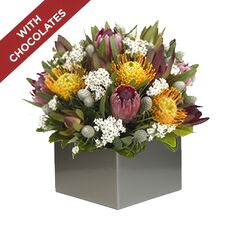
Father, brother, son, uncle, grandfatherThis is the buyer most caught by the doubt described above. The relationship is close, but flowers haven't historically been part of how you express it, and that gap is what makes you hesitate. Native arrangements solve this category structurally. The visual register is gift, not gesture. Mid-tier price ($150-200) signals deliberate without showing off. The Native Arrangement With Chocolates is the strongest single recommendation in this archetype. The chocolates make it feel like a complete gift rather than just flowers, which is the conversation you're trying to have anyway. More natives in the full collection.
Sending to a friend
A mate, a long-distance friend, someone going through somethingFlowers between friends, particularly between men, are the rarest send and often the one with the strongest emotional impact when they do arrive. Volume isn't what you want. Distinctiveness is. A bold mono-colour bunch (orange roses, deep red roses, structured natives) reads as deliberate friendship rather than casual reflex. Mid-tier budget. The Mixed Orange Arrangement is the clearest fit here. The card message does most of the work, not the stem count. "Heard about the rough week, mate, thinking of you" lands harder than thirty roses ever would. Orange flowers in full palette.
Sending to a colleague or client
Boss, direct report, the client you can't dropThe colleague send is governed by professional appropriateness more than personal taste. The audience is everyone in the office, not just him. Native arrangements in a vessel (cube, ceramic) read professional in any setting. So does a tight orange or red mono-colour palette. Avoid romantic palettes (deep reds with no orange break) in this category and avoid pastels of any kind. Office cutoffs matter here too, which is its own section below. If the right call eludes you, the Florists Choice format hands the brief to the florist with your card message guiding the build.
The colours and flowers that work
Once you've placed yourself in an archetype, the colour and stem decision narrows quickly. Two routes do most of the work for male recipients. Australian natives on one side. Bold saturated colours (orange, deep red, occasionally yellow) on the other. Pastels are the trapdoor most senders fall through, not because pastels are wrong, but because they pull the visual register toward feminine, and that register is exactly what the doubt was about in the first place.
The colour preference research has been documented by the Society of American Florists, the Bouqs Company, and the Plants and Flowers Foundation Holland in the studies cited above. Men, on average, gravitate toward saturated rather than tinted hues. Burnt orange, deep red, mustard yellow, dark burgundy. Not blush, lavender, soft cream. This isn't a stereotype. It's reflected in visual preference data going back two decades. You can use it.
Natives solve the male-recipient question structurally rather than rhetorically. You don't have to argue with yourself about whether what you're sending is masculine enough. The shape language is different. Cones from a Banksia, brushes from a Bottlebrush, structured forms from a Protea, instead of round petalled blooms. The colour palette is earthy by nature, burgundy, ochre, deep green, silver, the occasional saturated yellow or pink that reads as accent rather than feature.
And the vase life is dramatically longer for a reason that isn't decorative. Australian natives evolved in this climate. A protea has thicker bracts than a rose because it had to handle hotter, drier summers than European flowers ever did. A Leucadendron's woody stem holds water differently. Sending natives in a Brisbane summer is a different bet from sending imported tulips, because one of them was built for the conditions and the other one was bred in a Dutch greenhouse and shipped here to die over a long weekend. The maths writes itself. A Pink Mink Protea holds for two to three weeks. A Leucadendron runs three to four. Brunia barely changes for a month and dries on the stem looking presentable. A rose is finished by day seven.
Orange is underrated in commercial floristry. Everyone defaults to red for romance, pink for feminine, pastel for sympathy. Orange gets skipped. But on a desk or a kitchen bench, orange lifts a whole space. It photographs well. It reads strong from across a room. And it suits men and women equally. A mono-orange arrangement that lands feels deliberate. The catch is that mono-palette work is harder to build than mixed. There's nowhere for a weak stem to hide. Three roses at slightly different shades of orange will read as a mistake. Six that match read as design. So when you order a mono palette, you're betting on the florist's stock that morning. The good news is that's the floor, not the ceiling. Most of them hit it.
Skip ahead and browse if you're ready. Our orange flowers and red flowers ranges are sorted the same way. The colour decision narrows the options faster than the flower-type decision does.
The four products we'd actually recommend
From the full Lily's range, four products do the heavy lifting for male-recipient birthdays. They're not the four cheapest or the four most expensive. They're the four with the right combination of visual register, longevity, presentation moment, and recipient psychology. Each one carries Anna's specific reasoning.
The price points run $74 to $379. Lower end if you're sending something thoughtful without overdoing it. Upper end if you need volume to match the moment. Spend what fits the relationship, not what fits the worry. Overspending on flowers that die in three days reads as panic. Underspending on someone who'll know reads as reflex. The products below are calibrated to land at every tier without the mismatch.
Native Arrangement With Chocolates
If you're going to take one product away from this guide, this is it. Pink Mink Protea, yellow Pincushion, burgundy Leucadendron, silver Brunia, white Waxflower, all anchored in foam inside a metallic silver cube. The recipient does nothing on arrival. No vase, no cutting, no arranging. The chocolates make it read as a complete gift rather than flowers alone. Anna's read: two buyers for this. The one who specifically wants natives. The one who doesn't want to get it wrong. Male-recipient senders are heavily represented in both.
View this arrangement →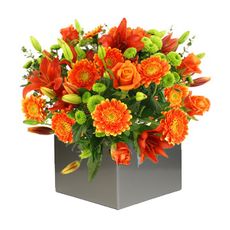
Mixed Orange Arrangement
The bold-colour route, executed properly. Orange roses, orange gerberas, orange Asiatic lilies (the smarter lily choice for foam, no pollen drop), green chrysanthemums for textural contrast. The cube vessel grounds the warmth and stops it reading loud. Suits men and women equally, which is exactly what you want when the recipient is a colleague, a milestone-birthday father, or anyone who would find pastels patronising. The foam handles the maintenance. Top up the water every two days and forget about it.
View this arrangement →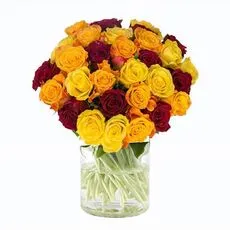
Rose Fire
For the partner-tier birthday only. Thirty-plus roses in deep red, bright yellow and true orange, a tri-colour palette that takes pure roses out of Valentine's territory and into birthday celebration. Anna's note: the reds anchor the warmth. The orange does the visual bridging that stops red-and-yellow reading like a football team. Yellow paired with the warm tones lands as vibrant rather than friendship. Volume is the message at this price. The card you write matters more than the stem count.
View this bunch →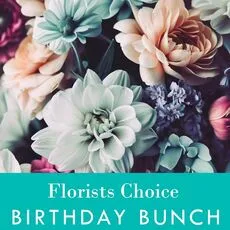
Florist's Choice Birthday Bunch
The catch-net product. If you're nervous about choosing stems and the natives haven't quite hit the mark, this is the one. The brief is delegated to the florist, and the card message tells them what to build. Write "for a man, bold colours please" on the card and they'll work to it. From three hundred and thirty-five reviews, the trust tier holds. The variation built into the format protects the quality. The florist who hasn't got perfect dahlias that morning doesn't force them. They reach for what's strong.
View this bunch →Substitution is the buyer's hidden anxiety on every order, and it's sharper for male recipients because the choice has already been agonised over. You picked the orange roses for a reason. What if those roses aren't in the bucket that morning?
On a mixed bunch, if the orange gerberas weren't in stock, the florist substitutes laterally with whatever orange was in. The customer rarely notices. On a single-variety orange rose bunch, there's nothing to substitute against. Pink is the wrong message. The order reworks. Or swaps colour. Or pushes a day. With Florists Choice, none of that happens. The brief IS the brief. The buyer specifies the palette through the card message and whatever's freshest builds it. For a buyer who's already done the agonising, that delegation removes a layer of fear most competitors don't even acknowledge.
Sending flowers to him at work
Workplace delivery is the section every other guide on this topic skips, and it's the section the buyer has the most questions about. Sending to home and sending to work are not the same decision. They serve different purposes and involve different audiences. The timing of either is its own variable.
The honest framing: sending flowers to a man's office isn't the embarrassing move buyers fear. It's a deliberate choice with a measurable effect. Whether you should make that choice comes down to one question. Who is the gift for? Just him, or him plus everyone he works with?
Andrew Thomson, Co-Founder Early on we got the workplace timing wrong. A buyer ordered for her partner at a workshop, we routed it for nine in the morning, and the recipient rang the shop later that day. He wasn't upset about the flowers. He was upset about being handed a wrapped bunch in front of his crew at the start of a shift. We took the lesson and changed the default. Workplace deliveries to male recipients now go end-of-day unless the buyer specifies otherwise. End-of-day means the flowers go home with him at the same time as his keys. The colleagues see them. He doesn't have to carry a bunch around the workshop until knock-off. If a buyer wants a different timing, that's a phone call. Ring 1300 360 469 and we'll route to whatever window suits.
The workplace question is one of the most common doubts I've watched buyers wrestle with, and the answer is simpler than people think. It depends on what you want the flowers to do. If the gift is for him, send to home. The flowers don't lose anything. The recipient gets them in his own space. The moment is private. If the gift is for him AND the audience of him receiving it, send to work. Both are legitimate. But you should know which one you're picking before the order goes through.
The thing buyers underestimate is how rare it is for a male recipient to be embarrassed by flowers at a desk. Visibly delighted is the norm. The fear is almost always the buyer's, projected outward. The colleagues don't react the way the buyer is imagining either. Most workplaces, the bunch arrives, three or four people stop to look, someone makes a joke, the recipient laughs, and that's it. The dread takes longer to read this paragraph than the moment itself takes to play out at the office.
How long should they last?
The longevity question is more important for male recipients than it is for women, for one specific reason: men, on average, are less likely to maintain flowers post-delivery. This isn't a character claim. It's an observation about pattern. The typical female recipient recuts stems, changes water, pulls dead heads. The typical male recipient puts the bunch on a surface, looks at it, and moves on. Five days later, the gerberas have collapsed and the water is cloudy because nobody has touched it. Choose the product accordingly.
Recommending the right product for the recipient is not the same as recommending the most beautiful product. If a man is living alone and gerberas are in the bunch, the gerberas will be wilted by Wednesday. He won't recut stems. He won't change the water. That's not a character flaw. It's just not what the gift was supposed to make him do. A native arrangement asks nothing of him. He gets to enjoy it for three weeks without the maintenance becoming a chore he failed at.
Foam arrangements solve this same problem with non-native stems. The foam holds water. The recipient pours a little in every two or three days, and the arrangement does the rest. No cutting, no fussing, no cleaning slime out of a vase. For male recipients specifically, foam over hand-tied is the easier sell. A hand-tied bunch in cellophane lands at the door and the next thirty minutes are the recipient's job. A foam arrangement lands ready to sit on a bench. Big difference for a man who wasn't going to ring his mum to ask which vase to use.
The practical heuristic: the longer the arrangement is designed to last, the better it suits a male recipient. Match the product to the actual habits of the recipient, not the hypothetical version of him you've been picturing.
If longevity is the deciding factor, Australian natives outlast every imported stem in our range. The full collection is here.
What he'll actually do when they arrive
Right, so I owe you the dad story. The first time I sent my dad flowers for his birthday, in my twenties, I bought him a bunch of pink roses and white lilies because that's what the florist I was using had on the front shelf and I didn't think too hard about it. He rang to thank me. Polite, lovely, my dad is always polite. But then he asked me how he was supposed to keep them, and where, and for how long, and the conversation went on for about ten minutes longer than it needed to. He was holding them like a piece of homework someone had handed him. I came off the phone thinking I'd done something nice. By dinner I was thinking I'd done something a bit weird.
Took me a few years to send him flowers again. The next time I went natives in a foam arrangement and didn't tell him in advance. He rang the next morning, completely different call. He told me one of the stems looked like a small explosion (the Pincushion, he meant) and he'd put it on the kitchen bench because that's where he sees it most. Same dad, same daughter, very different reaction. The gap was the product, not the gesture.
So here's what he'll actually do when they arrive. He'll stand in the doorway with them for a second. He may or may not have a vase ready. (Most men I know don't, including Andrew, and we own a flower shop.) If it's a foam arrangement or natives in a vessel he'll put it down on the nearest hard surface and look at it for a minute. If it's a hand-tied bunch in cellophane he'll work out where the kitchen scissors are and have a go at the wrapping, then put the whole thing in whatever container looks vase-shaped. He probably won't recut stems. He'll definitely take a photo and send it to you, mostly to confirm receipt, sometimes to say thanks. The photo is usually framed badly. That's the marker that he liked them, weirdly. The blokes who hated their flowers don't take photos.
And then a few days later something interesting happens. He'll look at the arrangement when he walks past it, and he'll think about the person who sent it, and that's the bit you can't see. That's the part the doubt at the checkout would never have predicted.
Further Reading
If you want to go deeper on birthday flower selection across all recipients (not just male ones), Anna's full birthday flower personality guide is the umbrella post. It covers personality-matched picks across all ages and recipient types, with a specific section on natives that this guide expands. And if the man you're buying for is your dad and the occasion is the September Sunday rather than his birthday, Father's Day flowers is the right destination instead.
When you're ready, the full birthday flowers for men range is here. If you want a hand picking the right one, ring our flower experts on 1300 360 469. We've been answering this exact question for over fifteen years. The doubt is normal. The flowers will land.
Browse Birthday Flowers for Men
Lily's Florist delivers Australia-wide through a network of 800+ partner florists.
23,362+ verified reviews on our reviews page.
Same-day delivery when you order before 2pm weekdays or 10am Saturdays.
Questions? Ring 1300 360 469
About the Authors
This guide was written by three people. Anna brought the floristry. Siobhan brought the buyer perspective. Andrew brought the operational angle. Each of them owns a mistake earlier in the post that shaped how they think about male-recipient orders now. Read our full story.

Andrew, Ivy, Siobhan and Asha. Hobart, June 2024.