
Cart is empty
 Shop By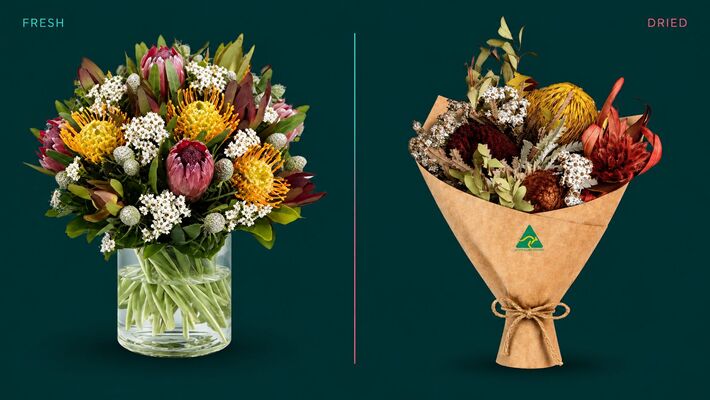
21–42
days a fresh leucadendron lasts, longer than any rose
15+ yrs
of qualified-florist bench experience in this guide
2
genuinely good answers, and one way to choose
You have seen the dried arrangements everywhere by now, banksia and bleached grasses sitting in a vase with no water, looking like they will be there forever, and somewhere in the back of your mind a quiet little voice is asking if sending fresh flowers is a bit of a waste when they will be in the bin by next Friday. We get that question a lot. At the kitchen table, in the reviews, on the phone. For years we did not have a good answer to it.
Here is the honest one. Fresh and dried natives are not really competing. They are the same wild plants doing two different jobs. Fresh gives you scent, living colour, and the weight of a moment that is happening today. Dried gives you something that is still on the shelf in a year, reminding the person you sent it to, every time they walk past it.
So this is not a which-is-better piece, because there isn't a better. There is only the one that suits your moment, your person, the distance between you, and what you want the flowers to do after the first week. I will walk you through both, warts and all, and our florist Anna will tell you straight where each one wins and where each one falls down.
And yes, near the end I am going to point you at two different shops, because they both happen to be ours. Stick with me.
In this guide
The short of it
Two good answers, and the one question that picks between them
The short answer: send fresh native flowers when the gift is about a moment happening now, a birthday, a sorry, a get-well, and send dried native flowers when it needs to last for months or years, or travel a long way. Fresh natives last one to three weeks in a vase. Dried natives last anywhere from a year to a decade.
Most people come to this decision for one of two reasons. Either you are far away and flowers are the thing you can do from a distance, or the occasion has crept up on you and you just want to get it right. Neither of those is a reason to overthink it. Fresh and dried natives are both a lovely thing to send. The only real question is what you want the flowers to do.
If the answer is be here, today, for this, fresh is the one. A birthday that is happening now. A sorry that cannot wait. A get-well. A funeral. Fresh carries the moment because it is alive and it is fleeting, and we read that as care.
If the answer is still be here later, dried is the one. A new home. A desk in an office. A friend three states away. A keepsake from a day that mattered. Dried says, plainly, this is meant to stay with you.
Hold that one question in your head for the rest of this. Everything else is detail.
Part one 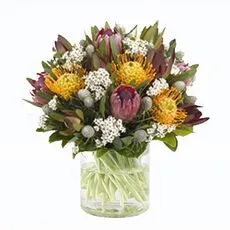 Australian Natives Bunch
 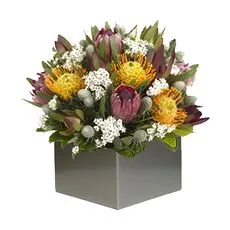 Native Flower Arrangement
 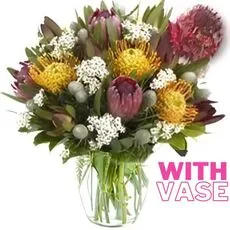 Natives with Vase
  Native Arrangement with Chocolates
Fresh natives: alive, and tougher than they look
The whole case for fresh is in one word: alive. There is the scent, the living colour, the small ritual of cutting the stems and topping up the water, and someone opening the door to find them. A hand-tied waratah at a wedding, a sprig of wattle left at a graveside. Those live in people's memory in a way a photograph never quite does.
The part that surprises people is how hardy natives are. These plants evolved for a brutal continent, so the stems are woody and the petals are built like armour. They do not behave like a supermarket rose that bows its head in two days. Most of our fresh native flower bunches will give the recipient a fortnight or more, and the best of them run for weeks.
A few of the fresh native arrangements we send most often:
Australian Natives Bunch Native Flower Arrangement Natives with Vase Native Arrangement with Chocolates Anna, qualified florist
The thing dried takes away from you is the smell. Fresh eucalyptus in a warm room gives you that menthol hit at the back of the throat, and wattle in late winter fills a whole hallway. You get none of that off a dried stem, because the drying drives off the oils that carry the scent. So if part of the gift is someone walking into a room and copping that wave of it, you want fresh, no argument. If the gift is the look, and you want the look to last, that is a different conversation, and we will have it in a minute.
On the bench: how long fresh natives actually hold
These are numbers Anna worked to for fifteen years, not a guess. Vase life in days, by the temperature the flowers are kept at:
| Native stem | Cool (15-18°C) | Moderate (20-24°C) | Warm (28-32°C) |
|---|---|---|---|
| Leucadendron | 21-42 days | 14-28 days | 10-16 days |
| Protea | 14-24 days | 10-18 days | 7-10 days |
| Waxflower | 14-21 days | 10-16 days | 5-10 days |
A leucadendron outlasts any rose in the building. A protea drinks like nothing else, so keep the vase full or the leaves blacken. Waxflower is the honest exception: it shrugs off heat better than most, but one dry spell or a hard knock and it shatters, every little flower off the stem at once, like someone tipped it over the bin.
There is a quiet sustainability story here too, and it is real rather than a sticker. Almost every native flower in an Australian shop was grown in Australia, most of it in the wildflower country of WA and along the New South Wales coast. A protea in a Perth bunch most likely grew within a couple of hundred kilometres of the door it lands on. Compare that to the standard mixed bunch, where a good share of the roses and carnations crossed an ocean before they reached you. Natives are the short-supply-chain exception, and they sip water in the paddock compared to roses.
Now the honest cons, because fresh is not the right answer every time. It has a clock on it, even the hardy ones, somewhere between one and three weeks. It asks a little of the recipient: a re-cut, a water change, keeping it off the heat and away from the fruit bowl. Some of the showiest natives, waratah especially, come and go with a short season. Fresh is not built for a long courier run in a hot van. And it runs into one wall that almost no one sees coming, which is Tasmania. More on that below.
Anna, one from the phones
A bloke rang once wanting fresh natives posted to his mum on a property an hour past Longreach, for her birthday, and he could not work out why I kept talking him off it. Fresh flowers travel in water and cool air, and a back-of-the-run mailbox in central Queensland in November is neither one. By the time they reached her they would have cooked in the box. I heard that call, or a version of it, hundreds of times over the years: someone a long way from the person they love, wanting to send something that does not travel. It is exactly the gap a dried option fills.
"The native arrangement I sent my daughter was stunning and has lasted so long."
★ ★ ★ ★ ★
Cathy Dixon, verified customer · native arrangement delivered to Canberra
Customers used to ask me which one was better. Wrong question. The right one is what you want the flowers to do once the week is up.Anna, Qualified Florist, 15+ Years on the Bench
Part two
Dried natives: built to outlast the moment
Natives dry better than almost anything else you can put in a vase, and it is not luck. It is the same toughness that keeps them alive in the bush. Paper-thin bracts, dense flower heads, leathery petals and fibrous stems that hold their shape instead of collapsing. The plant that survives a dry Australian summer also survives the drying rack with its form and a lot of its colour intact.
So what does that buy you. Permanence, for a start. A dried native bunch is a keepsake from the day it arrives rather than a week later. No water, no flower food, no trimming, no clock. It is available all year, with none of the seasonal gaps that take waratah off the table for months. It posts safely, which fresh cannot promise. The drying strips out most of the pollen and the allergenic proteins, so it suits a lot of mild hay-fever sufferers. And the earthy palette and the sculptural shapes sit beautifully in a rustic, coastal, Japandi or pared-back room, sent as a gift or kept for your own place.
One worry worth naming, because plenty of people feel it: that dried can seem like the lesser effort, like you reached for the easy option. It is the other way round. You choose dried when you want the gift to still be there in a year, not when you cannot be bothered with fresh. It is a different intention, not a smaller one.
Anna, on what dries and what doesn't
Not every native dries well, whatever the boards on Pinterest tell you. Banksia, billy buttons, a strawflower, those are bombproof, they barely change. A flannel flower I would never try to dry, it is too soft, it goes to dust in your hand. And a bottlebrush I would keep alive every time, because that red is the whole point of it and it does not survive the process. When I am building something to last, I am reaching for completely different stems than when I am building for this week.
The seven below are the ones that earn their place in a dried bunch. This is the backbone of what good dried natives are made from.
Banksia
Air or hang driedThe backbone of nearly every dried native arrangement. Holds its structure almost perfectly and lasts for years. Excellent colour retention.
Kangaroo Paw
Air or hang driedThe woolly texture holds magnificently and keeps most of its colour. A good 12 months and more of life once dried.
Everlasting Daisy
Strawflower · air, hang or silicaThe paper bracts literally evolved to persist. Excellent colour, years of life, and the flower whose meaning matches its nature.
Billy Buttons
Craspedia · air or hang driedLittle golden globes that hold near-perfect colour for years. One of the most reliable natives to dry, and one of the cheeriest.
Eucalyptus
Air, vase or glycerinFoliage that stays soft and faintly fragrant for weeks. A workhorse filler. Note: eucalyptus is Myrtaceae, which matters for Tasmania (see below).
Protea & Waratah
Air, hang or silicaDense heads that preserve well and keep their drama. Expect some colour shift as they settle, more so on the waratah.
Waxflower
Air or hang driedDelicate, but it holds, and a subtle scent can linger. Six to twelve months of life and a soft, filler-friendly texture.
The drying itself is simple enough: hang upside down somewhere dark and airy for a few weeks, stand the woody self-supporting stems in a dry vase, or use glycerin for a suppler, longer-lasting finish on foliage. You do not need to do any of it yourself, but it helps to know the bunch on your shelf was made to last on purpose.
How long dried actually lasts
Kept out of damp and direct sun, a dried native bunch holds for a year at the very least. Properly preserved, two to three years is normal. Sealed away from dust and humidity, some pieces go on for the better part of a decade. One distinction worth knowing: air-dried flowers are simply dried out, while preserved flowers are treated, usually with glycerine, to stay supple, which is why preserved pieces tend to last the longest of all. Either way, no water, no flower food, no trimming, ever. The trade is that they turn brittle and they collect dust over time, so a steamy bathroom or a sun-blasted windowsill is the wrong home for them.
The best part is the bit the buyer never sees. The person you send dried flowers to does not get a lovely week and then a composting job. They get a bunch that sits on a shelf and quietly keeps you in the room: they dust it, it survives a house move, it is still there when you next visit a year on. Anna still talks about callers who rang back weeks later, half surprised, to say the banksia was standing on the windowsill long after the roses would have gone in the bin. A fresh bunch does its work and goes. A dried one keeps doing it.
Anna, being straight with you
Dried colours settle. A bright fresh pink goes quieter and more earthy over the first few weeks. Plenty of people actually want that look now, it is half the appeal. But if someone is expecting the exact vivid colour they saw alive, they will be a bit surprised when it mellows. Better they hear that from me first than feel let down by it later. That, and the dust, are the honest downsides. Everything else is upside.
The spine of it
The decision, in one table
Here is the whole thing on one screen. Run your finger down the left column, see which side you land on more often, and you have your answer. Neither column is the winner. They just suit different occasions.
| What you are weighing | Lean fresh (Lily's) | Lean dried (Petal & Parcel) |
|---|---|---|
| The occasion | Birthdays, romance, sympathy, celebration, a gesture for today | Housewarmings, decor, corporate gifting, milestone keepsakes |
| Where they are | Same city or state, able to take a same-day delivery | Tasmania, remote, rural, interstate, or you are not sure they will be home |
| How long it should last | Days to weeks, where the fleeting beauty is the point | Months to years, on permanent display |
| Upkeep | They enjoy the ritual of looking after flowers | They want zero effort, no vase, no water |
| Fragrance | Irreplaceable, the wattle and eucalyptus do real work | Little to none |
| Keepsake intent | Can be dried later, after the occasion | Already a keepsake the day it arrives |
| Allergies | Low-pollen natives suit mild sufferers | Most pollen gone in the drying, very low irritation |
| Posting it far | Risky, moisture and heat and transit do not mix | Built for the box |
| Sending to Tasmania | Restricted for many species (see below) | A clearer path for non-Myrtaceae species, check first |
The shorthand we use on the phone: if it is a moment, a birthday, a sorry, a get-well, a today, send fresh. If it is meant to last, a new home, a desk, a far-away friend, a keepsake, send dried.
Anna's rule of thumb
A sorry, a get-well, a birthday that is today, those go fresh, every time, because the point is that it turned up alive while it mattered. A new house, a friend in Perth, something they will keep on the windowsill, that is where I would steer you to dried. I spent years on the phones talking people out of the wrong choice for their occasion. Nine times in ten, the day itself told us the answer before the flowers did.
Decided which way you are leaning?
The catch nobody mentions
The Tasmania problem nobody tells you about
This is the single best reason dried natives sometimes win outright, and almost no flower blog explains it. Tasmania runs a strict biosecurity border, and one rule on it reaches straight into the native florist's bucket.
Because of myrtle rust, a plant disease the island has worked hard to keep out, Tasmania prohibits bringing in plants, cut flowers, foliage, seed and pollen from the entire Myrtaceae family. The ban has been in force since 2010. The trouble is that Myrtaceae includes some of the most-used native material there is: eucalyptus in every form, bottlebrush, tea tree, paperbark and lilly pilly. In plain terms, you cannot send fresh eucalyptus or fresh bottlebrush into Tasmania at all. It is a hard border rule, not a delivery preference, and it surprises almost everyone.
On top of that, a separate pest scare over the tomato potato psyllid added fresh restrictions on some interstate cut flowers heading into Tasmania from late 2025, handled through certified pathways that keep shifting. The detail changes. The direction does not: fresh material faces a wall at the Tasmanian border that most senders never see coming.
Where dried gets a clearer run
Dried natives that sit outside the Myrtaceae family have a far cleaner path, and dried survives the Bass Strait crossing that fresh struggles with. The Proteaceae crowd is the heart of it: banksia, protea, waratah, leucadendron, plus kangaroo paw, billy buttons and the everlasting daisy. The florists we work with in and around Hobart have lived inside these rules for years, so the network knows the territory.
| Material | Into Tasmania | Why |
|---|---|---|
| Eucalyptus, bottlebrush, tea tree, paperbark | Restricted (Myrtaceae) | Family-wide ban to keep out myrtle rust, fresh material included |
| Banksia, protea, waratah, leucadendron | Clearer path | Proteaceae, not Myrtaceae |
| Kangaroo paw, billy buttons, everlasting daisy | Clearer path | Outside the restricted family |
| Anything dried with Myrtaceae in it | Check first | Dried does not automatically clear the family ban |
The honest version, because it matters: drying does not automatically give Myrtaceae material a free pass, and some lovely dried bunches do contain tea tree or eucalypt. So if you are sending into Tasmania, do not assume. Ask us, or check the specific bunch, and we will point you to one that travels. You can read the rule itself at Biosecurity Tasmania, and the cut-flower trade side is tracked by Flower Industry Australia.
A softer note
What the flowers mean
There is a reason we keep the flowers from the big days. They carry meaning, and natives carry a lot of it. The everlasting daisy is the one that gets me. It is often tied to immortality and to memory that endures, and it is also, literally, everlasting. The meaning and the flower are the same thing. That is the quiet hinge between a moment and a keepsake, and it is why a dried everlasting can say something a fresh rose cannot. It is also why the everlasting daisy has quietly become a fixture in sympathy flowers that are meant to be kept, not cleared away after a week. There is a quiet double edge to a flower that never fades. It is a comfort, and on a hard day it can be a reminder you did not ask for. It holds both at once, and that honesty is part of why a keepsake means what it does.
Natives also carry deep Aboriginal cultural knowledge, far more than I can do justice to here. The native flowers hub goes properly into that side of things, and I have left it to do that job well.
| Flower | Often associated with | Fresh or dried |
|---|---|---|
| Wattle | Unity, resilience, new beginnings, the national emblem | Both, the golden balls dry beautifully |
| Waratah | Strength, courage, survival | Both, Tasmania has its own endemic variety |
| Kangaroo Paw | Individuality, an out-of-the-ordinary friendship | Both, dries magnificently |
| Everlasting Daisy | Immortality, memory that endures | Dried, it is literally everlasting |
| Billy Buttons | Good health, lighting up someone's world | Both |
| Banksia | Hope and joy in many traditions | Both, striking dried |
| Flannel Flower | Resilience, an emblem of mental-health awareness | Fresh, too delicate to dry well |
Part three
Caring for each, the short version
Both look after themselves more than you would think. The quick version for each is below, and the deeper care lives in the guides linked underneath.
Quick care
Fresh natives: re-cut the woody stems on a sharp 45-degree angle with secateurs, not scissors. Strip any leaf that sits below the water. Keep the vase full, natives are thirsty. Re-cut every two or three days, and keep the whole thing off the heat, out of direct sun, and away from the fruit bowl.
Dried natives: no water, ever. Keep them out of direct sun so the colour does not fade, and away from steam and humidity. Handle as little as you can, and lift the dust off now and then with a hairdryer on cool or a soft brush.
One tip only a florist tends to give you: when the soft flowers in a fresh native arrangement start to fade, the banksia cones and the leucadendron will often dry out on their own right there in the vase. So do not bin the lot. Pull the spent stems and let the tough ones carry on. For the full fresh routine, our basic flower care guide walks through it, and the native specifics sit in the fragrance guide if scent is your thing.
Something new we built 


The box, not the bouquet: meet Petal & Parcel
Siobhan Thomson, Co-Founder
For years the Lily's site did really well, but a chunk of people would land on it, have a look, and quietly leave, not because they were the wrong people, but because a bouquet was not what they had come for. Fresh flowers need a florist, a delivery window, someone home, and same-day timing. That does not suit everyone, and we knew it.
The nudge came from our eldest, Asha. She was nineteen, doing a Diploma of Business, and in Term 3 of 2025 she looked up at the kitchen table and said, more or less, a lot of people who come to your site decide fresh flowers are not what they need, so what are you doing with all of them. She used Lily's as her school case study, got a Band 6 for it, and then would not let it drop (she is like that).
So we built the answer. A box, not a bouquet. A separate little business called Petal & Parcel, dried native flowers and gift boxes that do not wilt in a van, do not need a florist, and post safely anywhere in the country. Eighteen years of customers telling us they wished the flowers had lasted longer, and here was the thing that did.
If you have read our story you will know this is familiar ground. Before flowers we ran Down to Earth Organics in Kingscliff and a baby products website that, frankly, funded the early flower network. Same rules then as now: source it properly, Australian made wherever it exists, and packaging that does not make you feel guilty in the bin. Petal & Parcel ships in eco kraft, Australian made, and it is its own thing, our sister business, not Lily's in a new coat. You can have a look at petalandparcel.com.au whenever you like.
Andrew I watched the numbers for years. A website can convert well and still send a big slice of people back out the door, not because they were the wrong customers, but because a bouquet was never what they came for. We sat on that for too long. It took a nineteen-year-old with a business diploma telling us at dinner, on repeat, but we built the thing in the end.
There are four dried bunches to start with. Each one is built around banksia, because banksia is the most reliable native there is once it dries.
Amber Outback
Mustard and amberBanksia formosa, deep purple banksia, tea tree foliage and white ixodia. Warm and earthy, with a bit of outback about it. The one to reach for when the room leans rustic or the gift leans masculine.
Kimberly Sunset
Deep red, all banksiaRed banksia formosa, acorn banksia and burdett's banksia. Three banksias and nothing soft, which makes it the most durable of the four and a quiet, lasting choice for sympathy that is meant to endure.
Native Twilight
Lilac and purplePurple banksia hookeriana, banksia baxteri, white verticordia and leucadendron bracts. Softer and more feminine, the one people tend to pick for her, or for a milestone birthday.
Sunset Rosella
Pink, the brightestHot pink banksia, templetonia, soft pink tea tree and bronze eucalypt. The brightest of the four. A new home, a just-because, or anyone who likes colour that will not fade by Friday.
Sending to Tasmania? A couple of these carry Myrtaceae material like tea tree and eucalypt, which Tasmania restricts. Check with us before you order and we will steer you to one that travels.
Each bunch starts at $65, and you can add to it: a five-piece Butler Bath beauty pack, an Australian Flora soy candle, or both as a hamper. Petal & Parcel ships flat at $18.50 anywhere in the country, packed by us rather than a partner florist, and it lands in two to four days by courier. Different shop, different rules: no same-day, no vase, no water. A box you open and stand on a shelf.
Quick pick
A moment, today → Lily's. Fresh natives, made and delivered same day when you order before 2pm.
Meant to last → Petal & Parcel. Want it to endure or be a keepsake, lead with Kimberly Sunset for sheer durability, or Native Twilight for a softer palette. Posting it interstate or rural, any of them, that is the whole point. New home, Sunset Rosella or Native Twilight with a candle. Treating someone, add the beauty pack or the full hamper. Sending to Tasmania, ask us first.
We should be straight about one thing: there is a sale in this for us whichever way you go, fresh from Lily's or dried from Petal & Parcel. It is exactly why we will tell you when dried is the wrong call. A funeral this week is not a dried-flowers job, and neither is a hospital bedside. When the moment is now, fresh wins, and we would rather say so than miss the point of the gift.
So, the clean way to think about it. If your moment wants the scent and the ceremony of something alive, send fresh, that is what Lily's has always done. If it wants to still be there in a year, on a shelf, reminding them, that is what we built Petal & Parcel for.
Common questions
Fresh and dried natives, the questions we get asked
Do dried native flowers really last?
Yes. Kept out of damp and direct sun, a dried native bunch holds for a year at the very least, often two to three, and a sealed or preserved piece can go on for the better part of a decade. No water, no trimming. The trade is that the colours mellow and they collect dust over time.
Which native flowers dry best?
Banksia, billy buttons and the everlasting daisy are the most reliable, holding their shape and colour for years. Kangaroo paw, protea, waratah, leucadendron and eucalyptus all dry well too. Soft blooms like the flannel flower do not, and a bottlebrush is best left fresh, because its red does not survive the drying.
How long do fresh native flowers last?
Longer than most cut flowers, usually a fortnight or more in a vase. In a cool spot a leucadendron can run three to six weeks, outliving any rose in the shop. Re-cut the woody stems, keep the water topped up, and keep them off the heat and away from the fruit bowl.
Can you send flowers to Tasmania?
Yes, but with a real catch. Tasmania bans plant material from the Myrtaceae family to keep out myrtle rust, so fresh eucalyptus, bottlebrush and tea tree cannot cross the border at all. Dried natives outside that family, like banksia and protea, have a clearer path. If you are sending to Tasmania, check the specific bunch with us first.
Are dried flowers better than fresh?
It is the question everyone lands on, and the honest answer is neither. They do different jobs. Fresh gives you scent, living colour and the weight of a moment, which suits a birthday, a sorry or a funeral happening now. Dried gives you permanence and posts anywhere, which suits a keepsake, a new home or a friend a long way away.
Do dried flowers still smell?
Mostly no. Drying drives off the oils that carry a flower's scent, so a dried bunch is about the look rather than the fragrance. If scent is part of the gift, the menthol hit of fresh eucalyptus or a hallway full of wattle, you want fresh.
What is the difference between dried and preserved flowers?
Dried flowers are simply air-dried until the moisture is gone. Preserved flowers are treated, usually with glycerine, so they stay supple rather than brittle. Both skip water and last for months or years, but preserved stems tend to stay flexible and hold their colour the longest.
Further reading
If you want to go deeper on natives before you decide, start here.
An Introduction to Australian Native Flowers The science, the species and the cultural story behind why natives are different. Basic Flower Care 101 How to get the longest life out of a fresh arrangement once it arrives.
Two shops, one job: getting the right flowers to your person. Send something alive today, or something that lasts for years.

Lily's Florist delivers fresh flowers Australia-wide through a network of 800+ partner florists.
23,362+ verified reviews on our reviews page.
Same-day delivery when you order before 2pm weekdays or 10am Saturdays.
Questions? Ring 1300 360 469, 7am to 6pm weekdays and from 10am Saturdays.
About the authors
This guide was written by Siobhan, with the floristry from Anna and a note from Andrew. Between them, three people who have spent the better part of two decades sending flowers around Australia. Read our full story.

Andrew, Ivy, Siobhan and Asha. Hobart, June 2024.