
In 1924, a woman named Janet Heyden walked into Newington State Hospital in Sydney to visit a friend. The building housed hundreds of elderly and destitute women, many of them widowed by the First World War, and almost none of them had visitors. Heyden was so shaken by what she saw that she went home to Leichhardt and started a public appeal. She enlisted schools, businesses, the Sydney Feminist Club. Children made drawstring bags filled with toiletries, confectionery, and knitted goods. On the second Sunday of May that year, nearly 700 women at Newington received a gift and a visit. Not one was forgotten.
That building is now Silverwater Correctional Complex. A prison. The tradition Janet Heyden started from that visit has become a billion-dollar industry. And somehow, a hundred years later, the instinct that drove her through those doors is the same instinct that has you here right now, two hours or two states away from your mum, trying to figure out which flowers to send.
My name is Siobhan. Andrew and I started Lily's Florist in 2009 and built it into a network of more than 800 partner florists delivering flowers across Australia. Anna, a qualified florist who trained in North Carolina with fifteen-plus years on the bench, took over ten thousand inbound calls from our Pottsville office between 2010 and 2013 and has been consulting on everything floristry-related for the business ever since (and does our books). She has forgotten more about Mother's Day buying patterns than most people will ever learn. Between the three of us, we have watched twenty Mother's Days come through this business. This guide is everything we picked up along the way.
Not just which flowers look pretty in May (although Anna has strong opinions on that). The science of why your mum will cry when they arrive. The reason you are more organised for her than you ever are for your Valentine. What she actually wants. What to write on the card. And the autumn flowers that will last two weeks on her kitchen bench instead of wilting by Wednesday.
In this guide
The Best Flowers for Australian Mother's Day
This is the part most guides get wrong. Mother's Day falls in early-to-mid autumn in Australia. Every Northern Hemisphere article recommending tulips, daffodils, and cherry blossom is useless here. Those flowers are either out of season, imported at a premium, or simply unavailable in Australian wholesale markets in May. Anna worked the bench long before she joined us, and she spent years advising callers on exactly these choices (I lost count of how many times I overheard her say "not tulips, not in May"). These are the flowers she recommends for autumn, why they work, and how to keep them going. They apply to wrapped bunches and vase arrangements alike.
Chrysanthemums
"Mums for Mum" / peak season MayThe quintessential Australian Mother's Day flower, and the nickname is almost too perfect. Chrysanthemums bloom in response to shortening daylight, which means autumn naturally produces peak supply. Full bloom from March through June, peaking right on cue for the second Sunday in May. They last 10 to 14 days in a vase, among the longest of any cut flower. Varieties range from classic white Polaris to architectural disbud singles, curling spider mums, and compact pompoms. Available in white, pink, yellow, purple, red, bronze, even green.
Anna: Chrysanthemums are one of the most forgiving flowers on the bench. They drink well, they hold their colour, and they do not sulk in the van. A properly conditioned chrysanthemum will go ten days minimum. The disbuds can go fourteen. Two weeks of colour in mum's kitchen. Most flowers cannot promise that.
Note: chrysanthemums contain pyrethrins and are toxic to cats and dogs. Worth considering if mum has pets. In some East Asian cultures (Chinese, Japanese, Korean), chrysanthemums also carry associations with mourning. In Australia the Mother's Day connection is dominant, but it is worth knowing if your mum's cultural background makes this flower a complicated choice.
Carnations
The original Mother's Day flowerAnna Jarvis chose the carnation as the official Mother's Day flower because it was her own mother's favourite bloom. Pink carnations signify gratitude and maternal love. White carnations represent remembrance, traditionally worn to honour a mother who has passed. Modern florist varieties have deep ruffled petals that look almost like peonies when they open fully. They go 10 to 14 days with proper water changes. Year-round availability, but autumn quality is excellent.
Anna: The ruffly ones look almost like peonies when they are fully open. And they last. Two weeks is standard if the water is changed. A pink carnation on day fourteen looks almost the same as day one. Roses cannot do that. By day seven a white rose is browning at the petal edges. The carnations carry the arrangement through that second week when the roses are finishing up.
Roses
Pink, blush, and apricot for MumMother's Day roses are not Valentine's Day roses. The palette shifts from red to blush pinks, apricots, and pale creams. Pink roses convey gratitude and love rather than romantic passion. Available year-round, but autumn varieties tend to have deeper colour saturation and better vase life. Cooler overnight temperatures in May slow the ageing process and help the petals hold their blush longer.
Anna: Autumn roses are some of the best of the year. The cooler nights help them hold colour longer. A pink rose delivered in May will keep its blush for a week. The same rose in January might fade in three days. Autumn does a florist's job for them.
Australian Natives
Banksias, waxflowers, proteasA growing trend driven by sustainability and local identity. Only an estimated 50% of flowers sold in Australia are locally grown. Natives offer earthy charm, exceptional vase life (many last two to three times longer than traditional blooms), and a distinctly Australian feel. Banksias entering peak in autumn. Proteas transitioning from late summer. Waxflowers in full production. They pair beautifully with softer European blooms as textural accents.
Anna: Natives have a second life that soft flowers do not. The banksias and proteas dry beautifully. Mum gets two weeks of fresh colour, then months of a dried display she can keep on a shelf. You are not buying a week of flowers. You are buying something that stays.
Orchids
Phalaenopsis / the months-long giftA well-presented orchid plant can bloom for months. Year-round availability. The most enduring expression of appreciation in the range. Refined, symbolically associated with beauty, strength, and elegance. Ideal for mums in modern apartments where cut flowers may not have the conditions to last.
Anna: Orchids are one of the few flowers that actually thrive in the conditions most flowers hate. They like indirect light, they tolerate air conditioning, and the waxy petals handle coastal humidity. For a mum in an apartment with aircon running all day, an orchid outlasts any cut arrangement by months.
Hydrangeas
Full, impactful, rescuableSymbolise heartfelt emotions and gratitude. Full, rounded blooms create instant volume and impact. Available in autumn, though late in the season. The one flower with a built-in rescue mechanism that Anna insists every Mother's Day recipient should know about (see care tips below).
Anna: Hydrangeas are the one flower I could rescue from the dead. If they have wilted, submerge the whole head in cool water for half an hour. They drink through the petals, not just the stem. Tell mum that trick and she will get an extra week out of them.
Peonies
If available / limited autumn seasonFull, lush, ruffled petals in soft pastels. The premium choice when they can be sourced. Peony availability in Australian autumn is tight and prices reflect it. Beautiful but unpredictable. Vase life of 5 to 7 days. Do not treat peonies as a guaranteed option for Mother's Day. They are a "check first" flower.
Anna: Peonies are a treat when they are available. But they are seasonal and they go fast. If you want peonies for Mother's Day, the florist needs to check with their wholesaler a week in advance. Do not promise what you cannot source.
Lisianthus & Ranunculus
The luxury supporting castTexture-rich flowers that elevate premium arrangements. Ranunculus has multi-petalled, rose-like blooms in pastel tones. Lisianthus brings ruffled, velvety layers. Both are in autumn season and both play into the dominant 2025/2026 colour story: blush pinks, pale lavender, butter yellow, creamy white, soft apricot. Garden-style, layered, gentle. The colours of comfort and nostalgia.
Six Arrangements Worth Sending
These are the six products Anna steers people toward when they ask which flowers to send for Mother's Day, and if you are short on time, the Florist's Choice at $74.50 is where I would start. Each one connects to the autumn flowers in the guide above. Prices are starting points. Every arrangement is made fresh by a partner florist in or close to your mum's area, using whatever came through the wholesale market that morning.
Deal of the Day
From $42.95 · 123 reviews at 4.5 starsThe budget entry point, and it is not a compromise. The florist spends your budget on whatever was strongest at market that morning. No photo to match means no forced substitutions. In May that usually means autumn chrysanthemums, seasonal roses, and whatever is freshest on the bench. Anna's honest take: a good florist with freedom and a budget will outperform the same florist forced to match a photograph. And mum does not see a price tag. She sees flowers at the door.
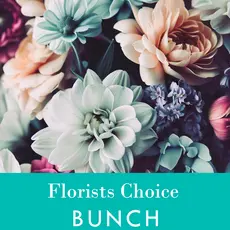
Florist's Choice Bunch
From $74.50 · 551 reviews at 4.5 starsSame principle as the Deal of the Day with a higher stem budget. The florist picks, you trust. 551 verified reviews says the model works across hundreds of partner florists in different climates. This is the product for the caller who says "just make something nice" and means it. People order blind and come back.
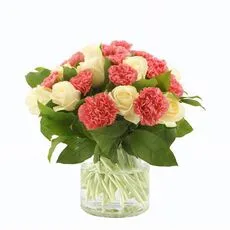
Pink Carnation & White Roses
From $80.95 · 37 reviews at 4.5 starsTwo stem types. No colour confusion. The carnations carry the pink, the roses carry the white, and the built-in longevity difference means the arrangement transforms over two weeks. The roses finish around day seven. The carnations keep going to day fourteen. Anna rates this as one of the safest choices in the range for the daughter-to-mother demographic.
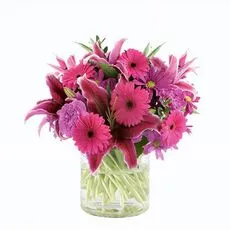
Pretty Pinks Bunch
From $80.75 · 39 reviews at 4.5 starsArrives in a glass vase, ready to display. Mum does not need to find a container, cut stems, or arrange anything. Gerberas for immediate impact, Asiatic lilies that open over the following days, roses tucked between, and stock for height and that clove-like scent. If your mum likes pink and you want zero-effort presentation, this is the one.
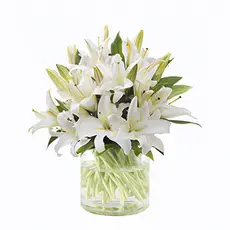
Oriental Lilies Bunch
From $80.75 · White, in glass vasePure white Orientals in a cylinder vase. Elegant, fragrant, and the buds open in sequence over ten to fourteen days. This is the arrangement that fills a room with scent. One caution: the fragrance is intense. If mum is in hospital or sensitive to strong scent, go with the Blush Pinks instead (Asiatic lilies, no fragrance). If she loves it, nothing else in the range comes close.
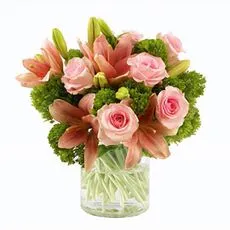
Blush Pinks Bunch
From $99.95 · 40 reviews at 4.5 starsThe 2025/2026 colour story in a bunch: soft blush roses, Asiatic lilies (scentless, so safe for hospital rooms), Green Trick dianthus that outlasts everything else by a week, and hypericum berries for texture. The green accents stop it looking like a bridesmaid bouquet. Anna says the blush palette is the first thing callers ask for during Mother's Day week. The palette says "I chose this on purpose."
Not sure which one? The full Mother's Day collection has more options, or ring 1300 360 469 and let the team help you choose.
The knock on mum's door. The look on her face before she has even read the card. That is what you are ordering.
Browse Mother's Day FlowersThe Seasonal Guide
A quick reference for choosing by season, longevity, or budget. Every flower listed below is available in our Mother's Day range, made fresh by a partner florist in or close to your mum's area.
Chrysanthemum
"Most forgiving flower on the bench"
Carnation (pink)
"Looks almost like a peony when fully open"
Rose (pink/blush)
"Autumn roses hold their blush for a week"
Australian Natives
"You are buying something that stays"
Orchid (plant)
"Thrives in conditions most flowers hate"
Hydrangea
"The one flower I could rescue from the dead"
Peony
Premium treat. Check availability first.
Ranunculus
Multi-petalled texture. Pastel trend.
Carnations get a bad reputation from people who remember the cheap ones at petrol stations. A good florist carnation is a completely different flower.Anna, Qualified Florist, 15+ Years
How to Keep Them Alive Longer
This section is for mum, not for you (although feel free to pass it on). You will never see these flowers, never touch them, never change the water. That is the strange thing about sending flowers. The care is out of your hands the moment you click order. But if you forward mum this page, or screenshot these three tips, you are giving her the knowledge to keep them going. Most of the advice out there about flower care is generic. "Trim the stems and change the water." Anna has spent her whole career watching what actually works and what is folklore. These are the ones that actually work.
The Hydrangea Rescue
If the hydrangeas have wilted (and they probably will at some point), do not throw them out. Submerge the entire flower head in a basin of cool water for 30 minutes. Hydrangeas absorb water through their petals, not just the stem. This trick works because the stomata on the petal surface open in cool water and rehydrate the bloom from the outside in. It can bring back a hydrangea that looks completely finished. Anna has done it hundreds of times.
Native Stem Prep
Woody-stemmed natives like banksias and proteas need more than a clean diagonal cut. Gently crush or split the base of the stem vertically for about two centimetres. The woody exterior restricts water uptake through the cut alone. Splitting it increases the surface area in contact with water. Most guides skip this because they are written for roses and soft stems. If mum got a mixed bunch with natives, this step extends the native stems by days. For more care advice, see our full flower care guide.
The Lily Pollen Trick
If the arrangement includes lilies (Oriental or Asiatic), check the stamens. When lily anthers open, they release a heavy orange pollen that stains fabric permanently. Clothing, tablecloths, curtains. It does not wash out. I ruined a white shirt my first week at the florist shop at Salt in Casuarina. Brushed past a fully open Oriental and the pollen went straight across my chest. I tried water, soap, everything. The stain set within minutes. After that I removed every anther before it split open, on every lily, every time. It added a minute per stem but saved me the phone call. Removing the anthers also extends the bloom by three to four days because the flower stops spending energy on reproduction and puts it into holding the petals instead. Tell mum to pinch them off before they open. She will thank you.
Two things kill flowers faster than anything else. Fruit bowls and sunny windowsills. Ripening fruit releases ethylene gas. A banana within a metre of the flowers will knock days off the carnation life and speed up petal drop on the roses. Direct afternoon sun fades pigment and heats the water. The best spot is a kitchen bench or dining table away from direct light and away from the fruit. Cooler rooms extend everything. A rose that gives you seven days in Melbourne winter gives you four in a Brisbane living room in February.
And change the water every two to three days. Not because of some vague hygiene reason. Because bacterial growth in the water blocks the stem ends and stops water uptake. A stem sitting in three-day-old water is slowly suffocating. Fresh water, re-cut the stems by a centimetre, back in the vase. That alone adds two to three days to most arrangements.
What to Write on the Card
Most people spend longer agonising over the card message than choosing the flowers. I order flowers for my mum Julie in Taree every year, and I still sit there for ten minutes staring at the card field on our own website, the one I helped build, trying to figure out what to write that does not sound like I copied it from a greeting card. Anna saw the same thing on every second call: the pause after "and what would you like the card to say?" followed by silence, or "um, just put Happy Mother's Day." The card outlasts the flowers in memory. Mum reads it once fast (who is it from?) and once slow (what does it say?). Here are messages that work, from years of hearing what people say and what they wish they had said.
For Your Mum
"Love you, Mum. Wish I could be there today." Short, honest, acknowledges the distance. Works every time.
"Happy Mother's Day. You make everything better." Simple. True. No performance.
"From your favourite child. (Don't tell the others.)" Only works in close families. When it works, it gets a laugh and a photo of the card texted back immediately.
For a Mother-in-Law
"Happy Mother's Day from both of us. Thank you for everything." Inclusive, warm, safe. Do not overthink this one.
"We're thinking of you today. Love, [both names]." Avoids trying too hard. Let the flowers do the heavy lifting.
For a Grandmother
"Happy Mother's Day, Nan. We love you." Include the grandchildren's names if you can. Nan wants to know the kids remembered.
For a Partner Who Is a Mother
"You're an incredible mum. Today is yours." Acknowledges the role, not just the relationship. She is not just your partner today. She is the mother of your children. Name that.
Skip the florist's pre-written message if you can. A handwritten line, even a short one, lands harder than a template. And keep it brief. The card is small. The callers who agonised over three paragraphs always rang back asking if it all fit on the card. It did not. One real sentence is enough. The people who rang happiest were never the ones who wrote the most. They were the ones who wrote something true.
When to Order
Mother's Day 2026 falls on Sunday 10 May. If you are reading this in early May, you are already in the window. If you are reading this in April, you are ahead of most people (and Anna would be proud of you).
From twenty years of data, Thursday and Friday of Mother's Day week are the busiest days. Friday is always the peak, and it is not a gentle curve. Last year our order queue on Friday looked like a cliff face. Orders placed Thursday or Friday for Saturday or Sunday delivery give the florist breathing room. The stems come in from the wholesale market that morning and need two to four hours of hydration before they can be arranged. A florist working ahead of schedule picks the best stock and builds without rushing.
Conditioning is the part nobody sees. When stems arrive from the market at 5am, they are dehydrated from transport. A rose that goes straight into an arrangement without proper conditioning will wilt within hours of delivery. Two to four hours in clean water with the stems freshly cut, in a cool room, is what separates a bunch that lasts a week from one that droops by dinner. Pre-ordering gives the florist that time. Same-day orders compress everything.
If you are ordering for same-day delivery, the cutoff is 2pm weekdays and 10am Saturdays. There is no Sunday delivery for Mother's Day. Flower markets close Saturday afternoon, and stock that has been sitting since Friday loses vase life with every hour. If you want flowers there on Sunday morning, they need to go out Saturday while the stems are at their freshest.
One thing to think about with Saturday delivery: mum might be out. A Mother's Day lunch, a grandkids' sport game, a hair appointment before Sunday. If there is a safe spot at her place where the florist can leave them out of the sun, add it to the delivery notes when you order. A shaded porch, a side gate, a neighbour who is always home. The florist would rather leave them somewhere cool than take them back to the shop.
Pre-ordering also gives you the pick of the range. Peonies, if available, go first. Premium stems get snapped up early in the week. The Thursday-ordering crowd gets the best of what came through the wholesale market that morning. The Saturday-morning panic buyer gets whatever the florist still has in the cool room. Both will look good. But early gets first choice.
Our Mother's Day collection is live now. If you genuinely cannot decide, Florist's Choice lets the florist pick the best stems from whatever came in that morning. Delivery is $16.95 flat, anywhere in Australia (we subsidise the real cost, which is often higher), through a partner florist in or near your mum's area. If you need help choosing, ring 1300 360 469 (7am to 6pm weekdays, 10am Saturdays) and ask one of the team. They have had this conversation thousands of times. They are good at it.
After you order, there is a gap. You have paid, the florist is working, and you are waiting. The photo from mum usually comes within the hour. If it takes longer, do not read into it. She might be crying. She might be at lunch. She might be terrible with her phone. It comes when it comes.
A florist does not need to know the neuroscience to understand what they are delivering. But it explains why mums cry over a $60 bunch and a card that just says "love you."Anna, Qualified Florist, 15+ Years
Why Mother's Day Hits Differently
You know that thing where you open the Mother's Day card aisle and your eyes sting before you have even picked one up? Or you are on the phone ordering flowers and your voice goes tight for no apparent reason? There is a neurobiological explanation for that, and it starts before you were born.
Oxytocin is produced in the hypothalamus and released two ways simultaneously: into the bloodstream and directly within the brain. It is the chemical that triggers uterine contractions during labour, milk let-down during breastfeeding, and the emotional bonding between a mother and her newborn (I had to read that sentence three times before it stopped making me teary). Research by Ruth Feldman at Bar-Ilan University found that oxytocin levels measured in the first trimester of pregnancy directly predicted the quality of bonding after birth. Higher early oxytocin meant more affectionate gaze, more touch, more vocalisation with the infant. A systematic review in Acta Obstetricia et Gynecologica confirmed that increased maternal oxytocin is associated with more affectionate contact following mother-infant interaction.
The crucial part: the maternal brain undergoes structural changes during pregnancy and the postnatal period. Not temporary hormonal shifts. Permanent rewiring. The bond becomes hardwired, independent of hormonal control over time. When Mother's Day arrives and an adult child feels compelled to do something, they are responding to circuitry that was laid down before they could walk.
Professor Jeannette Haviland-Jones, director of the Human Emotions Lab at Rutgers University, ran a series of double-blind studies published in 2005. Participants received one of three gifts: a decorative candle, a fruit basket, or a floral bouquet. The delivery people were actually measuring facial expressions. Result: 100% of flower recipients responded with the Duchenne smile, the involuntary "true smile" involving the mouth, cheeks, and eyes. Neither the candle nor the fruit basket produced a universal response. Three days later, flower recipients were still reporting elevated mood. Haviland-Jones said of the result: she thought "No, this doesn't happen. In the emotions lab, you never get a 100 percent response." Flowers also triggered a dopamine, oxytocin, and serotonin release simultaneously. A separate study from Tokyo's Mizuho Information Research Institute found that just four minutes near unscented pink roses increased parasympathetic nervous activity, the rest-and-recovery branch of the nervous system.
Receiving flowers on Mother's Day creates what researchers describe as a double neurochemical event. The oxytocin-rich maternal bond is activated by the gesture of filial acknowledgement, while the flowers themselves simultaneously trigger dopamine and serotonin. The circuitry is not the same as a romantic bouquet between partners. The chemicals are not the same. The emotional depth is not comparable. A bunch from a child to a mother lands in a way that a Valentine's Day delivery simply cannot replicate.
Haviland-Jones went further. She proposed that flowering plants are, essentially, the pets of the plant world. Her co-evolutionary theory suggests that flowers evolved to exploit a human emotional niche: they trigger positive states that helped early humans identify fruitful, healthy environments. Flowers precede fruit. Humans who responded positively to blooming plants were more likely to find food. Over millennia, this created a feedback loop. Humans cultivated flowers. Flowers evolved to please humans. It is, if Haviland-Jones is right, a five-thousand-year relationship with no known material reward. We grow flowers because they make us feel something, and we have been doing it since before we understood why.
I never learned the neuroscience until recently. But I saw it play out on calls every Mother's Day for the whole time I was on the phones. The person ordering for mum was calmer, kinder, more patient than the Valentine's Day caller. They were not panicking. They were grateful. Completely different energy. And the callbacks were different too. Callers who rang back happy always described colour first. "They were so bright." "Mum said the pink was gorgeous." Nobody ever rang and said "the spiral technique was excellent."
The Two Women Who Started Mother's Day
Janet Heyden, Leichhardt, Sydney, 1924
Most Australians have no idea that our Mother's Day tradition started in Sydney. Janet Heyden did not set out to create a national holiday. She set out to visit lonely women in a hospital and could not stop thinking about them afterwards. Her public appeal grew each year. Schools joined. Businesses donated. The Sydney Morning Herald reported in May 1924 that the nearly seven hundred women at Newington had each received a gift, and not one was forgotten. Heyden kept going back, kept organising, kept raising money, right up until she died in 1960. She received recognition from King George VI and Queen Elizabeth II along the way, but the tradition she started outlived all of that. Australia has celebrated Mother's Day continuously since that first visit in 1924.
Anna Jarvis, West Virginia, 1908
The American story is the one most people half-remember, and it has an ending nobody expects. Anna Marie Jarvis was from Grafton, West Virginia. She never had children of her own. Her mother, Ann Reeves Jarvis, had been a peace activist and community nurse during the Civil War, organising work clubs for mothers on both sides of the conflict. When her mother died on 9 May 1906, Jarvis began campaigning for a national day of tribute. The first official observance was a memorial service in 1908. By 1914, President Woodrow Wilson had signed it into law.
Then it got away from her. Florists, confectioners, greeting card companies turned her quiet tribute into a commercial occasion. Jarvis spent the rest of her life trying to undo what she had created. She organised boycotts. She threatened lawsuits against the floral industry. She called the people profiting from the holiday "charlatans, bandits, pirates, racketeers, kidnappers, and termites." She had wanted handwritten letters and personal visits, not purchased gifts.
She died in 1948, broke and alone in a sanitarium. The irony of that is hard to sit with when you run a flower delivery business. But I think about Janet Heyden more than Anna Jarvis, and Heyden got closer to the point. She did not create a day. She created a gesture. The gift bags full of toiletries and knitted goods were not expensive. They were evidence that someone remembered.
The woman who invented Mother's Day spent the rest of her life trying to destroy it. She died broke. The holiday she hated is now worth a billion dollars in Australia alone.Siobhan Thomson, Co-Founder, Lily's Florist
Why We Are More Organised for Mum Than for Our Valentine
This is the observation that surprised us most when we sat down and looked at twenty years of order data. Mother's Day is not just bigger than Valentine's Day. The buying behaviour is nothing alike. Close to 60% more flowers are bought for Mother's Day than for Valentine's Day in Australia, and the build-up to the peak looks completely different.
Over the last two years, our average order value for Mother's Day has been around $120 compared to $111 for Valentine's Day (including GST and delivery). People spend more on their mothers than on their partners. That says something.
But the real difference is not the money. It is the timing.
Andrew Anecdotally, from our experience over the last 20 years, we find that people in general, compared to other big holidays, are far more organised. It's also far busier than any other main event during the whole year. The busiest days for flower sales are Thursday and Friday, but Friday is always the peak day. Unlike Valentine's Day, it's a gradual build-up to that peak for around about two weeks before the event, whereas Valentine's Day it's generally fairly quiet until 24-48 hours beforehand. We think this is just due to the typical buyer for Valentine's Day versus the typical buyer for Mother's Day.
Andrew is right about the buyer profile, and the psychology behind it is fascinating. Mother's Day purchasing is driven by anticipatory warmth and gratitude. NielsenIQ data from 2025 shows purchases starting in April, weeks before the second Sunday in May. A third of buyers order two weeks in advance. Another 29% order a week out. Two thirds browse in store before buying, and more than half research online first. It is a considered, multi-channel journey.
Valentine's Day purchasing, by contrast, is driven by fear. Researchers at the University of Toronto describe Valentine's Day as a "temporal landmark," a psychological dividing line that forces people to assess their romantic situation. Performance anxiety kicks in. Relationships are 2.5 times more likely to end in the two weeks surrounding February 14 (though only for couples already in distress). FOMO accounts for roughly 60% of impulse purchases. Nearly 40% of Valentine's Day orders happen within 48 hours of the date.
The relationship explains everything. The bond with a mother is not under threat from an insufficient gift. Mum is not going to critique the flowers. The gesture is evaluated on thoughtfulness, not price point. Unconditional love does not require urgency. It requires sincerity. And that sincerity shows up in the data as a two-week build, measured consideration, and a calm inbox that fills gradually with names I recognise from last year ordering again.
The Valentine's Day inbox explodes on February 13 with first-time buyers who have not thought about flowers since last February. You can feel it in the order queue.
Australia's Billion-Dollar Tribute
Australians are projected to spend close to one billion dollars on Mother's Day in 2026. Flowers remain the number one gift choice at 37%, ahead of food and beverages (20%), dining out (10%), and gift vouchers (10%). The average spend per person hit $141 in 2025, up from $102 the year before. Fewer people celebrated (around 7 million, down from 9.7 million), but those who did spent significantly more. The under-35 cohort dropped off sharply, squeezed by cost-of-living pressure, while the 65-plus age group nearly doubled their involvement.
Gen X spent the most overall ($189 million), but Gen Z showed the highest year-on-year growth at 15%. The tradition is gaining traction with younger Australians even as economic pressure makes it harder. People do not skip Mother's Day. They might downgrade from a $120 order to a bunch under $60, but they still order.
The spending data comes from ARA and Roy Morgan annual surveys, supplemented by ANZ customer transaction data. The pattern is consistent year on year: fewer people skip Mother's Day than almost any other gifting occasion.
What Mums Actually Want
Now that you have seen the flowers and the products (and hopefully ordered), consider what mums actually say when asked what they want on Mother's Day. Not what the industry tells you to buy. What they say directly.
Consumer research from YouGov, CivicScience, and Yelp converges on the same handful of answers. Around 60% of mothers want to spend the day surrounded by family. Quality time. Flowers do not compete with that. They complement it. Between 42% and 48% would enjoy dining out. About a third specifically list flowers as their preferred gift. A similar number want something handmade by the giver. And somewhere between 20% and 32%, depending on the survey (I suspect the real number is higher), actually want some alone time. A morning without being asked where anything is. A cup of tea that stays hot.
Millennial mums skew toward spa experiences. Nine percent of them would appreciate, in their own words, "a day off from being mum." Gen X and Boomer mums lean toward the traditional gathering, the lunch, the flowers on the table.
The thing about flowers is they sit at a strange intersection. They are a gift and a message at the same time. They say "I thought about you enough to choose something beautiful" without the permanence pressure of a practical gift or the guilt of a voucher that sits unused in a drawer for six months. Mum does not need to find space for them in a cupboard. She does not need to pretend she likes the colour. They arrive, they are beautiful for a week or two, and then they are done. There is something honest about that. A gift with a lifespan.
One more data point that changed how I think about this: 24% to 25% of Australian Mother's Day gift buyers purchase for someone other than their birth mother. Mothers-in-law, grandmothers, partners who are also mothers, sisters, close friends with maternal roles. If mum's birthday falls close to Mother's Day (and you would be surprised how often it does), we have a dedicated collection for that overlap. When one occasion generates multiple purchases from the same person, the cumulative spend dwarfs any single-recipient holiday. The buyer base is multigenerational and multi-recipient. That is what makes Mother's Day the biggest floral event of the year.
Further Reading
If you found this guide useful, these two posts go deeper on the flowers and the care.
Mother's Day 2026 is Sunday 10 May. Our full Mother's Day collection is ready, with same-day delivery when you order before 2pm weekdays or 10am Saturdays. $16.95 flat delivery, anywhere in Australia.
Browse Mother's Day Flowers
Lily's Florist delivers Australia-wide through a network of 800+ partner florists.
23,000+ verified reviews on our reviews page.
Same-day delivery when you order before 2pm weekdays or 10am Saturdays.
Questions? Ring 1300 360 469
About the Authors
This guide was written by Siobhan Thomson with expert floristry contributions from Anna and operational data from Andrew Thomson. Between them: twenty years of Mother's Day deliveries, fifteen years of bench experience, and more than ten thousand phone calls from people trying to get it right for mum. Read our full story.

Andrew, Ivy, Siobhan and Asha. Hobart, June 2024.