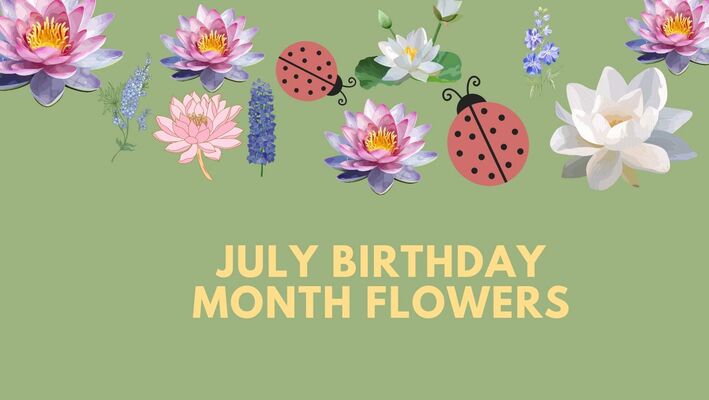
July's birth flowers are larkspur and water lily. But in Australia, where July is mid-winter, only larkspur is reliably available. Water lily is not a commercial cut flower in any season. This is the only Northern Hemisphere birth flower month where the Australian calendar actually agrees with the tradition.
The agreement is partial. Delphinium (the species florists almost always call larkspur, the trade treats them as the same thing) is at peak in cool conditions, which July provides in southern Australia. Northern Australia is a different matter. Brisbane through to Cairns and Darwin, the supply line gets fragile. The other birth flower is the lily of every culture's mythology, the lotus of Buddhism, the Egyptian lily of Ra. None of which makes water lily a cut flower. It has never been one.
So July's birth flower story turns on two asymmetries. The Northern and Southern Hemisphere axis, where the calendar agrees and where it inverts. The cut-flower and non-cut-flower axis, where commerce can deliver and where it can only gesture. Most of the pages you read on this topic ignore both, which is partly why we are rebuilding this one. The blue is unmatched and the flower is one of the most fragile commercial stems we send. Both true.
What follows is the science (Anna does floristry for a living and the chemistry runs deeper than most people expect), the cultural history we kept finding ourselves wanting to talk about over dinner, and the practical buying decisions for an Australian July birthday. Two products, two paths, both designed around what the flowers themselves actually want. Read it in order if you have the time. Skip to the buying steps if you do not.
In this guide
The one month the calendars agree
July in the Northern Hemisphere is the height of summer. Delphiniums stand in English cottage gardens, water lilies open on village ponds, July birthdays in London catch their birth flowers at peak. July in Australia is the opposite. Mid-winter, cold mornings, frost in the southern states, light through cloud most weeks. The Northern Hemisphere birth flower calendar is inverted by six months for almost every other month of the year.
July is the exception. The flower the Northern Hemisphere assigns to July, delphinium, genuinely prefers cool growing conditions. July is when cool growing conditions exist in Australia. The Northern Hemisphere accidentally assigned a flower whose biology matches our winter. For one month of the twelve, the tradition and the supply chain agree.
The agreement is partial, which the buyer needs to understand. Delphinium is not on the official list of best Australian winter cut buys (that list runs tulips, ranunculus, sweet peas, anemones, stock, which are the cool-season field crops with the most reliable Australian supply). Delphinium is largely imported or glasshouse-grown rather than a winter field crop here, which is why supply is strong in southern markets (Hobart, Melbourne, Adelaide, southern WA, Canberra) and unreliable in tropical northern markets (Brisbane up to Cairns and Darwin). The recipient's postcode decides what the supply chain can actually do.
A reader landing on this page is almost certainly a friend or family member of a July-born person, planning a birthday, expecting to learn that they should send larkspur or water lily. The honest version is more nuanced. Water lily cannot be sent. Full stop. Larkspur can be sent in July (and we love sending it, when the supply line is on our side) but the flower is fragile in ways most buyers do not expect. A native bunch is the genuinely Australian alternative, at peak in winter, longer lasting, safer for pets. The rest of this post unpacks each of those, and yes, this took ages to write. Worth it.
The first time I watched a delphinium spike shatter in the cool room I thought I had done something wrong. The whole bottom third of the spike dropped overnight. Every floret. I went looking and the answer was the bowl of apples on the office desk one room over. Same building. Ethylene travels. After that I would tell every customer ordering delphinium the same thing. Keep them away from the fruit bowl, and not just on the same bench, the same room. A 28-degree kitchen with a bowl of ripening bananas will take a spike out inside 12 to 24 hours. Different room is safe. The same chemistry that kills the spike also means delphinium hates air-conditioning drafts. The vents pull moisture out of the petals faster than the stem can replace it. Position the vase away from the airflow. Delphinium in July gives 10 to 14 days in cool conditions if you respect both rules. A bouquet left on a Hobart doorstep in July faces zero heat damage. The climate does the work.
Nobody cuts water lily and sells it. The whole plant is built to live with its roots in mud and its flower on the water surface. The moment you sever that, the petals start collapsing in hours. In fifteen years on the phones I took exactly one order for water lily as a cut option, for a wedding with floating arrangements on a pond. The florist who built it sourced from a specialist grower for that day. They held for the event and then they were done. If a buyer asks for water lily, the only straight answer is no, we cannot send that. We can send something that honours the spirit of the choice. The flower itself is not commercial.
July is exactly the kind of month where flexibility wins. Let the florist build the right winter bunch around your intent. The blue might be delphinium, hyacinth, iris, blue thistle, or lisianthus, depending on what is in the bucket that morning.
Send a Florist's Choice Birthday Bunch, from $75Nothing else in the flower world matches delphinium blue.Anna, Qualified Florist, 15+ Years
Two flowers, two stories, two very different verdicts
Larkspur and water lily share a birth-month assignment and almost nothing else. One is a spike of stacked florets, sometimes two metres tall, named for the back claw of a small bird. The other is a circadian aquatic plant whose mythology shows up in places it has no business being: the Pawnee plains, the Egyptian Book of the Dead, a glasshouse in Derbyshire in 1849. We will start with the botanic facts and then sit them next to each other on a card grid, because the comparison is the point.
Larkspur in one paragraph
Most florists still call the annual species "larkspur" and the perennial species "delphinium," but the most recent taxonomy (Kew's Plants of the World Online synonymises Consolida into Delphinium) has them as one genus of about three hundred species in the buttercup family. Two names, both descriptive. Delphinium from the Ancient Greek δελφίνιον; Pedanius Dioscorides looked at the closed bud and thought of a dolphin's nose. Larkspur is older English; the elongated petal spur looked like the hind claw of a lark, and Shakespeare called it "Lark's Heel."
The flower's structure is unusual enough to mention. What look like petals are actually five petal-like sepals, one of which extends into a hollow spur an inch or so long. The plants reach two metres in good conditions, with a single spike carrying twenty or more individual flowers. The spur is a nectary; its length is matched to specific pollinator tongue lengths, which is a polite way of saying the flower and one specific bee have been in conversation for a long time.
The Ajax myth, made physical in the petals
The species name of the most common florist larkspur is Consolida ajacis. Ajax's larkspur. After Achilles was killed at Troy, Ajax the Greater and Ulysses competed for his armour. When the armour went to Ulysses, Ajax fell into a rage, slaughtered cattle in a delusion, and ultimately fell on his own sword. Larkspur grew from his blood. The petals carry, at the right angle, a pattern that reads as the letters "AI," the Greek word for "alas." This is exactly why the species is named ajacis. The mythology is encoded in the petal pattern; the petal pattern named the species. It is one of the cleaner loops in botanical nomenclature.
One Delphinium species, D. staphisagria or stavesacre, was used as a lice killer at the Battle of Waterloo in 1815. The ancient Greeks called it phthiroctonon, "louse killer." It was reportedly standard issue to British troops. Four years later, in 1819, French chemists Lassaigne and Feneulle isolated delphinine from stavesacre seeds: one of the earliest plant alkaloid isolations in chemistry's history.
All Delphinium species are toxic. The genus carries around 427 alkaloids, one of the most alkaloid-rich plant groups known. Larkspur is responsible for an estimated 2 to 5 percent of cattle deaths in North America each year. The most potent toxin in the genus, methyllycaconitine, is now one of the most precise molecular tools available for studying the α7 nicotinic receptor, a receptor implicated in Alzheimer's disease. The same compound that kills cattle is in active use in Alzheimer's drug-development research. We will return to the toxicity question for pet owners further down.
Water lily in one paragraph
The genus is Nymphaea, about fifty species, from the Greek Nymphaios, "of the nymphs"; the water nymphs of Greek mythology lived in the streams and ponds where these flowers grew. The lotus of Buddhism rises from mud through water to bloom above the surface, and the metaphor for spiritual ascension has held its shape for two thousand five hundred years. The Pawnee story has a woman cutting a hole in the sky to look down at earth; the crumbs of blue sky that fell through the gap became larkspur. (That last one is for the larkspur, not the water lily. We mention it here because the colour blue keeps showing up in both flowers' stories.) Two facts about water lily worth one sentence each: the flower generates its own heat (Victoria amazonica's floral chamber can reach 34.7°C against a 24°C ambient, which is how it attracts scarab beetles for pollination), and the open-at-dawn, close-at-dusk rhythm is not a passive response to light, it is driven by the plant's internal circadian clock, the same molecular feedback loop that governs animal biological clocks.
One species note for Australian readers. The yellow water lily (Nymphaea mexicana) is listed as an invasive weed under NSW WeedWise. It is not the ornamental birth flower Nymphaea, it is an introduced exotic, but the visual similarity means anyone planting a water lily near a watercourse should check the species first.
Side by side
Larkspur
Delphinium / Consolida ajacisThe tall, spurred summer flower of the Northern Hemisphere. Up to two metres in good conditions, with a single spike carrying twenty or more florets. The flowering blue is one of the rarest colours in the cut-flower trade; most "blue" stems are dyed, delphinium blue is real pigment. In Australia, delphinium is at peak in July, which is the one month the Northern Hemisphere birth flower calendar and the Australian growing calendar agree on. Toxic to cattle. Beloved by Shakespeare. Named for Ajax.
Water Lily
Nymphaea, approx. 50 speciesThe aquatic perennial of every culture's mythology. The lotus of Buddhism, the Nymphaea caerulea of Ra and the Book of the Dead, the Victoria amazonica whose leaf taught Joseph Paxton how to engineer the Crystal Palace. Petals open at dawn and close at dusk on a circadian clock as precise as any animal's. It is not a cut flower. It cannot be sent. In Australia it blooms October through March. In July, it is dormant. For a July birthday in Australia, every commercial path leads elsewhere.
The lily pad that built the Crystal Palace
Two of the strangest stories in the history of these two flowers do not belong in a buying guide. They belong in a history book, or a paper on neurobiology, or an architectural lecture. I first read about the Devonshire daughter on a lily pad sitting in a Sydney hotel room (the Crystal Palace story was a sidebar in something Andrew had open on his laptop) and almost dropped my coffee. We are going to tell them anyway, because they are the part of the post we kept dragging into dinner conversation for weeks.
The largest member of the water lily family is Victoria amazonica, with leaves three metres across and strong enough to hold a small adult. In 1849, Joseph Paxton, the head gardener at Chatsworth, managed to cultivate it in England, which had never been done before. To prove the leaf's load-bearing strength, the Duke of Devonshire put his seven-year-old daughter Annie on a lily pad in costume as a fairy. She stood on it. The pad held. National Geographic has the engineering breakdown if you want the full structural story.
What Paxton noticed in that leaf, radiating longitudinal ribs acting as primary girders, transverse cross-ribs distributing load across the surface, became the structural foundation of the Crystal Palace. The Great Exhibition of 1851 was held inside what was, structurally, a giant water lily leaf.
"Nature was the engineer. Nature had provided the leaf with longitudinal and transverse girders and supports that I, borrowing from it, have adopted in this building."
The Crystal Palace was 1,851 feet long, the largest building in the world at its time, three times the floor area of St Paul's Cathedral. The number 1,851 was not a coincidence. A 2022 paper in Science Advances confirmed the mechanical logic Paxton observed in the leaf, more than 170 years after he built a building from it. The lily pad got the maths right.
Andrew, Co-Founder The Paxton story is one I have been collecting for years. The number 1,851 chosen for the building length to match the year of the Great Exhibition is the kind of detail that does not show up in pop history. It only appears in the engineering papers. Worth knowing for a buying guide. Not worth pretending it changes which flower you send.
The painter who saw past his own lens
Claude Monet painted water lilies obsessively for nearly thirty years, from his garden pond at Giverny. His cataracts began around 1905. By 1912 his acuity in his worse eye had dropped to 20/50. Between 1912 and 1923, his paintings shifted measurably toward yellows, oranges, and reds; this is not stylistic interpretation, it is documented by comparative pigment analysis. He destroyed many canvases from that period after his 1923 cataract surgery, when he could see the colours clearly again.
Here is the strange part. The standard cataract surgery of 1923 removed the lens entirely (a condition called aphakia). The human lens normally blocks ultraviolet light. Without it, the operated eye could potentially detect UV in the 300-400 nanometre range. Water lilies, viewed under UV, show violet and blue auras invisible to a normal-vision human eye. Monet's post-surgical paintings of his water lilies show increased blue and violet in the light around the flowers. The Science History Institute has the full hypothesis.
Monet may have painted an ultraviolet dimension of his water lilies that was invisible to every single person who has ever looked at the canvases. We will probably never know for certain. But it is the kind of thing that, once you have read it, changes the way you look at the paintings.
One more, then we are back to the buying guide
Ancient Egyptian religious life ran on Nymphaea caerulea, the blue Egyptian water lily. The Hermopolitan creation myth held that the sun god Ra emerged from a blue lotus at the start of time. The flower's daily behaviour, opening at dawn and closing at dusk, was read as Ra's daily journey across the sky. The Book of the Dead used the flower as a symbol of crossing into the afterlife.
All of that has chemistry behind it. N. caerulea contains apomorphine, a dopamine agonist currently approved for treating Parkinson's disease, and nuciferine, which acts on the serotonin 5-HT2A receptor. A 2025 study at UC Berkeley by Liam McEvoy worked out the Egyptian method of extraction: nuciferine is only slightly fat-soluble, so simple wine soaking would have failed. The Egyptians infused oil first, then mixed the oil into wine. The Ebers Papyrus describes exactly that, in writing, three thousand years before the chemistry was understood.
The lily pad taught Paxton how to build the largest building in the world. The same plant family has never been a cut flower. Both facts sit in the same family of plants. We do not really know what to do with that, but we like that we know it.
Cultural depth done. The practical question, what to actually send to a July birthday in Australia, is more grounded.
Monet may have painted an ultraviolet layer of his water lilies, one that nobody else can actually see. Read that twice. We did.Siobhan Thomson, Co-Founder
Sending pink larkspur in 1850 was a coded insult
Sending pink larkspur to someone in 1850s England would have been understood as calling them fickle. The Victorian colour code for larkspur was specific enough that a bouquet was a coded message. Pink meant inconstancy, blue meant dignity, purple meant first love, white meant happiness. Two centuries later, almost no recipient decodes the codes any more. But the sender can still choose to honour them.
| Larkspur Colour | Victorian Meaning | What a buyer should understand in 2026 |
|---|---|---|
| Blue | Dignity and grace | The safest, most universally well-received option. Also the colour every buyer expects when they think "larkspur." |
| Pink | Fickleness | Knowing this changes the gift. A modern buyer can either ignore the meaning entirely (most do) or lean into it for a self-aware July birthday card. |
| Purple | First love, haughtiness | Strong for milestones. Eighteenths, twenty-firsts, first-relationship anniversaries. |
| White | Happiness and cheer | Excellent for milestone birthdays where the recipient might also have sympathy associations with the year. Anna's note: white in a winter arrangement reads as celebration when the rest is warm and full. |
The Victorian system is real history but not modern usage. Kate Greenaway's Language of Flowers, Madame Charlotte de la Tour's 1819 Le langage des Fleurs, two centuries of documented use. But pink larkspur in 2026 reads as "pretty pink flowers" to almost every recipient. The colour-meaning system is now a layer the sender can choose to honour or to ignore. Either is legitimate. We just think it is worth knowing the codes exist.
One footnote, because it is too good to leave out. Crushed water lily roots were prescribed in medieval monasteries as an anaphrodisiac, to suppress sexual desire in monks and nuns. The pharmacology of the alkaloids known to exist in Nymphaea species means the medieval prescription was not necessarily wrong. It just has not been formally tested. Make of that what you will.
The toxicity question, and the better answer for pet households
Some flowers are not as innocent as they look. Larkspur is one of them. The same chemistry that makes it a research compound for Alzheimer's disease, and the same chemistry that has killed two to five percent of North American cattle each year, is in the cut stem on the kitchen bench. Not enough to harm an adult human who is not eating it, but worth knowing if a curious cat or dog shares the house.
Yes, larkspur is toxic to cats and dogs, and the toxicity is well documented. All Delphinium species carry norditerpenoid alkaloids. The most potent, methyllycaconitine, is precise enough that researchers use it as a probe for the α7 nicotinic receptor when studying Alzheimer's. Keep bunches out of reach of pets that chew flowers, or substitute with natives.
Delphinium is on every reputable toxic-plant list for pets. If the recipient has cats or dogs that chew flowers (and some do), keep the vase high. A worktop with no jumping access, not a coffee table. If the cat has form, the answer is to send something else entirely. Natives are safer. Carnations are safer. Gerberas are safer. If the household has a chewer, write that in the card message and the florist will substitute.
If you suspect a pet has ingested any part of a Delphinium plant, contact your vet immediately. The Animal Poisons Helpline (1300 869 738) is available 24/7 across Australia. Most exposures from a cut-stem arrangement are mild, but the toxicity is real and the helpline is the right first call.
There is a flower category that solves the toxicity question entirely. Australian natives.
July is also when the natives are at their best, which is the part most people miss. Banksia, waratah in some regions, kangaroo paw, leucadendron, gum nuts, eucalyptus. Winter is their flowering season. The waxy cuticles on most of these stems shrug off cold air the way a tulip cannot. A leucadendron will hold for 21 to 42 days. A king protea flower head is almost indestructible. Banksia hangs on for two to three weeks in a vase. A native bunch for a July birthday is not a compromise. It is the Australian answer to an English tradition, in season, longer lasting, and the leucadendron will still be standing at day twenty-eight while the delphinium has been composted for a fortnight.
The call I would get every July, more than once a week, was the customer in Sydney sending to someone in Cairns who specifically wanted delphinium because it was the recipient's birth flower. Delphinium in Cairns in July is not something we can guarantee. The supply chain to Far North Queensland for cool-season specialty stems is fragile. Cool stems travel from Brisbane by air freight, and the order quantities are small enough that some weeks the wholesaler does not bring delphinium north at all. I would have the conversation on the phone. Blue or purple is the colour theme of larkspur. Statice, hyacinth, iris, blue thistle, sometimes blue-tinted lisianthus when the wholesaler has them. Together they read as a blue and purple winter bouquet without forcing a fragile spike across a state border. The card message field lets the buyer tell the florist what matters. Write that you wanted delphinium and you trust them to honour the blue intent. Florists who pretend the substitution never happens are the ones who make people angry.
Banksia, leucadendron, kangaroo paw, waratah. Winter is when the natives are at their peak. Two to four week vase life, no ethylene anxiety, safer in pet households, and made of the plants that actually grow here in July.
Celebrate the Australian winter. Order Australian NativesHow to send flowers for a July birthday in Australia
Four steps, in order. The first one is the only one that depends on geography. The other three are universal across the country.
Check the recipient's state
Australia's climate splits cleanly down a north-south line in July. Hobart, Melbourne, Adelaide, Canberra, Perth (south of the river), southern NSW: delphinium supply is strong, cool conditions are kind to the stems, July is the right month. The southern partner florists are pulling stems off the Flemington (Melbourne) or Sydney market floor before sunrise. Brisbane and north, Darwin: it gets harder. The Rocklea market in Brisbane does carry delphinium some July weeks but the air-freight run to Cairns or Darwin is small enough that wholesalers will skip stocking it. The recipient's postcode determines what is realistic. If they are in the warm half, plan for substitution and lean into the card message field.
Order by 2pm weekdays or 10am Saturdays
Same-day delivery runs to a cutoff for a reason. The 2pm weekday cutoff exists because the florist needs the cool morning to source and condition the stems, and the delivery happens before van interior temperatures climb. Saturday cuts at 10am because the wholesale markets are half-day; 10am is the latest we can guarantee fresh stock for that day's delivery.
The 2pm cutoff is not arbitrary. Flower metabolic rates spike in the afternoon heat, especially in summer, and delivery vans can hit 45 degrees inside during peak hours. Cutting orders at 2pm means the florist has the cool morning to source and condition the stems, and the delivery happens before the van interior cooks them. In July it matters less because winter mornings are cold and afternoon temperatures are mild, but the cutoff is the same year-round for consistency.
Sundays we do not deliver. The wholesale market is closed Saturday afternoon, so Sunday delivery would mean Friday's stock, already three days old before it reaches the vase. We would rather be honest about that than offer a service that disappoints.
Delivery is $16.95 flat across Australia. That figure is subsidised. The actual cost of a driver, a van, and a delivery window in most Australian cities runs higher. We absorb the difference because delivery charges should not be the reason someone decides not to send flowers. For a smaller budget option, see our flowers under $60 range, or browse our blue flowers range for July-appropriate stems.
Use the card message field as a brief, not just a message
The card message field at checkout is for two things, not one. The visible message (the line printed on the card the recipient receives) goes in the obvious place. The brief to the florist, what you actually want the bunch to do, also goes there. Write that it is a July birthday, that you would prefer blue or winter tones, that delphinium if available, that the recipient has a cat (if applicable). The florist reads the message before building. This is the single most useful thing a buyer can do.
Andrew, Co-Founder We tried to send delphinium to Cairns once in our first year of running the Lily's network, around 2009. The order came in from a customer in Sydney who wanted blue for his mother's seventieth. We routed it to our partner in Cairns. The partner rang back at noon and asked if statice and blue thistle would be acceptable instead. Cairns market did not carry delphinium that morning, or the morning before, or any morning we checked that week. We learned. It still annoys me when a buyer expects us to make the impossible happen at any price, and it still gets sent into the system from time to time. The card message field exists because of that call.
If the birthday is in hospital, switch to box format
July hospital deliveries are common (winter admissions, post-op recovery, chemo cycles that run year-round). The format is more important than the stems.
If the July birthday is in a hospital ward, do not send the tallest delphinium spike you can buy. They do not fit the bedside table. The patient is not getting out of bed to find a vase, and anything over forty-five centimetres lands at reception rather than the bed. Order a box arrangement of mixed winter stems, soft scent, no strong pollen, low height, and write the patient's full name and ward number in the delivery note. The box is the vase. The florist puts everything together and the recipient just looks at it.
If you are sending to a ward, check our hospital flowers range for box-format options. Avoid strong-scented stems like Oriental lilies.
If you receive delphiniums, two things to do straight away
First, cut two centimetres off the stem ends at an angle and put them in fresh water with the food packet (or a quarter teaspoon of household bleach per litre if no food packet came with the bunch). Second, position the vase upright. Delphinium spikes are gravity-sensitive and apex-bend if stored on their side. Keep the vase away from fruit bowls and air-conditioning vents. The 12 to 24 hour fruit-bowl rule is real.
How the partner network actually delivers
When you place an order, the system routes it by postcode to a partner florist in or near the delivery area. There are over 800 partner florists across Australia in the network. Your Melbourne order goes to a partner buying at Epping that morning. Your Hobart order goes to a partner whose stock has crossed Bass Strait overnight on the ferry. Your Cairns order goes to a partner buying air-freighted stock from Brisbane. Same brand, three different supply chains, three different florists, all producing the same kind of bunch.
If anything goes wrong
If anything is wrong with what arrives, we want to hear about it. Same day if possible. The process is straightforward. Photos of the bunch from both sides, sent to [email protected] or via live chat on the site, and Andrew or one of the team will pick it up. We resolve most issues within 24 hours. Phone is 1300 360 469 between 7am and 6pm weekdays, 7am to 12pm Saturdays. ABN 17 830 858 659.
For other product paths in the same direction, browse the full Florist's Choice range, or look through our most popular birthday flowers or the main birthday flowers page for context.
The buyer never has to know about the supply chain difference. But it is the reason the same product in the same brand looks different in two cities.Andrew Thomson, Co-Founder
Further reading
July is one of twelve. If you are working through other birthdays in the family, or curious about the wider pattern, these are the related posts.
Two products cover most July birthday paths. The Florist's Choice Birthday Bunch for honouring the tradition with flexibility on the stem; the Australian Natives Bunch for skipping the tradition entirely and celebrating what is actually flowering in July here.
Browse all birthday flowers
Lily's Florist delivers Australia-wide through a network of 800+ partner florists.
23,000+ verified reviews on our reviews page.
Same-day delivery when you order before 2pm weekdays or 10am Saturdays.
Questions? Ring 1300 360 469
References
Primary sources cited in this post, in order of appearance.
- Wikipedia summary citing Kew Royal Botanic Gardens, Plants of the World Online. Taxonomic synonymisation of Consolida into Delphinium. en.wikipedia.org/wiki/Consolida
- Yin T., Cai L. et al. "Alkaloids with Anti-Alzheimer's Activity from Delphinium." PMC, 2022. pmc.ncbi.nlm.nih.gov/articles/PMC9051563
- National Geographic. "What a huge lily pad can teach us about building design." nationalgeographic.com
- McEvoy, L. "Investigating the psychedelic blue lotus of Egypt." Berkeley News, March 2025. news.berkeley.edu
- Science History Institute. "Could Claude Monet See Like a Bee?" sciencehistory.org
- NSW Department of Primary Industries, WeedWise. Yellow Water Lily (Nymphaea mexicana) listing. weeds.dpi.nsw.gov.au
- Paxton, J. Address to the Royal Society of Arts, November 1850. Quoted historical record.
About the authors
Three voices wrote this post. Siobhan held the narrative thread, Anna brought fifteen years of bench experience to the floristry mechanics and the substitution call, and Andrew added the operational layer on supply chains and the card message field. Read our full story.

Andrew, Ivy, Siobhan and Asha. Hobart, June 2024.