
Send a yellow chrysanthemum to the wrong door in November and you have not given a birthday gift, you have given a death curse. That is not hyperbole. The chrysanthemum is the traditional birth flower for November and the most culturally loaded stem on a working florist's bench, and most flower-meaning guides do not mention the second half of that sentence. This one does. It walks through what the flower really means, when chrysanthemums make good birthday flowers, and when to send something else.
The longer version, which is the version most birth-flower guides skip, is that the chrysanthemum is one of the most culturally loaded flowers on a florist's bench. Send the wrong colour to the wrong household and you have not given a gift, you have caused an incident (a real one, I know of a few). The good news is the rules are not complicated once someone explains them properly, which most flower-meaning guides do not.
So that is what we are doing here. Anna is our qualified florist, fifteen years and counting behind the bench, and she has handled chrysanthemums in every form a working Australian florist encounters. She is going to walk through what the flower actually means, what the colours signal across the cultures that live in Australia, why November in Sydney is nothing like November in Paris, and which chrysanthemums we send when the customer says "it is for mum's seventieth and please do not get this wrong." If you are ready to send already, you can browse the November birthday range. Otherwise, the long way round starts now.
If you only have 30 seconds
- Chrysanthemum is November's birth flower in most major lists, but in Australia it is peony season at the same time, and peonies are the genuinely seasonal stem of the month.
- Yellow and white chrysanthemums carry funeral weight in Chinese, Italian, Japanese, Korean, and parts of European tradition. The colour matters more than most flower guides admit.
- Chrysanthemums are listed as toxic to cats, dogs, and horses. If the recipient has pets that chew plants, ask for an alternative such as Australian natives.
- A disbud chrysanthemum costs roughly 55 cents to a dollar a stem at wholesale and holds two to three weeks in a vase. The same money buys about a third of a single rose. Chrysanthemums are the value play in commercial floristry, not the cheap option.
- "Mum" is both the florist abbreviation for chrysanthemum and the Australian word for mother, which is why chrysanthemums are tied to Mother's Day here, not to November.
What is the birth flower for November?
Yes, chrysanthemum is November's birth flower in the major lists, and it carries loyalty, longevity, friendship, joy, and remembrance in the modern reading. The interesting part of the answer is what comes next: colour, culture, and the second flower most lists do not bother with.
Some lists also include peony as a secondary November birth flower. The peony note is worth taking seriously here, because peony is one of the most prized cut flowers in commercial floristry and it has its peak Australian season in October and November. The Northern Hemisphere has peonies in their May to June window. We have them now. So when a customer in Sydney or Melbourne asks what the November birth flower is, the honest answer is there are two arguable answers and the second one matters more than most flower guides give it credit for.
When callers rang in November asking about birth-flower bouquets, the first thing I would ask was whether they wanted the symbolic flower or the seasonal flower. Chrysanthemum was the symbolic answer. Peony was the seasonal answer. The four to six week peony window falls right across the back half of October into early December, and most November calls landed inside it. I steered a lot of those callers toward peony-led arrangements with chrysanthemums in the structure. The peonies said "this is your month." The chrysanthemums said "this flower will still be on your bedside table when the peonies have dropped."
Why chrysanthemums are linked with November (and why Australia complicates that)
The chrysanthemum became November's birth flower through Northern Hemisphere tradition. In the United States, in the UK, in France and Italy and Japan, November is late autumn. The chrysanthemum is a classic late-season flower, blooming when shorter days and longer nights trigger its buds. It closes the gardening year. By November, in those climates, almost everything else is done.
Australian November is the opposite. It is late spring. The days are lengthening, the temperature is climbing, the jacarandas are finishing their bloom (poorly, if it has been a hot one), and the seasonal logic the Northern Hemisphere takes for granted is upside down. Most birth-flower content on the English-speaking internet is written from that Northern perspective. If a guide tells you chrysanthemums are November's autumn bloom, it is correct about the symbolism and wrong about your weather.
The Northern Hemisphere chrysanthemum story is about a flower that closes the year. The last big bloom before winter. In Australia, chrysanthemums work harder than that. They are on the bench every week of the year. November is not their hero month here. May is, because that is when the autumn ones come through and that is when Mother's Day falls. November is when the warm-climate buyer is looking for blooms that will survive the rising heat, and chrysanthemums are the most heat-resilient commercial flower we work with. The birthday story changes but the flower stays the same.
A bouquet built for a Belgian autumn does not solve the problem of a Brisbane warm front. Which blooms will look intentional ten days from now, in a house that is getting warmer not colder, with a fan turning in the corner? That is the lens we use when we build a November birthday bouquet.
Why is chrysanthemum linked to November?
- The chrysanthemum naturally buds when nights get longer, which is autumn in the Northern Hemisphere and contains November in their calendar.
- The Victorian birth-flower lists that became the modern tradition were written from a Northern desk. November and chrysanthemum was the local answer.
- The tradition crossed to Australia in the same century, with the same calendar attached, and stuck.
- The flower lasts so well in florists' coolrooms that growers found ways to supply it year-round, breaking the seasonal anchor commercially while leaving the symbolism intact.
- None of which changes that on the Australian calendar, November is late spring, and the chrysanthemum is doing different work here than it does in a London florist's window.
Peonies, the bonus November flower
This is the part of the birth-flower story you will not find on a US site. November in Australia is one of only twelve weeks of the year when peonies, one of the world's most prized cut flowers, are at peak commercial availability and the lowest seasonal price. They are grown in Victoria, in the New South Wales Southern Highlands, and in Tasmania. The window is short. Late October to early December. Four to six weeks. Then they are gone until next year, or available only at Dutch-import premiums through winter.
The buyer ordering a November birthday bouquet has a choice the rest of the world's calendar does not offer. Two real birth flowers for the month, both at peak, both Australian-grown. The smart November bouquet does not force the recipient to pick. It carries both. Peonies up front for the moment of unwrapping. Chrysanthemums in the build for the long-tail presence.
November is the only month in the Australian calendar where both birth flowers are simultaneously at peak commercial availability. Genuinely unusual. Most months you get one stem doing the symbolic work and nothing else. In November, the peonies are in their narrow window, and the chrysanthemums are at full year-round stock with the warm-climate cultivars coming on. When a customer wants a birthday bouquet that says "this is your month" without being a cliché, the peony-and-chrysanthemum combination is the answer nobody else thinks to give them.
What does the chrysanthemum mean?
Most flower guides treat chrysanthemum meaning as a single list. It is not. Australian birthday gifting reads it as affection and long-lasting friendship. East Asian traditions add longevity and the autumn scholar. Catholic Europe attaches it to the cemetery. The grandmother test resolves most of this: which Victorian flower-meaning book made it across to her bookshelf is half of which reading is in the room when the bouquet arrives.
Chrysanthemum meaning by colour
The colour table that follows is the most-asked-about part of any chrysanthemum guide. We have given it the cautious version, not the breezy version. Where a colour carries cultural weight that could land wrong, we have flagged it.
| Colour | Common modern meaning | Important caution |
|---|---|---|
| Red | Love, affection, romance | Safer in romantic or close-family gifting |
| Pink | Affection, warmth, gentle friendship | Good birthday option when available |
| Yellow | Joy, cheer, friendship | Older floriography sometimes reads yellow as slighted love or sorrow |
| White | Honesty, purity, respect | Can be strongly linked to mourning in Japan and parts of Europe |
| Purple or violet | Thoughtfulness, dignity, get-well wishes | Meaning varies by list and is weaker historically |
| Orange or bronze | Autumn warmth, energy, seasonal richness | More modern design meaning than formal floriography |
| Green | Renewal, freshness, novelty | Mostly contemporary florist interpretation |
Pink chrysanthemums are the safe and underused choice for a birthday. Customers default to roses without realising pink chrysanthemums give them four times the vase life at a quarter of the stem cost. Yellow chrysanthemums photograph cheerful and read cheerful. The Victorian "slighted love" meaning is dead in modern Australian gifting. Nobody you know reads a yellow bouquet as an insult. White disbuds are the sympathy default. We use them in wreaths and funeral sheaves more than any other stem, and if you are sending white chrysanthemums in a birthday context they need to be paired with bright colour or the bunch tips toward sympathy by accident. Orange and bronze are autumn flowers in the Northern Hemisphere but they work as warm-toned birthday flowers in Australia year-round. Green trick is a textural stem, not a colour story. It is filler in mixed bunches where it stops a bouquet from looking like one shade of paint.
If you are sending a partner or close family member a pink-led bouquet that uses chrysanthemums as structural contrast under the roses, the Blush Pinks Arrangement with Chocolates is the build we go to. The green trick chrysanthemums at the base give the pink palette structure. Without them the bunch reads as one soft cloud with no visual rest point.
The Northern Hemisphere chrysanthemum is the flower that closes the year. The Australian chrysanthemum is the flower that opens the warm season. Two springs, one flower, both meaningful in their own calendar.Anna, Qualified Florist
Chrysanthemum across cultures
Chrysanthemum is one of the most culturally complicated flowers in commercial floristry. Imperial dignity in one tradition, the flower of the dead in another, a cheerful birthday and Mother's Day staple here in English-speaking Australia. The same stem, the same colour, can be a celebration or a problem depending on which household it arrives at. A florist who has taken thousands of calls knows that, and asks the question.
China: two thousand years and the four cardinal virtues
On a Tuesday morning in Hurstville, a chrysanthemum bouquet at the wrong door is a death curse. That is not rhetoric. Chinese funeral tradition treats the chrysanthemum as the flower of the dead: white and yellow on the casket, red as mockery if it turns up at the wrong service. The rule has been active for centuries. In Sydney the Chinese-Australian communities concentrate around Hurstville, Eastwood, and Chatswood; in Melbourne around Box Hill and Glen Waverley. The rule applies regardless of postcode, but those are the suburbs where a working florist sees it play out on a Tuesday afternoon.
The funeral weight sits beside an equally old prestige. Cultivation goes back to at least the 15th century BC along the middle Yangtze, where Chrysanthemum morifolium, the parent of most florist chrysanthemums today, was first grown. In Confucian art and literature, chrysanthemum is one of the Four Gentlemen, the four plants representing the cardinal virtues of the scholar class: plum blossom for winter resilience, orchid for spring refinement, bamboo for summer integrity, chrysanthemum for autumn. To paint a chrysanthemum was to invoke the dignified scholar in retreat, the man or woman who had stepped back from the noise of the court to live with intention.
Chrysanthemum tea (júhuā chá) has been steeped in China for two thousand years and is still sold in supermarkets and served in restaurants across the country. So the chrysanthemum in Chinese culture is simultaneously the funeral flower, the autumn scholar's emblem, and a household drink. All three meanings are active at the same time, which is why the colour and the occasion both matter when a customer rings to send one.
Japan: imperial weight and Choyo-no-sekku
When a Japanese-Australian household receives chrysanthemums for a birthday, they are receiving the flower on the Imperial Seal. That is the cultural weight in the room. Japan gives the chrysanthemum the most concentrated political and ceremonial weight of any culture on earth, and a casual gift can read as anything but casual.
The 16-petal chrysanthemum, the Kikukamonshō, is the crest of the Japanese Imperial family. It is on Japanese passports and on the chains of the Order of the Chrysanthemum, Japan's highest civilian honour. The flower arrived from China during the Heian period (794 to 1185 AD) and became Imperial across the medieval centuries. It has stayed Imperial since.
Choyo-no-sekku, the Chrysanthemum Festival, is observed on the ninth day of the ninth month, a numerologically auspicious "double yang" date. Traditions include drinking sake with chrysanthemum petals and displaying chrysanthemum arrangements. Note the date: September. Their autumn. Six months opposite ours. Two springs, one flower, in a sentence.
The Japanese chrysanthemum carries more cultural weight than any I encountered on the phones. The Imperial Seal. Choyo-no-sekku in September. The flower on the passport. When a customer was sending to a Japanese-Australian household for a birthday, I would steer away from white, recommend a warm pink or mixed palette, and on the more uncertain calls suggest natives instead. The Japanese chrysanthemum is not a casual flower. Treating it as one is the mistake.
Europe: the flower of the dead in Catholic tradition
On the second of November in Leichhardt, a chrysanthemum bouquet reads as cemetery flowers arriving at the wrong door. That is All Saints' Day weight, and it is older than most of the suburbs the rule applies to. In France, Italy, Belgium, Austria, and Catholic-tradition Europe, families have visited cemeteries on November 1 and 2 for centuries with chrysanthemums in hand. The French nickname stuck: les fleurs des morts, the flowers of the dead. In Italy they are cemetery flowers, full stop. As a housewarming gift to an Italian household, they read as a death curse.
In Sydney the Italian-Australian community concentrates around Leichhardt, Haberfield, and Norton Street; in Melbourne, around Carlton and Lygon Street. Carl Linnaeus coined the scientific name Chrysanthemum in the 18th century from the Greek for gold flower, and by the 1700s the flower was embedded in European horticulture. The naming was European. So is the cemetery freight.
Korea: white funeral, yellow remembrance
The Korean colour rule sorts cleanly: white is funeral, yellow is memorial, pink and red and mixed are everyday gifting. In Sydney the Korean-Australian community concentrates around Strathfield and Eastwood; in Melbourne it is spread more thinly. The rule applies regardless of postcode, and on Korean households the colour does more work than any other variable in the bouquet.
Korean callers were rarer on the phones but the rule held when they came. White was funeral. Yellow was memorial. Pink, red, and mixed were fine for birthdays. The simplest call I would have was about the colours to avoid, not the colours to send. Start at the avoid list and the rest of the bouquet follows.
The cross-cultural map at a glance
| Culture | What chrysanthemums signal | What that means for a birthday gift |
|---|---|---|
| Chinese | Funeral flower. White and yellow equal death. Red reads as mockery at a funeral. Also the autumn scholar virtue. | Never send chrysanthemums to a Chinese household as a birthday gift. The recipient will read it as a curse. |
| Italian (Catholic) | Flower of the dead. Appropriate at funerals. Never as everyday gifts. | Same rule. Do not send chrysanthemums to an Italian-Australian household for a birthday. |
| Japanese | Imperial flower. Choyo-no-sekku celebrates it. White carries Buddhist memorial association. | Dignified and formal. Pink or warm mixed palette shifts toward celebration. Not a casual choice. |
| French, Belgian, Austrian | All Saints' Day cemetery flower. Strong memorial association on November 1 and 2. | A French-Australian receiving chrysanthemums on November 1 or 2 will read them as cemetery flowers. |
| Korean | White equals funeral. Yellow equals remembrance. | Pink, red, or mixed chrysanthemums are acceptable. White or yellow alone reads as a funeral signal. |
| English-speaking | Cheerful, friendly, long-lasting florist flower. Birthday-appropriate. Australian Mother's Day association. | The default reading for most Australian buyers. Pink, yellow, orange, mixed are warm and celebratory. |
A caller once wanted to send chrysanthemums as a birthday gift to a Chinese colleague. I redirected to roses. You send chrysanthemums to a Chinese home for a birthday and the message you are sending is the opposite of what you intended. It is not a small mistake. The colleague would have read the bouquet as a death curse. Roses cost more. We sent roses.
The Italian thing catches Australian callers out in the other direction. They send chrysanthemums as a birthday gift to an Italian colleague's house and do not understand the reaction. Full stop. At the funeral, absolutely appropriate. As a housewarming gift, absolutely not. We get the call the next day and it is too late by then.
When in doubt, ask. One question, "does the recipient have a cultural background where chrysanthemums carry a different meaning?", prevents a mistake that cannot be unsent. If you are not sure and cannot ask, the safer move is to skip chrysanthemums entirely and send Australian natives or a Florist's Choice bouquet where a working florist chooses for the recipient and the occasion. The Native Arrangement with Chocolates is the build we recommend when the cultural register is uncertain: banksia, leucospermum, waxflower, no chrysanthemums, no lilies, no funeral baggage in any of the cultures named above. White chrysanthemums do have their place in Australian floristry, but it sits inside sympathy and funeral work, not inside birthday gifting.
If you have read this far and are now worrying you may have already ordered the wrong bouquet, ring before the delivery if you can. The most common call we get on this topic is from a customer who has just realised the cultural angle. The bouquet can usually be changed on the morning of, provided we know in time.
Are chrysanthemums good birthday flowers?
In English-speaking Australia, yes. They are excellent birthday flowers when the colour palette is warm (pink, yellow, orange, bronze, mixed) and when the recipient does not have one of the cultural backgrounds covered above. Vase life beats any other commercial cut flower on the wholesale floor, heat tolerance is high, supply is year-round, and the stems pair beautifully with roses, gerberas, native foliage, and almost any seasonal flower you want to feature.
Vase life depends heavily on which Australian climate band the flowers land in. The numbers below come from our internal climate-stem matrix, built from years of bench data across cool, moderate, and warm-climate deliveries.
| Climate band | Disbud (single bloom) | Spray (multiple blooms) |
|---|---|---|
| Cool Hobart, Melbourne winter, 15–18°C rooms | 18–30 days | 14–28 days |
| Moderate Sydney, Adelaide, Melbourne spring and autumn, 20–24°C rooms | 14–24 days | 10–21 days |
| Warm Brisbane summer, Darwin, Cairns, 28–32°C rooms | 10–14 days | 7–12 days |
The cockroach of the flower world. Put them next to the fruit bowl, on the doorstep, wherever. They just keep going. I have seen mums still holding structure at fourteen days when the roses have dropped and the lilies have gone translucent. In a wreath that needs to survive a chapel service, a graveside committal, and then sit on a headstone for a day or two after, chrysanthemums are doing the heavy lifting on longevity. People do not think of them as premium, but in sympathy floristry their stamina is worth more than any rose. They are also ethylene-insensitive, which is professional florist language for "you can put them next to the fruit bowl and they do not care." Every other guide tells you to keep flowers away from the fruit bowl. Chrysanthemums break that rule. They are one of seven commercially common cut flowers that ignore ethylene gas completely.
Andrew, Co-Founder Chrysanthemums are the flower most often dismissed by customers as the cheap option. Wholesale, they are the cheap option. A disbud at the market runs roughly 55 cents to a dollar a bloom. A premium rose runs three to four dollars. A peony in season runs three to seven. But the vase life inverts that ratio. The chrysanthemum still looks intentional on day twelve. The rose is done by day five. If you measure value as cost per day of presence on the recipient's bench, the chrysanthemum is the most efficient flower in commercial floristry. Customers do not always see it. They see the stem cost, not the timeline.
The other thing customers do not see is what a working florist does with a budget. If a customer rings and asks for roses on an $80 cap, the florist building that order quietly leans on chrysanthemum and gerbera for the volume, so the bunch still reads as a gift on day twelve. Eight roses for eighty dollars looks tighter in the photo and feels generous on day one. By day five the recipient has a vase of dropping heads. The chrysanthemums earn their place on every bench in the network for that reason, not the photo reason.
The build we go to most often for a warm-toned November birthday is the Mixed Orange Bunch. Green trick chrysanthemums anchor the structure. Gerberas and orange-toned stems carry the visible warmth. The colour reads cheerful and Australian and seasonal without leaning on Northern Hemisphere autumn cues.
The Mixed Orange Bunch is one of the few hand-tied sheafs in the range where chrysanthemums are the design backbone, not filler. The green trick chrysanthemums in this build do two jobs. They hold the colour structure across the full vase life of the bunch, and they break the orange monotone so it does not read as one heavy block of warmth. At day twelve, when the gerberas are done and the roses are fading, the green chrysanthemums are still going. Value the photo does not show. The photo shows day one. The chrysanthemums earn their place on day ten.
For a milestone birthday (a fiftieth, a sixtieth, a seventieth, mum's first birthday since dad died) the build moves into different territory. The Celebration Package with Vase carries yellow spray chrysanthemums alongside a bright mixed palette, with a glass vase, sparkling wine, and chocolates. The chrysanthemums do the silent value work. Roses are what the customer sees in the photo, but the chrysanthemums are what the recipient sees on day twelve when the roses have finished and the bunch still looks intentional. At a $252 price point the customer is buying a moment, but they are also buying a window of presence. The chrysanthemums extend that window by a week.
Most florist sites avoid this and they should not. Substitution is real. If we cannot get pink disbuds on a Tuesday morning in November, we use what is available at the same colour and value. The recipient gets pink chrysanthemums. Variety may differ from the catalogue photo. The customer gets the bouquet they ordered. The honest version of that conversation is that flowers are perishable and stock changes weekly. Pretending otherwise is how florists end up with disappointed customers. If colour or style matters precisely (white wedding stems, a specific cultivar for a sympathy build), tell us before you order, not after.
The botany, in plain language
A chrysanthemum is not a single simple flower. Like daisies and sunflowers, it belongs to the Asteraceae family, where the "flower" is a structure called a capitulum, a dense head made of many smaller florets (New York Botanical Garden covers the anatomy in detail). Two kinds work together on the same head. The disc florets in the centre are tubular and fertile, the engine of seed production. The ray florets around the rim are the showy, petal-like flowers that pull the eye in. This composite structure helps explain why chrysanthemums come in so many forms, from simple daisy-like blooms to tightly packed pompoms and dramatic spider mums. As Anna puts it: most customers think a chrysanthemum is one big flower, but it is a community of small flowers stuck on the same head. If one floret on the rim browns, the rest of the head still holds. A rose only has one chance. A chrysanthemum has fifty.
Photoperiod, or why November in the Northern Hemisphere
Chrysanthemums are short-day plants. That sounds like a horticulture exam answer, but on a florist's bench it means this: the flower decides to bud when the nights get long. In nature that triggers in autumn. The Victorian list-makers who wrote the modern birth-flower tradition noticed, called November the chrysanthemum month, and the calendar got fixed from there.
Commercial chrysanthemum growers control the daylight in the greenhouse. Black-out curtains for short days, supplementary lights for long days. The Perth growers produce chrysanthemums year-round using this method in a climate where the flower would naturally bloom in a narrow autumn window. Most of the chrysanthemums that arrive on a Sydney bench have come up through Flemington Markets in the early-morning run; Melbourne benches source through Epping, Brisbane through Rocklea. Same-day pick, into the bouquet by mid-morning. The flower in your November birthday bunch is responding to a calendar the grower built, not the seasonal calendar Australia is running.
Why a new chrysanthemum colour takes decades
A chrysanthemum carries six sets of chromosomes. Most plants have two. That makes the chrysanthemum one of the most genetically complicated flowers in commercial trade, and the practical upshot is visible on the wholesale floor: a new chrysanthemum colour shows up on the market once every few years and lasts for decades. Roses get a new variety every spring.
Chrysanthemum colour is chemistry as much as it is meaning. The yellow, orange, and bronze tones come from carotenoid pigments, the same family of compounds that colour carrots and pumpkins. The red, pink, and purple tones come from anthocyanins, the pigments behind red wine, blueberries, and autumn leaves. Different cultivars carry different ratios. A yellow chrysanthemum and a purple chrysanthemum are biologically about as different from each other as a carrot is from a beetroot, despite both being the same flower.
Customers sometimes ask why a chrysanthemum cannot be dyed to match a colour scheme. We can dye carnations and roses by feeding them dyed water. We cannot reliably dye chrysanthemums because the pigment chemistry holds. The colour you see is the colour the cultivar carries. Which is part of why breeders fight so hard to develop new colours. There is no cheating with chemistry.
The pyrethrum connection
Certain chrysanthemum relatives produce pyrethrum, one of the oldest botanical insecticides known. Duke University has mapped the specific mosquito scent receptors that respond to it. None of which means a birthday bouquet repels insects (the pyrethrum species are not what you buy from a florist), but it tells you the chemistry in this family is louder than the polite gift label suggests. Anna's line on this, when a customer dismisses chrysanthemums as cheap filler: they are not just pretty, they are weaponised.
Forms on the bench
The botanical taxonomy is one thing (Kansas State Extension publishes the full form classification used in horticultural judging). What a chrysanthemum looks like in a bucket at 6am is another. Florists work with six practical forms.
Daisy
Single ring of flat petals around a yellow discThe simplest form. Reads as a daisy at a glance because, biologically, it almost is. Works in informal mixed bouquets where round closed forms would feel too dense.
Disbud
One large bloom per stemThe wreath workhorse. One big head, fills the eye. Used when the bouquet needs a focal anchor that lasts.
Spray
Multiple small blooms per stemThe silent hero of mixed bunches. Adds volume, holds colour for two weeks, fills gaps efficiently. The flower the customer never asks for and always benefits from.
Green Trick
Mossy green spheresProfessional design flower. Reads as foliage at a glance but it is a bloom. Holds two weeks. Stops a bunch from looking monochromatic.
Spider Mum
Long thin curling petalsDrama flower. Not used in standard mixed bunches because the form fights with rounded blooms. Works in modern sculptural bouquets where the shape is the point.
Pompon
Round, dense, button-shapedNeat little spheres. Works in posies. Holds form even when the petals start to age, which most flowers do not.
Pet safety, and what to choose instead
This is the part of the chrysanthemum story most birth-flower guides skip, and it is the one with actual consequences. Chrysanthemums are not a pet-safe flower. The ASPCA lists them as toxic to dogs, cats, and horses. The toxic compounds include sesquiterpene lactones and pyrethrins (the same chemistry that makes them useful as an insecticide). Clinical signs include vomiting, diarrhoea, hypersalivation, incoordination, and dermatitis.
Pet note
Chrysanthemums and pets do not mix. The toxicity is real (vomiting, drooling, irritation) and it applies to dried petals on the floor, not just fresh stems on the bench. We keep a flag on customer accounts who have asked to avoid pet-toxic flowers. About one in twenty regulars uses it. If you are not sure, ask for the native arrangement on the next call.
Around 2012 I had a regular customer who had lost a cat to a bouquet she had brought home from a different florist years before we knew her. The cat chewed lily leaves, not chrysanthemums in her case, but the principle is the same. If the recipient has pets that chew plants, you ask before you send. We keep a flag on the customer account if they have asked us to avoid lilies or chrysanthemums. About one customer in twenty asks for that flag, which tells you it is a real concern and not a niche one.
When a customer is sending to a pet household and asks for a safer option, the default I would recommend was roses with eucalyptus and native foliage. The eucalyptus is fragrant enough that most dogs and cats lose interest after one sniff. The roses are safe at the petal level (watch for thorns, but cats and dogs rarely chew through them). Add some snapdragons or stock for spring colour. Skip chrysanthemums, lilies, and tulips. That was the cleaner-margin option, and the one I steered toward most often on the phones.
If the recipient has pets and you want the simplest pivot, ask for an Australian native arrangement. Banksia, leucospermum, waxflower, leucadendron, brunia. None of these are on the ASPCA toxic list the way chrysanthemums and lilies are. They also carry no funeral baggage in any of the cultures named earlier. The same build solves both the pet concern and the cultural concern in one product, which is unusual and worth knowing about. There is also an Australian-grown story attached: up to 95 percent of Australian flower exports are native species, so a native arrangement is one of the few commercial flower categories where the buyer is reliably supporting Australian growers rather than imported stock.
Andrew, Co-Founder The pet flag is a small thing on the system that matters disproportionately. A note against the customer's account that says "no lilies or chrysanthemums to this delivery address." Once it is on, every order to that address skips both. Customers do not have to remember to mention it again on the next call. We added the flag after the second or third call from people who had lost pets to bouquets ordered with us elsewhere in the network. It is not the kind of feature you advertise, but it is the kind that tells you who you are dealing with.
Skin sensitivity note
This is mostly a florist's problem, not a recipient's. The same chemistry that makes the chrysanthemum family a natural insecticide can cause contact dermatitis in people who handle stems daily. If you are unwrapping one bouquet at home, you are very unlikely to react. If you arrange fifty wreaths a year, you wear gloves.
The mum, the Mum, and Australian Mother's Day
In the trade every chrysanthemum is a "mum." In Australia every mother is a "Mum." The collision of language is why Australian Mother's Day, on the second Sunday of May, runs on chrysanthemums by the truckload. Autumn here. Their seasonal peak coincides with the biggest single occasion in the floristry calendar, and the industry leans into the pun without irony.
The first time someone explained the mum-Mum thing to me I thought they were joking. I had grown up in Taree calling my mother Mum and the flower was just a flower, no link in my head between the two. Then we got into the trade in 2009 and within about a fortnight I understood. Mother's Day weekend is the biggest two days of the year for chrysanthemum production across the entire Australian commercial flower industry. We build more chrysanthemum bunches in those two weeks than the rest of the year combined. There is no other flower that responds to a single occasion at that scale, except maybe roses for Valentine's Day.
The thing that took me longer to see is that the May Mother's Day chrysanthemum bouquet and the November birthday chrysanthemum bouquet are doing different jobs. The May buyer is responding to abundance. The flower is everywhere, the autumn cultivars are coming in by the truckload, and the whole trade leans into the pun for two weeks. You are buying the seasonal moment. The November buyer is doing something quieter. There is no industry occasion driving the call. The customer has looked up the birth flower and discovered it is chrysanthemum and decided to honour the symbolism. That is a more deliberate purchase, and it deserves a more deliberate bouquet.
For a mum's November birthday in particular, it lands cleanly. You are sending a flower whose nickname is also the name we use for mothers, in a month that has its own quiet symbolic claim on the same stem. The birthday flowers for mum range is built around that logic and chrysanthemums sit in most of the warm-toned options.
Where the birth-flower tradition comes from (the honest version)
The birth-flower tradition is largely Victorian. It draws on the 19th-century "language of flowers" (floriography) popularised in English-speaking Europe and inherited in Australia and North America. It is not Indigenous Australian, not universally observed, and the assigned flowers vary between different lists. The November chrysanthemum association is the most consistent across major lists, and peony appears as a secondary in some. The honest framing, in case you have ever wondered whether the tradition is something ancient and universal. It is neither. It is a pleasant 19th-century convention that has stuck.
For the buyer pairing birth flower and birthstone in one gift, the colour to ask for is yellow, orange, or bronze. The chrysanthemum palette echoes citrine and golden-topaz cleanly. We have built a few of these where the customer ran the bouquet alongside a jeweller's box: flower for the gesture, stone for the keepsake. The pairing reads intentional, not gimmicky.
On flowers and feeling better
Research on flowers and emotion (most notably Rutgers psychologist Jeannette Haviland-Jones) suggests receiving flowers produces immediate positive emotional responses and supports social connection. The Society of American Florists has cited the work for two decades. Useful background on why a bouquet works as a gift. It is not a basis for selling flowers as a treatment for anything. A chrysanthemum bouquet is a thoughtful gesture. Enough.
Three chrysanthemum-led options at three price points
If you are ready to send and want our recommendations, these are the three builds we put forward most often for an Australian November birthday.
 The cheerful pick
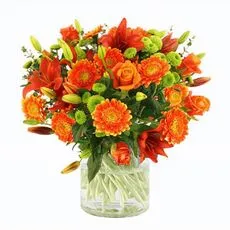
 Mixed Orange Bunch
$174.95Green chrysanthemums hold the structure on day twelve when the gerberas are done. Orange tones carry the warmth on day one. The "I want to send something cheerful" answer.
View product → The milestone pick
 Celebration Package with Vase
$252.50Yellow spray chrysanthemums for the long-tail presence, roses for the photo, sparkling wine for the milestone, glass vase to keep. The "this is a big birthday" answer.
View product → The cultural-safety pick
 Native Arrangement with Chocolates
$166.50No chrysanthemums. Australian natives only. The "the recipient is Chinese, Italian, Japanese, French, or has a pet" answer.
View product →November chrysanthemum questions, answered
What is the November birth flower?
Chrysanthemum is the traditional November birth flower. Some lists also include peony as a secondary November flower, particularly relevant in Australia where peonies are in peak season October to December. The smart November bouquet here usually carries both.
What does the chrysanthemum symbolise?
Loyalty, longevity, friendship, joy, and remembrance. The meaning shifts by culture and colour. In modern Australian birthday gifting it reads as cheerful, long-lasting, and affectionate. On a working florist's bench, it is the value play that lasts on the recipient's table when everything else has dropped.
What colour chrysanthemum is best for a birthday?
Pink, yellow, orange, bronze, or mixed chrysanthemums all read as warm and celebratory. White chrysanthemums should be chosen carefully because they carry memorial associations in Japan, Korea, and parts of Europe. Pink is the safe and underused birthday choice, with four times the vase life of a rose at a quarter of the stem cost.
Are chrysanthemums funeral flowers?
In some cultures, yes. Chrysanthemums are funeral flowers in Chinese, Italian, Korean, French, Belgian, and Austrian traditions. In English-speaking Australia they are most often cheerful birthday and Mother's Day flowers. The recipient's cultural background matters, and one phone call asking "does the recipient have a cultural background where chrysanthemums carry a different meaning?" prevents the mistake.
Are chrysanthemums toxic to cats and dogs?
Yes. The ASPCA lists chrysanthemums as toxic to dogs, cats, and horses. If the recipient has pets that chew flowers, choose a pet-safer alternative such as Australian natives, snapdragons, stock, or roses. About one in twenty of our regular customers carries a no-chrysanthemum or no-lily flag on the account for exactly this reason.
Is peony also a November birth flower?
Some lists include peony as a secondary November birth flower. In Australia this is especially fitting because peonies are in peak commercial availability through November, one of only twelve weeks of the year when they are at their best. Grown in Victoria, the NSW Southern Highlands, and Tasmania, then gone again until next October.
Why are chrysanthemums called "mums"?
"Mum" is the standard florist abbreviation for chrysanthemum. In Australia the word has a happy coincidence with "Mum" for mother, which is part of why chrysanthemums are tied to Australian Mother's Day. The whole industry builds more chrysanthemum bunches in the first two weeks of May than the rest of the year combined.
Do chrysanthemums last long in a vase?
Yes. They are among the longest-lasting commercial cut flowers. In a cool room or moderate temperature they hold 14 to 28 days. In summer heat they still outperform most other stems at 10 to 14 days. They are also ethylene-insensitive, which means they can sit next to a fruit bowl without ageing prematurely. They are one of seven commercially common cut flowers that ignore ethylene gas completely.
Further reading
If you have come to this post wanting the bigger picture on birth flowers month by month, or to compare the November story with other months in the calendar, these next reads are the natural follow-on.
Or read the sibling birth-flower deep dives: January (carnation), July (water lily and larkspur), August (gladiolus and poppy), and December (the three December flowers).
Ready to send a November birthday bouquet? Same-day delivery is available Australia-wide when you order before 2pm weekdays or 10am Saturdays. Flat rate $16.95 anywhere we go.
Browse birthday flowers
Lily's Florist delivers Australia-wide through a network of 800+ partner florists.
23,000+ verified Feefo reviews and a Feefo Trusted Service Award every year from 2024 to 2026.
Same-day delivery when you order before 2pm weekdays or 10am Saturdays.
Questions? Ring 1300 360 469
About the authors
This guide was written by Siobhan Thomson and reviewed by Anna, our qualified florist, with one operational note from Andrew on the value play of commercial chrysanthemums. Read our full story.

Andrew, Ivy, Siobhan and Asha. Hobart, June 2024.