
I typed "birth month flowers" into Google last week and read the first ten results. Every single one listed the same twelve flowers in the same order with the same symbolism pulled from the same Victorian-era references (the Victorians had a lot to answer for, honestly). Carnation for January. Rose for June. Holly for December. Nobody mentioned that half those flowers do not exist as cut flowers you can actually order for delivery.
Nobody mentioned that March daffodils make sense in England where March is spring, but in Australia, March is autumn and daffodils finished blooming four months earlier. The entire calendar is inverted down here and not one of those top-ten results was written by someone who has dealt with that reality on the phone, in a flower shop, at 9am on a Monday.
You are here because you want the birthday to feel considered, not generic. You want the flowers to carry "I know you," not just "happy birthday." And you are choosing them from a screen, probably from a different city, for someone who will open the door and see them before you do.
Anna is the person who took those calls. Fifteen years on a florist bench learning what survives and what does not, then three years answering inbound flower orders from every state and territory in Australia. She has redirected hundreds of callers away from birth flowers they could not get, toward arrangements that would actually arrive looking like a celebration. This is her guide.
Four of the twelve traditional birth flowers are available as commercial cut flowers in Australia. The other eight are garden plants, out-of-season bulbs, or vines that close before lunch. That ratio is the reason this guide exists.
In this guide
Only 4 of 12 Birth Flowers Are Available as Cut Flowers in Australia
We checked every traditional birth month flower against what Australian florists can actually source from wholesale markets in Sydney, Melbourne, Brisbane, Perth, Adelaide, and Hobart. Snowdrops, violets, primroses, lily of the valley, hawthorn, honeysuckle, water lilies, morning glory, cosmos, and holly are not commercial cut flowers. You cannot order them in a florist arrangement anywhere in Australia.
I took thousands of calls from people who wanted their birth month flower and I had to explain it does not exist as something a florist can put in a vase. Snowdrops are bulbs. Lily of the valley? Ground cover. It does not survive a supply chain. And holly is a Christmas decoration, not a stem. The internet lists these as if you can walk into a shop and buy them. You cannot.
| Month | Traditional Flower | Available? | What to Send |
|---|---|---|---|
| January | Carnation / Snowdrop | Carnation: Yes | Carnations. No substitution needed. |
| February | Violet / Primrose | Neither available | Purple lisianthus, purple roses, stock |
| March | Daffodil / Jonquil | Wrong season | Autumn roses, chrysanthemums, dahlias |
| April | Daisy / Sweet Pea | Gerbera daisy: Yes | Gerbera daisies in bright colours |
| May | Lily of the Valley / Hawthorn | Neither available | White Oriental lilies, white roses, stock |
| June | Rose / Honeysuckle | Rose: Yes (peak) | Roses. Winter = best vase life. |
| July | Larkspur / Water Lily | Delphinium: Seasonal | Delphiniums, tulips, ranunculus |
| August | Gladiolus / Poppy | Limited | Proteas, natives, late-winter stems |
| September | Aster / Morning Glory | Aster: Sometimes | Spring freesias, ranunculus, mixed |
| October | Marigold / Cosmos | Neither available | Orange roses, gerberas, chrysanths* |
| November | Chrysanthemum / Peony | Both available | Chrysanths (year-round) + peonies (peak!) |
| December | Narcissus / Holly | Limited | Summer birthday bunch, non-Christmas colours |
If your month is red on this table, keep reading. The substitute the florist reaches for is almost always a stronger product for Australian conditions than the traditional flower would have been.
*Chrysanthemums carry a funeral association in Chinese, Italian, and European cultures. See cultural warnings below before sending as a birthday gift.
January to June, the Australian Reality
Find your person's birthday month below. Each card tells you whether the traditional flower is available in Australia, what a florist will actually build if it is not, how long the stems last in Australian conditions, and where to order. If the month is marked as unavailable, the substitute and the reason for it are right there. No pretending you can buy snowdrops at Flemington.
January
Carnation (Dianthus caryophyllus)Available year-round. Carnations are the most underrated stem in the industry. I conditioned them for fifteen years and they outlasted everything else in the bucket. They wholesale at $0.35 to $0.80 per stem and hold for up to three weeks in a cool room. Three weeks. Longer than any rose, any lily, any gerbera. The only thing that kills them fast is ethylene, a ripening gas that fruit gives off and warm carnations produce themselves. A fruit bowl on the same bench will age a carnation bunch in two days that would otherwise last a fortnight. January is mid-summer in Australia, so expect 7 to 14 days without air conditioning. Bright pinks, reds, and oranges read as birthday. Avoid white carnations if the recipient has Chinese or Asian heritage, as white carries a funeral association in those cultures.
Send: Birthday flowers with carnations. No substitution needed. Full January guide.
February
Violet (Viola) and Primrose (Primula)Neither available as cut flowers. Violets and primroses are garden plants. They do not survive a wholesale supply chain and no florist stocks them as cut stems. For a February birthday, the substitute is the colour register itself: purple and lavender. Purple lisianthus is the smartest stem a florist can use here. Each stem branches, so you get three or four open blooms where a rose gives you one. Customers mistake them for roses. They cost less per visual impact and handle late-summer humidity better, which matters for a February delivery when the heat has not broken. Stock adds the fragrance that lisianthus lacks. Purple roses are imported year-round. Together they give 14 to 22 days and build the purple register without a violet in sight.
Send: Purple flowers. Lisianthus, stock, purple roses.
March
Daffodil (Narcissus pseudonarcissus)Wrong season entirely. This is the month that exposes every Northern Hemisphere birth flower list. March daffodils make sense in England where March is spring. In Australia, March is autumn. Daffodils bloom August to October in southern states and they are long gone by March. Roses hit excellent quality in autumn because the heat stress of summer has passed and the stems hold stronger. Chrysanthemums come into season. Early dahlias still linger. Daffodils are also associated with Daffodil Day cancer awareness in August, which is not a negative, but worth knowing.
Send: Autumn roses, chrysanthemums, or yellow flowers for the golden colour connection.
April
Gerbera Daisy (Gerbera jamesonii)Gerberas: yes, everywhere, all year. True English daisies (Bellis perennis) are garden plants, but gerbera daisies are one of the most available stems at any Australian wholesale market. They arrive looking like a celebration: bright, open-faced, every colour. The problem is hollow stems. I watched more gerbera heads droop in my first year on the bench than any other flower. They lack lignin, which means bacteria in the vase water colonise the base faster than any other commercial stem. The head droops by day four if the water is not changed. Recut 2cm off the base on day two, fresh water, and you buy another week. Sweet pea (the second April flower) is a winter stem in Australia and not available in mid-autumn.
Send: Gerbera daisies in birthday brights.
May
Lily of the Valley (Convallaria majalis)Not commercially available. Lily of the valley is the one birth flower everyone requests and nobody can get. It is tiny, intensely fragrant, and does not survive a commercial supply chain. The substitute that delivers on the promise is an Oriental lily: room-filling fragrance, 12 to 21 days at cool temperature, multiple buds opening in sequence. One stem fills an entire room by day three. The trade-off is pollen. Rust-orange pollen stains fabric permanently. Remove the anthers the moment each bloom opens. Oriental lilies are banned at all Epworth hospitals in Victoria due to fragrance and pollen, and restricted in shared wards elsewhere.
Send: White Oriental lilies, white roses, or white stock. Not for hospital rooms.
June
Rose (Rosa)Fully available. Peak season. June is winter in Australia, and winter is kind to roses. Cool temperatures slow bacterial growth in the vase and the stems hold structure longer. A June birthday rose in Melbourne can give ten to fourteen days. The same rose in a Brisbane February gives half that. Imported Colombian roses dominate the market and are bred for stem length and vase life, not scent. I noticed it the first season I opened a box of imports next to a bucket of locally grown. The imports looked better. The locals smelled better. The scent was bred out to gain the extra ten centimetres of stem. If the buyer specifically wants fragrant roses, they need David Austin or garden varieties at two to three times the wholesale price. Red for a partner, pink for a mother or friend, mixed colours for a general celebration.
Send: Roses. The one month where birth flower and best product are the same thing.
Carnations last three weeks in a cool room. Longer than any rose, any lily, any gerbera. The only thing that kills them fast is ethylene.Anna, Qualified Florist, 15+ Years
Found your month? Same-day delivery when you order before 2pm weekdays.
Order Florist's ChoiceJuly to December, the Second Half
The back half of the year gets more complicated. Some months align with the Australian season. Others are complete mismatches. November is the one month where both traditional birth flowers are available and both are genuinely worth ordering.
July
Delphinium (Larkspur)Seasonal, but good timing. July is mid-winter in Australia, which is when delphiniums are at their best. Nothing else in the flower world matches delphinium blue. Tall spikes, striking colour, 10 to 14 days at cool temperature. The risk is ethylene sensitivity: every floret on the spike can drop simultaneously if the arrangement is near ripening fruit or a warm vent. Pre-treatment with STS solution is essential. For a July birthday in Melbourne or Hobart, delphiniums are spectacular. For a July birthday in Darwin, they will not survive the afternoon. Winter also means tulips, ranunculus, and stock are all at peak. July is the best flower-buying month of the year in Australia.
Send: Delphiniums plus winter stems, or blue flowers. Full July guide.
August
Gladiolus and Poppy (Papaver)Both limited. Gladioli are dramatic spikes when the florist has them, but they are not a year-round wholesale stem. Poppies have a vase life of three to five days and are not commercially viable. For the August birthday buyer who wants bold, tall, dramatic presence, Australian natives deliver that energy year-round: proteas, leucadendrons, banksias. A leucadendron can last 21 to 42 days in a vase. A king protea flower head is almost indestructible. These stems carry the gladiolus spirit without the seasonal limitations. August is also Daffodil Day month, and late-winter tulips and stock are still going strong in southern cities.
Send: Native flowers for drama, or late-winter mixed stems. Full August guide.
September
Aster and Morning Glory (Ipomoea)Aster: sometimes. Morning Glory: never. Morning glory is a vine that blooms at dawn and closes by midday. It will never be a cut flower. Asters are available seasonally and underrated, with a daisy-like quality and broader colour range than most people expect. September is when freesias come back into the Australian market. Freesias are bud-blasters: if they dehydrate on the truck, the buds fail to open and you get a stick with nothing on it. But a properly hydrated freesia gives ten to sixteen days at cool temperature and fills the room with a scent that is cleaner and less overpowering than lily. Ranunculus returns too, opening over four to five days like a slow-motion rose, and at roughly $0.90 wholesale per stem in season it is one of the best value-for-visual flowers in the market. Early peonies occasionally appear in late September at premium prices.
Send: Spring freesias, ranunculus, asters when available, or mixed flowers.
October
Marigold (Tagetes) and CosmosBoth garden-only. Marigolds and cosmos are garden flowers with no meaningful wholesale presence. For the warm orange and gold tones they represent, chrysanthemums in amber and gold deliver exactly that warmth and last three weeks. Orange roses and orange gerberas are always available. But before you order chrysanthemums as a birthday gift, read the cultural warnings section. In Chinese, Italian, and broader European tradition, chrysanthemums mean death. Peonies arrive in late October for their four-to-six-week domestic window. Premium but spectacular.
Send: Orange flowers, warm-toned roses. Check cultural context first.
November
Chrysanthemum and PeonyBoth available. The luxury month. November is the one month where both birth flowers are genuine products. Chrysanthemums are the most temperature-resilient commercial stem: 18 to 30 days at cool temperature, ethylene-insensitive, woody stems, barely any fragrance. They are the cockroach of the flower world in the best possible way. Peonies are the opposite: 4 to 6 week domestic window, grown in Victoria, the NSW Southern Highlands, and Tasmania, wholesale $3 to $12 per stem depending on scarcity. If the recipient loves peonies and their birthday falls in November, say so when you order. By mid-December they are gone until next year.
Send: Peonies if budget allows (mention it on the order). Or chrysanths for longevity. Cultural caveat below still applies. Full November guide.
December
Narcissus (Paperwhite) and HollyPaperwhites limited. Holly is decoration only. December birthdays compete with Christmas for delivery slots. Corporate Christmas orders, office farewells, and end-of-year thank-yous placed by PAs weeks in advance fill florist capacity two to three days earlier than any other month. A birthday order placed on December 18 for December 20 delivery is fighting for the last available window. Order by December 15 for anything in the last ten days of the month. The other December problem is heat. A bouquet left on a 34-degree doorstep while the recipient is at work loses two days of vase life before anyone opens the door. Morning delivery slots matter more in summer than any other variable. Steer away from red and green if you want the gift to read as birthday, not Christmas afterthought. Sunflowers, gerberas in pink and yellow, roses in peach or coral.
Send: Summer birthday flowers in pink, peach, coral, or yellow. Order before 2pm for same-day. Full December guide.
The recipient was not comparing it to a peony. She was comparing it to an empty doorstep.Anna, 15+ Years on the Bench
Birthday Flowers You Can Actually Order
Every month in the guide above links to a product category. These six are specific arrangements that map to the birth flower theme for the months where the traditional flower is unavailable or where a Lily's product is the strongest match. Most contain three or four stem types that fade at different rates, which means the arrangement changes across the week. That is not decay. Gerberas bow out on day four, roses carry the middle, chrysanthemums hold through week two. Your $80 does not buy three days on a kitchen table. It buys a fortnight of a display that keeps evolving. If budget is tight, our flowers under $60 range still delivers a florist-made arrangement with the same care.
For February: Purple Mixed Flowers
The violet palette, without the violet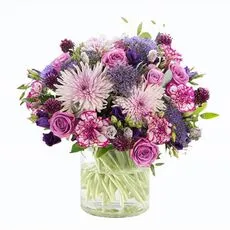
Disbud chrysanthemums in deep magenta anchor the centre, then the colour graduates outward through mauve roses to soft lilac lisianthus. The tonal layering is what makes this work. Dark at the centre, mid-tones through the body, light at the edges. Your eye moves through the arrangement instead of bouncing off a flat wall of one colour. The disbuds will still look like day one when the roses are softening around day six. Two looks from one bunch.
For April: Bright Mixed Gerberas
The birthday daisy, done properly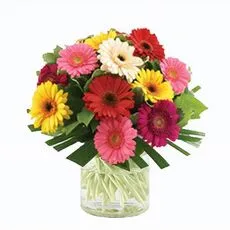
Single-genus product. Every bloom is a gerbera, which means there is nowhere to hide. Hot pink, yellow, white, red, orange and coral in a fishbowl vase. The flat, symmetrical heads with that dark centre read brilliantly on a screen and even better on a kitchen table. The neck-bend issue is real with gerberas: hollow stems lack lignin and the head droops if the water goes stale. A florist who wires every stem before building this bunch adds fifteen minutes of care. That invisible fifteen minutes is the whole product.
For May: Oriental Lilies
The lily of the valley substitute that delivers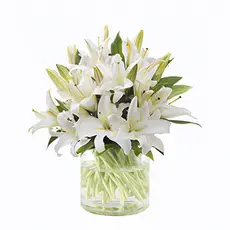
White Oriental lilies in a glass cylinder. Five to six stems carrying a mix of open blooms, half-open blooms, and closed buds. The staggered stages mean the arrangement has a built-in timeline: open blooms give day-one impact, half-open flowers take over by day three, tight buds crack open around day five. Total bloom count across the arrangement's life: fifteen to twenty-five individual flowers from one purchase. Remove the anthers before they shed or the pollen will permanently stain anything it touches.
For June: 6 Red Roses
Winter roses at peak vase life
June is winter in Australia. Cool temperatures slow bacterial growth in the vase and the stems hold their structure for ten to fourteen days. Six roses in a glass cylinder with silver dollar eucalyptus. The roses are at about 40 to 50% open, which is the sweet spot: enough openness that the colour registers, enough reserve that you get another four to five days of development. Tight buds look fresher in a photo but they sometimes lack the stored sugar to bloom fully. These ones have the energy.
For July: Blue Mist Bunch
True blue is rare in flowers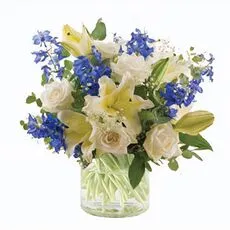
Most "blue" flowers are actually purple or violet. Delphinium is one of the few stems that delivers an honest blue. The spikes drive the height, white roses sit at the equator where the eye rests, and Asiatic lilies crack open across days three to five as a slow-release second wave. Asiatics over Orientals is a deliberate choice here: lighter petals, no fragrance to overwhelm, and many varieties are bred pollen-free. The arrangement sheds small blue florets from the delphinium base around day four. Not a defect. That is how delphinium ages. Pull the spikes when they are done and the roses and lilies carry the second week.
For September: The Floriade Bunch
Spring in a vase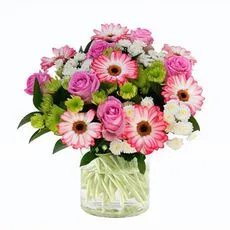
Named after Canberra's spring flower festival. Pink gerberas for focal impact, pink roses for body, lime green spray chrysanthemums for the contrast that makes the pinks pop. Without the green, this would be a wall of pink. The chrysanthemums add that spring-garden energy and they are the toughest stem in the arrangement by a margin: twelve to fourteen days while the gerberas give four to six. Pull the spent gerberas on day six and the roses and chrysanthemums carry the second week.
Most of the callers who asked for a specific birth flower ended up ordering something different once I explained the availability. The ones who let go of the species got a better bunch because the florist picked from whatever came in strongest that morning rather than hunting through three-day-old stock to match a photo. A Florist's Choice bunch built from fresh stems has more energy in it. The blooms open further, the colour holds longer, and the whole arrangement lasts two to three days more than one assembled from leftovers. That is the trade-off: give up the species, gain the longevity. A Florist's Choice Birthday Bunch does that by design.
The Cultural Warnings Nobody Includes
Not one of the top-ten birth flower guides on Google mentions this. Some birth flowers carry a second meaning that can cause genuine offence depending on the recipient's cultural background. These are not hypothetical risks. Anna redirected hundreds of these calls during her years on the phones.
A caller once wanted to send chrysanthemums as a birthday gift to a Chinese colleague. I redirected to roses. You send chrysanthemums to a Chinese home for a birthday and the message you are sending is the opposite of what you intended. The caller had no idea. Most people do not. Chrysanthemums are a standard stem at every wholesale market in Australia. They last three weeks. They come in every colour. And in Chinese, Italian, French, Belgian, and Austrian culture, they mean death.
If you do not know the recipient's background, pink roses. They carry no negative associations in any culture, anywhere. Order them and move on.
Hospital Birthdays: Which Birth Flowers Are Safe to Send
A birthday in hospital is already not how they planned it. The flowers will not fix that. They do something smaller and more honest: they prove someone outside those walls remembered what day it is.
If the birthday person is in hospital, flower choice matters more than usual. Intensive care, oncology, haematology, and burns units do not accept flowers at any hospital in Australia. General wards, surgical wards (post-recovery), rehabilitation, and palliative care typically do. Flowers go to the main reception desk, not to the ward. A staff member walks them to the patient. Always include the ward and room number on the order or the arrangement sits uncollected at reception.
| Stem | Hospital Safe? | Why |
|---|---|---|
| Carnation (Jan) | Safe | Low allergen, waxy petals resist AC drying, no scent issue. Lasts well in hospital climate. |
| Gerbera (Apr) | Safe | Low allergen, no significant fragrance. Cheerful and bright in a clinical setting. |
| Rose (Jun) | Safe | Self-pollinating, pollen not airborne. Mild scent varieties (imports) widely accepted. |
| Chrysanthemum (Nov) | Safe | Ethylene-insensitive, long-lasting, minimal fragrance. Mild allergen for Asteraceae-sensitive patients. |
| Oriental Lily (May sub) | Restricted | Banned at Epworth hospitals (VIC). Pollen airborne. Strong fragrance in shared wards. |
| Delphinium (Jul) | Fragile | Ethylene-sensitive. May shatter (florets drop) in hospital environment near fruit baskets. |
If the birthday person is in hospital, gerberas or chrysanthemums. No lilies. No strong scent. A box arrangement, not a hand-tied bunch, because the hospital does not keep spare vases. And wait until they are on a general ward. If they are still in ICU or recovery, the flowers will be refused at reception. Order once they have a ward number.
The card does not need to be clever. "Happy birthday. Thinking of you today" is enough. For a hospital birthday, short and warm beats a paragraph they have to read through medication fog.
For hospital-safe birthday flowers, order before 2pm weekdays for same-day delivery. Include the patient's full name, ward, and room number.
When the Birth Flower Is Not Available
Eight of twelve months have a birth flower you cannot reliably order in Australia. When callers hit that wall on the phone, Anna had two paths for them: match the colour tone of their birth flower (purple for February, gold for March, blue for July, orange for October) and let the florist work within that palette, or let go of the birth flower theme entirely and trust the florist to build the best arrangement from the morning's stock.
Most chose the second path. The ones who did rarely looked back.
How Florist's Choice Works
The florist checks what came in strong at market that morning. They read the card message: birthday. They note the recipient's details if provided: age, colour preference, any stem requests. Then they build from the freshest stock in the shop rather than hunting for specific stems that might be three days old on the shelf. Our Florist's Choice format gives the florist permission to use their best judgement. If peonies are in the bucket in November, they go in. If carnations are the strongest stem in January, the florist builds around those. The photo on the website is a mood board, not a contract.
Andrew The substitution thing comes up constantly. Someone orders lilies and the florist has a better quality rose that morning. The florist substitutes. We note it. If the change is significant, we call. I have rung customers at 7am to explain why their peony order became garden roses because the peony shipment from the Yarra Valley arrived bruised. Most people say thank you. Some say they want a refund. Both are reasonable. But the buyer should know going in: flower delivery is a perishable, season-dependent product. The florist cannot conjure peonies in March. What they can do is build the best possible arrangement from what came off the truck at five that morning. If you tell us it is a birthday and give us a colour preference, that is enough for a florist to do their job well.
A caller wanted peonies for a March birthday. Pisces, she said, as if that explained it. Peonies finished in December. I asked what the person actually liked about peonies. Turns out it was the petal density, not the species. I steered her toward a garden-style rose in a layered formation that gives the same ruffled, full look. She ordered it. No complaint. The recipient never knew the difference because she was not comparing it to a peony. She was comparing it to an empty doorstep. The recipient has no reference photo. They have a door, and then they have flowers at the door. Everything between those two moments is the florist's job.
I have watched people agonise over birth flower accuracy for half an hour on our website. They leave and come back three times. They google "can I get lily of the valley delivered in Sydney" and the answer is no, you cannot, not reliably, and the stems would cost a fortune and last four days.
Asha got roses for her birthday last year. I have no idea what month they were supposed to represent. I know they were pink, and I know she put them on her desk and sent me a photo with a heart. That photo is still on my phone. The roses are compost.
Further Reading
We publish individual deep-dive guides for each birth month, plus personality-based flower matching and age-specific birthday flower advice.
Milestone birthdays carry more weight. We have specific guides for 50th, 60th, 70th, and 80th birthday flowers. Shopping for someone specific? Try birthday flowers for Mum, for a wife or partner, or for him. Sending to Canberra? Our Canberra birthday flowers guide covers what grows locally and what the Floriade season means for stem selection.
Ready to send birthday flowers? Same-day delivery when you order before 2pm weekdays or 10am Saturdays. $16.95 flat delivery, Australia-wide.
Send Birthday Flowers
Lily's Florist delivers Australia-wide through a network of 800+ partner florists.
23,000+ verified reviews on our reviews page.
Same-day delivery when you order before 2pm weekdays or 10am Saturdays.
Questions? Ring 1300 360 469
About the Authors
This guide was written by Anna (floristry expertise and stem data), Siobhan Thomson (narrative framing), and Andrew Thomson (operational perspective on substitution). Combined: 30+ years in the Australian flower industry. Read our full story.

Andrew, Ivy, Siobhan and Asha. Hobart, June 2024.